

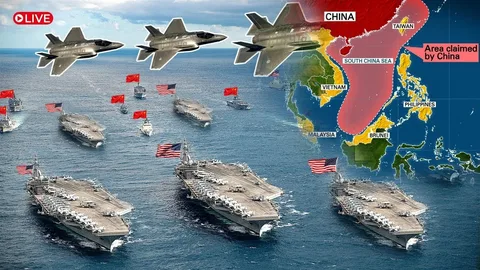

The South China Sea dispute involves overlapping territorial claims from six countries and one territory: China, the Philippines, Vietnam, Malaysia, Brunei, and Taiwan. The conflict centers on control of strategically vital waters, hundreds of small islands, vast fishing grounds, and enormous underwater reserves of oil and natural gas. Despite a landmark international ruling in 2016, the South China Sea dispute remains unresolved, and confrontations at sea continue to occur on a near-regular basis.
Background: Why Is the South China Sea So Important?
To understand the South China Sea dispute, it is important to first understand what makes this body of water so valuable. The South China Sea is a semi-enclosed sea in Southeast Asia, bordered by China to the north, Vietnam to the west, the Philippines to the east, and Malaysia and Brunei to the south.
More than three trillion dollars’ worth of trade passes through these waters every single year, making the South China Sea one of the most economically significant shipping lanes on the planet. Beneath its surface lie an estimated 11 billion barrels of oil and 190 trillion cubic feet of natural gas, according to the United States Energy Information Administration. The sea is also home to some of the world’s most productive fishing zones, which millions of people across Southeast Asia depend on for their livelihoods and food security.
Controlling the South China Sea means controlling access to these massive resources. That is why so many countries are willing to risk diplomatic fallout and even military confrontation to assert their claims.
South China Sea Dispute: Between Which Countries?
The South China Sea dispute is not a conflict between just two countries. It involves multiple overlapping claims that create a deeply complicated legal and political situation.
China makes the most expansive claim of all. Beijing asserts sovereignty over nearly 90 percent of the South China Sea through what is known as the “nine-dash line,” a boundary that stretches deep into waters that other nations consider their own exclusive economic zones under international law. China’s claim includes the Paracel Islands, the Spratly Islands, the Scarborough Shoal, and the Natuna Islands area.
The Philippines contests China’s presence in several areas that fall within its exclusive economic zone under the United Nations Convention on the Law of the Sea (UNCLOS), particularly around the Spratly Islands and Scarborough Shoal. Manila has been at the center of many of the most publicized confrontations with Chinese coast guard and maritime militia vessels in recent years.
Vietnam has long-standing claims to both the Paracel Islands and the Spratly Islands. Vietnam and China have clashed militarily over these territories in the past, most notably in 1974 and 1988. Hanoi remains one of Beijing’s most assertive challengers in the dispute.
Malaysia claims portions of the Spratly Islands that fall within its continental shelf and exclusive economic zone. Kuala Lumpur has generally pursued a quieter diplomatic approach compared to the Philippines and Vietnam, but it has not surrendered its territorial positions.
Brunei claims a small area of the southern Spratly Islands that overlaps with the exclusive economic zones defined under UNCLOS. Brunei is the smallest claimant and has no military presence on any disputed features, but it maintains its legal position.
Taiwan claims virtually the same territory as China, including the Paracel and Spratly Islands. Taiwan even occupies Itu Aba, the largest naturally occurring island in the Spratlys. Taiwan’s claim is rooted in the same historical basis as China’s, predating the political separation of 1949.
So to directly answer the question: the South China Sea dispute is between six countries and one territory China, the Philippines, Vietnam, Malaysia, Brunei, and Taiwan.
History of the South China Sea Dispute
The history of the South China Sea dispute stretches back centuries, though the modern conflict took shape in the twentieth century as newly independent nations began asserting maritime boundaries.
China has long claimed historical fishing rights and sovereignty over the South China Sea, pointing to ancient maps and records as evidence. However, modern international law does not recognize historical claims as a sufficient basis for territorial sovereignty over maritime zones.
During the colonial era, France controlled Vietnam and administered the Paracel and Spratly Islands. Japan occupied the islands during the Second World War and used them as a military base. After Japan’s defeat in 1945, the islands were left in a legal vacuum that competing powers rushed to fill.
In 1947, the Republic of China before losing the civil war to the Communist Party published a map with eleven dashes encircling most of the South China Sea. When the People’s Republic of China was established in 1949, it inherited and slightly modified this claim, reducing it to nine dashes. This “nine-dash line” became the foundation of China’s modern territorial assertions.
Through the 1950s and 1960s, as Southeast Asian countries gained independence, they began asserting their own maritime rights. Confrontations started occurring with increasing frequency from the 1970s onward. China seized the Paracel Islands from South Vietnam in 1974 during a brief but deadly naval battle. In 1988, Chinese and Vietnamese naval forces clashed near Johnson South Reef in the Spratly Islands, killing 64 Vietnamese sailors.
The 1990s and 2000s saw repeated diplomatic efforts to manage the dispute. In 2002, ASEAN member states and China signed the Declaration on the Conduct of Parties in the South China Sea, pledging to resolve disputes peacefully. However, the declaration was not legally binding, and the situation on the water continued to deteriorate.
South China Sea Dispute Timeline: Key Events
Understanding the South China Sea dispute timeline helps clarify how the situation escalated from a historical disagreement into an active geopolitical flashpoint.
1947 — The Republic of China publishes the eleven-dash line map, claiming most of the South China Sea.
1974 — China captures the Paracel Islands from South Vietnam in a naval battle, killing more than 70 Vietnamese sailors.
1988 — China and Vietnam clash near Johnson South Reef. China seizes several Spratly Island features. Sixty-four Vietnamese sailors are killed.
1995 — China occupies Mischief Reef, a feature within the Philippines’ exclusive economic zone, triggering a major diplomatic crisis between Beijing and Manila.
2002 — China and ASEAN sign the Declaration on the Conduct of Parties, a non-binding agreement to avoid escalation.
2009 — China formally submits the nine-dash line map to the United Nations, provoking immediate objections from Vietnam, the Philippines, Malaysia, and Indonesia.
2012 — China gains effective control of Scarborough Shoal after a tense standoff with Philippine vessels. The Philippines loses access to this traditional fishing ground.
2013 — The Philippines files a formal arbitration case against China under UNCLOS at the Permanent Court of Arbitration in The Hague.
2014 — China begins a massive island-building campaign in the Spratly Islands, constructing artificial islands complete with runways, radar installations, and military facilities. Satellite imagery shocks the international community.
2016 — The Permanent Court of Arbitration issues a landmark ruling in favor of the Philippines, declaring China’s nine-dash line claim to have no legal basis under international law. China rejects the ruling entirely.
2019–2023 — Confrontations between Chinese coast guard vessels and Philippine fishing boats and supply ships intensify. Water cannons, laser devices, and physical obstruction are used by Chinese forces against Filipino personnel.
2024–2025 — The situation near Second Thomas Shoal becomes a near-daily flashpoint as Philippine vessels attempt to resupply troops stationed on a deliberately grounded warship and Chinese forces attempt to block them.
South China Sea Dispute Islands: What Is Being Claimed?
The South China Sea dispute islands are at the physical heart of the conflict. The most contested island groups are the Spratly Islands, the Paracel Islands, and the Scarborough Shoal.
The Spratly Islands are a scattered group of more than 100 small reefs, cays, atolls, and islands spread across a large area of the southern South China Sea. They are claimed in whole or in part by China, Taiwan, Vietnam, the Philippines, Malaysia, and Brunei. Several countries maintain military outposts on different features within the group. China has transformed several submerged reefs into large artificial islands equipped with military infrastructure, including missile defense systems and airstrips capable of handling fighter jets.
The Paracel Islands are located in the northern part of the South China Sea and are currently controlled entirely by China, which seized them from Vietnam in 1974. Both Vietnam and Taiwan continue to claim sovereignty over the Paracel Islands, but China’s military presence makes any physical challenge extremely difficult.
Scarborough Shoal is a triangular chain of reefs and rocks located roughly 240 kilometers west of the Philippine island of Luzon. It has been under effective Chinese control since 2012. The shoal sits well within the Philippines’ 200-nautical-mile exclusive economic zone and has been a major source of tension between Manila and Beijing.
These South China Sea dispute islands matter not only for their own resources but because controlling them allows a country to project naval and air power across vast areas of the surrounding sea.
What Is Happening in the South China Sea Right Now?
The South China Sea dispute today is more active and confrontational than it has been in many years. The most intense flashpoint currently is Second Thomas Shoal, known in the Philippines as Ayungin Shoal, where China and the Philippines are engaged in a dangerous standoff.
The Philippines deliberately grounded an old navy vessel, the BRP Sierra Madre, on the shoal in 1999 to establish a physical presence. A small number of Philippine marines are stationed aboard the rusting ship. The Philippines has been attempting to resupply these personnel with food, water, and building materials, but Chinese coast guard vessels have repeatedly blocked, harassed, and physically intercepted Philippine supply boats. Chinese forces have used water cannons, military-grade lasers, and even seized equipment from Philippine personnel during these confrontations.
The United States, which has a mutual defense treaty with the Philippines, has repeatedly affirmed that an armed attack on Philippine armed forces, vessels, or aircraft in the South China Sea would trigger its treaty obligations. This has significantly raised the geopolitical stakes of every confrontation.
Vietnam, Malaysia, and other claimant states have also reported ongoing incidents involving Chinese maritime militia and coast guard vessels operating within their exclusive economic zones. The situation remains highly volatile, and the risk of miscalculation leading to a more serious incident is real and widely recognized by security analysts.
What Happened in 2016 in South China Sea?
The year 2016 was a pivotal moment in the history of the South China Sea dispute. In July 2016, the Permanent Court of Arbitration in The Hague issued one of the most significant rulings in international maritime law history, finding overwhelmingly in favor of the Philippines in its case against China.
The tribunal ruled that China’s nine-dash line claim had no legal basis under UNCLOS. It found that China had violated the Philippines’ sovereign rights by interfering with Filipino fishing and oil exploration activities within the country’s exclusive economic zone. The tribunal also ruled that China had caused serious environmental damage to coral reefs in the South China Sea.
China flatly rejected the ruling, calling it “null and void” and refusing to participate in the arbitration proceedings. Beijing has continued to operate in the South China Sea exactly as it did before the ruling, with no adjustment to its territorial positions or its maritime activities.
The 2016 ruling did not resolve the South China Sea dispute, but it fundamentally shifted the legal and diplomatic landscape. It gave the Philippines and other claimant states a powerful legal argument on the international stage, even if China shows no signs of accepting its authority.
Impact: Global and Regional Consequences
The South China Sea dispute has consequences that reach far beyond the countries directly involved. The global economy depends on the freedom of navigation through these waters, and any serious military conflict would disrupt supply chains, energy markets, and trade flows worldwide.
For the United States, the South China Sea dispute is a central element of its broader strategic competition with China. Washington has conducted regular Freedom of Navigation Operations, sending naval vessels through waters claimed by China to assert the principle that international waters cannot be claimed as sovereign territory. These operations have repeatedly drawn angry responses from Beijing.
For ASEAN as a regional bloc, the South China Sea dispute has created deep divisions. Member states directly involved in the dispute push for stronger collective responses, while others particularly those with close economic ties to China resist actions that could antagonize Beijing.
For China, the South China Sea dispute is framed as a matter of national sovereignty and historical rights. Beijing has invested billions of dollars in military infrastructure on artificial islands and has shown no willingness to compromise on its core territorial positions. Chinese officials routinely describe foreign criticism of their activities in the South China Sea as interference in China’s internal affairs.
Is the South China Sea Dispute Resolved?
The short and direct answer is no. The South China Sea dispute is not resolved, and there is currently no credible diplomatic process underway that is likely to resolve it in the near future.
Despite years of negotiations, the 2016 international tribunal ruling, and countless diplomatic statements, none of the core territorial disputes have been settled. China has not softened its position, the Philippines and Vietnam continue to push back, and the United States remains deeply involved. If anything, the intensity of the dispute has increased in recent years rather than decreased.
Experts and analysts largely agree that a comprehensive resolution to the South China Sea dispute would require China to fundamentally revise its territorial claims something Beijing has shown absolutely no willingness to do.
Conclusion
The South China Sea dispute is a defining conflict of the twenty-first century, one that involves resources, sovereignty, international law, and great-power competition all tangled together in one of the world’s most strategically vital waterways. Six countries and one territory are locked in competing claims over islands, reefs, and maritime zones that no legal framework has yet been able to sort out.
The history of the South China Sea dispute shows how decades of unresolved tension can harden into entrenched positions that become increasingly difficult to walk back. The South China Sea dispute timeline makes clear that this is not a new problem it has been building for decades. And the situation today, particularly around Second Thomas Shoal and the ongoing Filipino-Chinese confrontations, demonstrates that it is not getting better on its own.
Without a genuine commitment from all parties and particularly from China to engage with international law and negotiate in good faith, the South China Sea dispute will remain a powder keg in the heart of Asia, with the potential to draw the world’s major powers into a conflict none of them would benefit from.
FAQs
What is happening in the South China Sea right now?
The most active flashpoint in the South China Sea right now is the ongoing standoff near Second Thomas Shoal, where Chinese coast guard and maritime militia vessels have been regularly blocking, harassing, and using water cannons and military-grade lasers against Philippine supply boats attempting to deliver food, water, and materials to Filipino marines stationed on the grounded warship BRP Sierra Madre. These confrontations have occurred dozens of times in recent years and have escalated significantly in 2023 and 2024. The United States, bound by a mutual defense treaty with the Philippines, has warned China that any armed attack on Philippine forces in the South China Sea would trigger American military obligations.
What happened in 2016 in the South China Sea?
In July 2016, the Permanent Court of Arbitration in The Hague an international tribunal established under the United Nations Convention on the Law of the Sea issued a sweeping and historic ruling in the arbitration case filed by the Philippines against China in 2013. The tribunal found that China’s nine-dash line claim, which covers nearly 90 percent of the South China Sea, had absolutely no legal basis under international maritime law. The court ruled that China had violated the Philippines’ sovereign rights by blocking Filipino fishermen and interfering with oil exploration activities within the Philippines’ own exclusive economic zone.
Is the South China Sea dispute resolved?
No, the South China Sea dispute is definitively not resolved, and there is no realistic prospect of a comprehensive resolution in the near term. The core issue China’s sweeping nine-dash line claim that overlaps with the exclusive economic zones of multiple neighboring countries has not moved an inch despite an international tribunal ruling against it, years of diplomatic negotiations, and repeated confrontations at sea. China has continued building and militarizing artificial islands in the Spratly Islands, has maintained control of Scarborough Shoal despite Philippine objections, and shows no sign of softening its territorial positions.