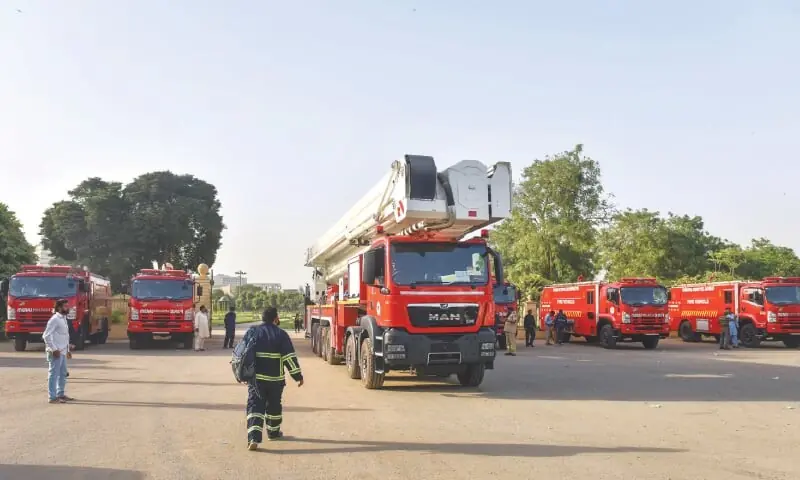
LAHORE: The Punjab government has initiated multiple major steps at public-sector hospitals across the province to prevent a recurrence of the incident that claimed the lives of 14 infants at the Pakistan Institute of Medical Sciences (PIMS) in Islamabad. Chief Minister Maryam Nawaz has ordered an urgent review of fire-safety arrangements, and the Punjab Healthcare Commission (PHC) has directed both public and private hospitals to tighten emergency preparedness. The push marks one of the fastest healthcare policy responses seen in Punjab in recent years, and it is being watched closely as a test of whether Punjab hospital safety can actually be improved rather than just promised.
Background: What Happened at PIMS
The fire broke out in the early hours of August 26, 2026, on the third floor of the Mother and Child Health ward at PIMS, inside the neonatal intensive care unit. Fifteen newborns were in the nursery at the time. Fourteen suffered fatal burns; only one child was rescued alive.
Witnesses later said they struggled for hours to get help from emergency services and had to break windows to reach the ward, describing locked doors along the way. A subsequent fire report from the Capital Development Authority found that safety arrangements at PIMS were inadequate and that emergency exit routes had been blocked. An internal government inquiry, submitted to Prime Minister Shehbaz Sharif days later, confirmed serious gaps in hospital safety and emergency response.
That inquiry set off a wave of scrutiny that has since spread well beyond Islamabad, straight into Punjab’s own hospital network.
Details: Punjab’s Response to the Tragedy
Punjab’s reaction has moved on two tracks at once: political direction from the top, and technical inspection on the ground.
Orders From the Chief Minister’s Office
Maryam Nawaz ordered an immediate, province-wide audit of fire-safety systems at government hospitals soon after the PIMS deaths were confirmed. The instruction covers everything from firefighting equipment to emergency exits, and it applies to every public-sector health facility in Punjab, not just the largest teaching hospitals in Lahore.
PHC Directives Under the Community Safety Act
The Punjab Healthcare Commission followed with formal directives to both public and private hospitals, telling them to strengthen emergency preparedness “without delay.” The commission has asked the Punjab Emergency Services Department to inspect hospital buildings under Section 3(3) of the Punjab Community Safety Act, 2021, along with the Punjab Community Safety Buildings Regulations, 2022.
Under this framework, District Emergency Officers now have the authority to inspect hospital buildings, check that fire-safety equipment is properly installed, and issue a one-year safety certificate to facilities that meet the requirements. Hospitals that fail the check are expected to fix the gaps or face further action.
What’s Happening at the District Level
The Rawalpindi division offers an early look at how uneven hospital fire safety has been. A review found that public hospitals across Rawalpindi, Murree, Attock, Chakwal and Jhelum needed 49 additional fire hydrants between them. Twenty-one have already been installed, and work on the rest is being pushed forward. Once hospital administrations formally certify that risk-management measures are in place, an independent third party is expected to verify the work.
Quotes: What Officials Are Saying
The Punjab Healthcare Commission has been blunt about the scale of the problem, saying district officers are “authorised to inspect buildings, including hospitals, verify the installation and availability of fire safety arrangements” before any certificate can be issued.
At the district level, officials chairing the Rawalpindi review described the situation in similarly direct terms, telling hospital heads and administrators that fire protection and emergency preparedness could no longer be treated as a secondary concern once patients, particularly infants, are involved.
Impact: Why This Matters Beyond Punjab
Punjab’s response has effects that stretch past the province’s own hospital network. In the National Assembly and Senate, lawmakers have already called for a special parliamentary committee and broader reforms to hospital safety across Pakistan, and the federal government has ordered fire-safety audits at hospitals in Islamabad, including PIMS, Polyclinic, and other major facilities.
Families of the infants who died at PIMS have been promised Rs5 million in compensation each, and officials have said those responsible for negligence will be held accountable. Against that backdrop, Punjab’s early and visible push on hospital fire safety is being read as an attempt to get ahead of the same kind of failure before it happens again, rather than respond after the fact.
Conclusion: What Comes Next
Fire-safety audits are continuing hospital by hospital across Punjab, with certificates being issued only where facilities meet the legal requirements. District administrations are expected to report back on outstanding gaps, such as missing hydrants or blocked exits, in the coming weeks. Whether these Punjab healthcare reforms hold up over time, once the immediate public attention fades, will likely determine whether this becomes a genuine turning point for hospital safety in the province or another audit that quietly loses momentum.
Frequently Asked Questions
What happened in PIMS Hospital Islamabad?
A fire broke out early on August 26, 2026, on the third floor of the Mother and Child Health ward at the Pakistan Institute of Medical Sciences in Islamabad, inside the neonatal intensive care unit. Fifteen newborns were present in the nursery at the time of the blaze. Fourteen of them died from severe burns, while only one infant survived and was rescued. An official inquiry later found serious lapses in fire-safety arrangements, including blocked emergency exits, and several hospital officials were suspended in the aftermath.
Where is PIMS Hospital?
PIMS, or the Pakistan Institute of Medical Sciences, is located in Islamabad, Pakistan, on Ibn-e-Sina Road in sector G-8/3. It functions as a major public-sector referral hospital for Islamabad, Rawalpindi, Azad Jammu and Kashmir, and parts of northern Punjab, and includes the Islamabad Hospital, a Children’s Hospital, and the Maternal and Child Health Care Centre where the fire occurred.
What was the old name of PIMS hospital?
Before it became the Pakistan Institute of Medical Sciences, the project was originally planned in the 1960s under the name Islamabad Hospital Complex. It was first envisioned as part of the National Institute of Health premises before being relocated to its current, more central site and later established as PIMS when it opened in 1985.