

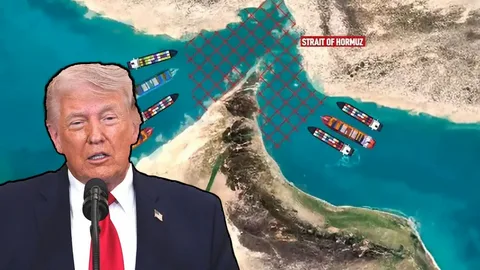

President Donald Trump launched “Operation Project Freedom” on May 4, 2026, a bold U.S. military effort to escort commercial ships safely through the Strait of Hormuz. Within just 24 hours, however, Trump announced a pause on the operation, citing diplomatic progress with Iran and a request from Pakistan. The rapid reversal has left global markets, shipowners, and world leaders watching closely.
Background
The Strait of Hormuz has been at the center of an escalating crisis since early 2026. President Donald Trump announced major combat operations against Iran on February 28, with massive joint U.S.-Israeli strikes targeting military, government, and infrastructure sites. Following a ceasefire, peace talks in April failed, and Iran continued to block the critical waterway.
Operation Project Freedom is a United States military operation launched in May 2026, in response to Iranian attacks on shipping in the Strait of Hormuz. During the 2026 Iran war and following the Iranian blockade, the U.S. had dropped bunker-buster bombs on Iranian anti-ship cruise missile sites and sank Iranian minelaying vessels.
The Strait of Hormuz is one of the world’s most critical maritime chokepoints. A significant portion of global oil exports passes through it daily, making any disruption a matter of international economic concern.
What Is Project Freedom?
Trump first announced Project Freedom on Sunday in a social media post, promising the U.S. Navy would guide ships safely out of the restricted waterways. The mission was framed as a defensive escort operation, not an offensive military campaign.
Secretary of State Marco Rubio clarified at a White House news conference that Operation Epic Fury the U.S. military’s name for the broader Iran war is over, and that Project Freedom is a separate defensive operation. “There’s no shooting unless we’re shot at first. We’re not attacking them,” Rubio said.
Defense Secretary Pete Hegseth also described Project Freedom as a temporary defensive effort to reignite commercial shipping through the strait, which had been effectively choked off for weeks by Iran.
What Happened During Project Freedom?
On May 4, the operation began and immediately faced fierce resistance. U.S. forces sank six Iranian small boats near the Strait of Hormuz. CENTCOM Commander Admiral Brad Cooper said Iran historically deploys between 20 and 40 small boats when harassing vessels, but on that day only six appeared, and they were quickly eliminated using Apache and MH-60 Seahawk helicopters.
The United Arab Emirates reported it was attacked with ballistic missiles, cruise missiles, and drones coming from Iran, resulting in three injuries. CENTCOM confirmed that Iran’s Islamic Revolutionary Guard Corps launched multiple cruise missiles, drones, and small boats at ships being protected.
On May 4, a Panamanian-flagged cargo ship, HMM Namu, was struck by an explosion and caught fire while anchored off the UAE. Trump blamed Iran and urged South Korea to join the operation.
Despite the military activity, shipowners and operators expressed caution about whether Project Freedom could significantly change the situation. Industry observers noted that unless both parties signal willingness to allow transit and that behavior holds over time, the risk profile for vessels and crews remains high.
Why Did Trump Pause It?
Just one day after launching the mission, Trump announced a pause on Project Freedom, citing diplomatic progress. Stock futures rose following the announcement, raising hopes for a peace agreement.
In a Truth Social post, Trump said: the pause was based “on the request of Pakistan and other Countries,” on the military success achieved, and on “Great Progress” made toward a complete and final agreement with Iran. He added that while Project Freedom is paused, the U.S. Navy blockade in the Strait will remain in full force.
The halt came just hours after Rubio had framed Project Freedom as the next necessary phase of the conflict, calling Iran’s attacks on ships and mining of the strait “criminal” acts that were “completely illegal, completely illegitimate and completely unacceptable.”l
Iran’s Reaction
Tehran reacted with sharp hostility to the operation. Iranian military official Dr. Ali Akbar Ahmadian labeled the United States “American Pirates,” accusing the U.S. of holding the world’s shipping and energy security captive. He warned that “complex, combined asymmetric operations in the depths of the battlefield will alter the equations” in a way that would exceed what Iran calls the threshold of tolerance.
Major General Ali Abdollahi of the Iranian military also stated that Project Freedom would constitute a violation of the fragile U.S.-Iran ceasefire. Iran has shown no willingness to stand down without guarantees on its own terms.
Global Impact
The crisis in the Strait of Hormuz is not just a military story it is a global economic emergency. Oil prices remained well above $100 a barrel, while average gas prices in the United States climbed to $4.48 a gallon.
The Trump administration stated that nearly 23,000 sailors on vessels representing 87 countries have been stranded in the Persian Gulf due to the ongoing blockade and conflict.
On the diplomatic front, Secretary Rubio announced that the U.S. would put a new draft resolution before the United Nations Security Council to defend freedom of navigation in the waterway. Bahrain, Saudi Arabia, the UAE, Kuwait, and Qatar co-authored the draft resolution. However, a previous attempt at such a resolution was vetoed by China and Russia.
Pakistan’s Prime Minister also weighed in. Prime Minister Shehbaz Sharif said it is “absolutely essential that the ceasefire be upheld and respected, to allow necessary diplomatic space for dialogue leading to enduring peace and stability in the region.”
Hinglaj Mata Temple Recently in the News
While the world watches the Strait of Hormuz crisis unfold, another story from the region has also drawn attention. The Hinglaj Mata Temple, which has recently been seen in the news, is located in Hinglaj, a town on the Makran coast in the Lasbela district of Balochistan, Pakistan. It lies in the middle of Hingol National Park and is one of the 51 Shakta Pithas in Hinduism.
The Balochistan government has decided to declare the historic Hinglaj Mata Temple a world tourism site. The decision was taken during a meeting between Chief Minister Sarfraz Bugti and Senator Danesh Kumar, as part of initiatives to promote minority religious tourism in the province.
Assam Chief Minister Himanta Biswa Sarma also recently highlighted the temple’s significance, calling Balochistan a land of “profound historical and spiritual significance” for Hindus, with the Hinglaj Mata Temple being one of the 51 revered Shakti Peethas in Hindu tradition.
The temple’s growing profile on the world stage even as the wider region faces conflict reflects how sacred geography and geopolitics increasingly intersect in South Asia.
Conclusion
The launch and rapid pause of Operation Project Freedom reveals just how complex and volatile the situation in and around the Strait of Hormuz remains. Trump’s willingness to pause the mission suggests diplomacy is still in play, but the U.S. Navy blockade continues. With oil prices elevated, 23,000 sailors stranded, and a fragile ceasefire in the balance, the coming days of Iran-U.S. negotiations will be critical. The world is watching to see whether a “complete and final agreement” can be reached or whether Project Freedom will be relaunched under even more dangerous circumstances.
FAQs
Did any ship get through the Strait of Hormuz?
Yes. The Trump administration confirmed that two vessels were helped through the strait during the brief window that Project Freedom was active on May 4–5, 2026. However, the operation was paused before broader shipping resumed, and the situation remains uncertain.
What is Project Freedom?
Project Freedom is the name given to the U.S. military’s effort to escort commercial ships through the Strait of Hormuz. It is described as a defensive operation separate from the earlier offensive Operation Epic Fury focused on protecting civilian shipping lanes.
How many ships are stranded in the Strait of Hormuz?
According to the Trump administration, nearly 23,000 sailors aboard vessels representing 87 countries have been stranded in the Persian Gulf as a result of Iran’s blockade and ongoing conflict in the region.