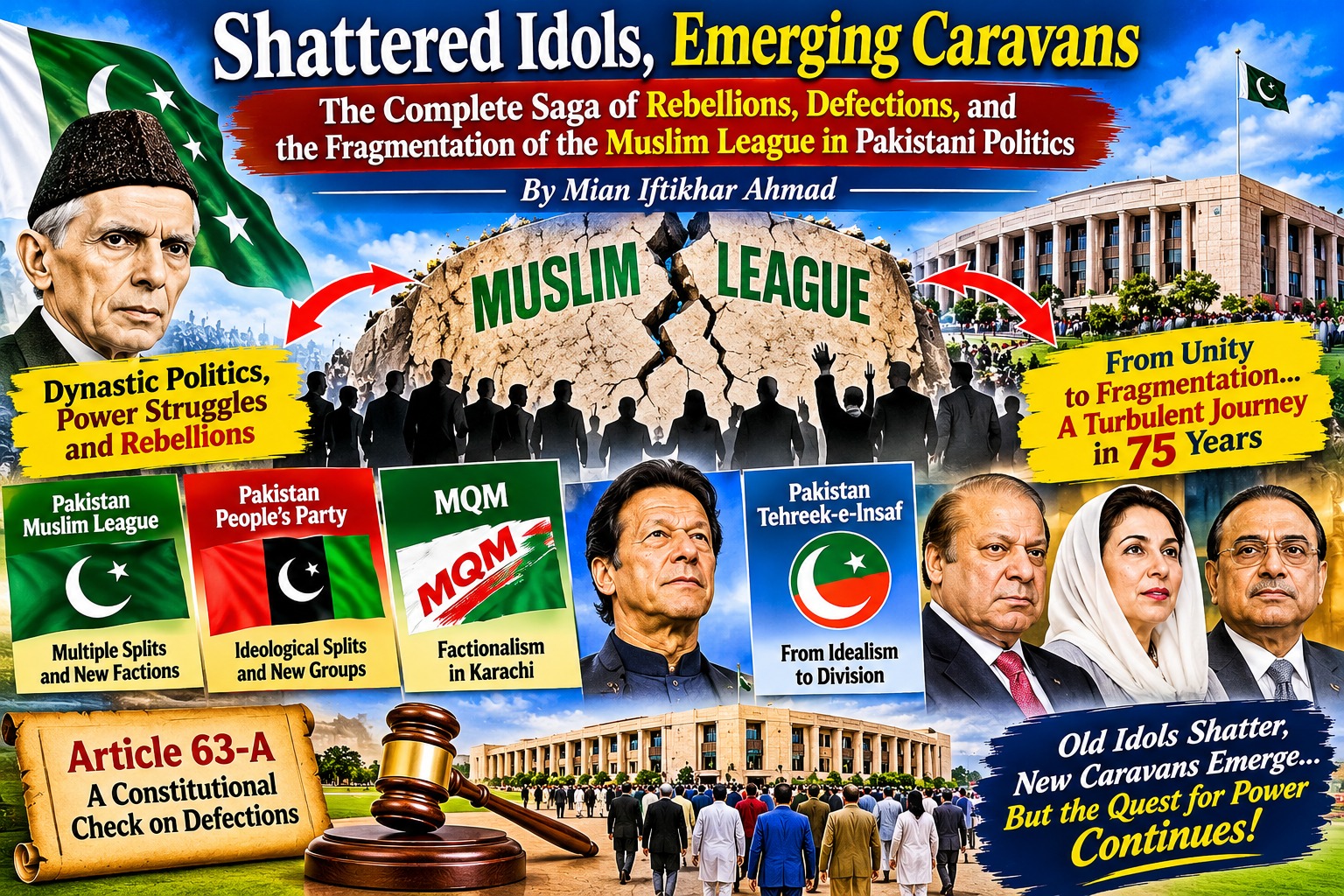
Shattered Idols, Emerging Caravans: The Complete Saga of Rebellions, Defections, and the Fragmentation of the Muslim League in Pakistani Politics
By Mian Iftikhar Ahmad
The Chessboard of Power, the Cloak of Ideology, and the Psychology of Rebellion: A study of Pakistan’s political history reveals a reality as clear as daylight: political parties here revolve around personalities, dynasties, and the appeasement of the corridors of power rather than any solid ideological foundation or manifesto. This is why, over the past seventy-five years, Pakistan’s political landscape has resembled not a tranquil pond, but a raging river whose course shifts every few years. The most prominent manifestation of this political upheaval is the rebellions, defections, and factionalism born within political parties.
In political lexicon, when a leader parts ways with their alma mater or parent party, it is viewed from two contrasting angles. The party leadership labels them a “traitor,” a “turncoat” (lota), or an “opportunist,” whereas the rebel leader calls their move “the voice of conscience,” “ideological difference,” or “upholding democratic principles.” However, keen observers of Pakistani politics know that mere ideologies are not the sole drivers behind these rebellions; rather, three major catalysts remain at work: first, dynastic politics and personal autocracy; second, the unfair distribution of election tickets; and third—the most potent catalyst—the political engineering of the establishment and martial law eras.
The Psychological and Political Anatomy of Rebellion: When political parties in Pakistan are in the opposition, the spirit of unity and sacrifice within them reaches its peak. Yet, the moment the threshold of power draws near or a confrontation erupts with the establishment, cracks begin to appear in party walls. The shifting loyalties of “electables” (influential figures capable of winning elections) just before polls is likened in Pakistan to “seasonal migration.”

On the other hand, whenever a popular political leader falls out of favor or martial law is imposed in the country, a faction emerges from within the party itself that opts for reconciliation or power-sharing. In Pakistan’s history, such groups earned titles like “King’s Party” or “Patriots.” Interestingly, these dissenting leaders often lay the foundation of a new party, though most of these parties survive for only one or two electoral cycles before eventually merging back into a major party or vanishing into the pages of history.
The Fragmentation of the Founding Party: The Journey from Muslim League to Muslim Leagues: The biggest and most cautionary example of political defection in Pakistan is that of the creator of Pakistan itself, the All-India Muslim League, which became the Pakistan Muslim League after independence. Founded in Dhaka in 1906, the party that united the Muslims of the subcontinent under one flag to add an independent state to the world map fell victim to personal egos, provincial prejudices, and tug-of-war for power just two years after independence.
Following the demise of Quaid-e-Azam Muhammad Ali Jinnah in 1948 and the assassination of Prime Minister Liaquat Ali Khan in 1951, the leadership vacuum created in the Muslim League tore the party apart. This fragmentation began in 1949 when popular leaders of East Pakistan (now Bangladesh), Huseyn Shaheed Suhrawardy and Maulana Abdul Hamid Khan Bhashani, rebelled against the central leadership’s policies and neglect of Bengali rights to form the All-Pakistan Awami Muslim League. This very party later became the “Awami League” and served as the catalyst for the Fall of Dhaka and the creation of Bangladesh in 1971.
The situation in West Pakistan was no different. In 1949 itself, Punjab’s first Chief Minister, Nawab Iftikhar Hussain Mamdot, established the Jinnah Muslim League after severe differences with the central leadership and Mumtaz Daultana. Similarly, in 1952, Sindh’s influential politician Muhammad Ayub Khuhro set up a separate faction named the Sindh Muslim League following clashes with the central command. This musical chair of power pushed the country into such political instability that in 1958, General Ayub Khan imposed the country’s first martial law, abrogated the constitution, and banned all political parties, permanently dissolving the original Pakistan Muslim League.
Muslim Leagues Born from the Womb of Martial Law: Following the 1958 martial law, when President Ayub Khan enforced his presidential constitution in 1962 and granted conditional permission for political activities, he needed a party to lend political support to his system. Thus, for the first time in Pakistan’s history, the Muslim League was split into two under official patronage:
- Convention Muslim League (1962): Politicians loyal to Ayub Khan held a convention in Karachi to lay the foundation of this party. Built with the full backing of the establishment, this party became known as the country’s first formal “King’s Party,” and an intriguing historical fact is that a young Zulfikar Ali Bhutto served as its first Secretary-General.
- Council Muslim League (1962): Ideological leaders who rejected Ayub Khan’s dictatorship—including Mumtaz Daultana, Khawaja Nazimuddin, and Ayub Khan’s own brother Sardar Bahadur Khan—convened a meeting of the Muslim League Council and announced the revival of the original democratic Muslim League. Later, Madar-e-Millat Mohtarma Fatima Jinnah contested the 1965 presidential election against Ayub Khan from this faction’s platform.
This chain did not stop here. Ahead of the 1970 general elections, Khan Abdul Qayyum Khan, the strongman of the Frontier (Khyber Pakhtunkhwa), rebelled against the Council Muslim League to form his own faction named Muslim League (Qayyum) so he would not have to ally with Ayub Khan’s supporters. After the tragedy of 1971 and the rise of Zulfikar Ali Bhutto, when various factions of the Muslim League lay scattered, Nurul Amin and later Sindh’s spiritual leader Pir Pagara (Shah Mardan Shah II) founded the Pakistan Muslim League (Functional) in 1973 to unite all factions. Instead of fostering unity, it evolved into a permanent faction of its own and remains a key stakeholder in Sindh’s politics today.
Zia-ul-Haq’s Sheltering Tree, Nawaz Sharif’s Rise, and Musharraf’s “King’s Party”: Following the ouster of Zulfikar Ali Bhutto’s government in 1977 and General Zia-ul-Haq’s martial law, Pakistani politics entered a new era. If General Ayub Khan had relied on the Convention Muslim League to perpetuate his rule, General Zia-ul-Haq chose the route of non-party elections to stem the popular tide of the People’s Party, and then in 1985 nurtured a new “official Muslim League” through those very elected members. During this period, more branches sprouted from the Muslim League tree that shaped the course of national politics for the next four decades.
Junejo’s Rebellion and the Birth of Muslim League (N) (1985 to 1993): After the 1985 non-party elections, General Zia-ul-Haq nominated soft-spoken Sindhi politician Muhammad Khan Junejo as Prime Minister. Junejo gathered scattered members inside and outside parliament to reorganize the Pakistan Muslim League, which included Punjab’s young Chief Minister Nawaz Sharif. However, history repeated itself; when Muhammad Khan Junejo signed the Geneva Accords against General Zia-ul-Haq’s wishes and hinted at investigating the Ojhri Camp disaster, Zia-ul-Haq dismissed his own handpicked government in May 1988.
After this dismissal, the Muslim League effectively split into two: one faction stood with Muhammad Khan Junejo, termed Muslim League (Junejo), while the other was organized under establishment patronage led by Punjab Chief Minister Nawaz Sharif and Fida Mohammad Khan, participating in the 1988 and 1990 elections from the platform of the “Islami Jamhoori Ittehad” (IJI).
Following Muhammad Khan Junejo’s death in 1993, severe disputes arose over the party presidency. Hamid Nasir Chattha and Iqbal Ahmed Khan retained the Junejo Group, while Nawaz Sharif gained complete control over the majority faction and formally named it Pakistan Muslim League (Nawaz) or PML-N. Thus, for the first time, the Muslim League was named after an individual. Meanwhile, in 1995, Punjab Chief Minister Mian Manzoor Ahmed Wattoo formed another faction named Pakistan Muslim League (Jinnah) after differences with Hamid Nasir Chattha.
The Coup of October 1999 and the Creation of “Q-League”: In October 1999, General Pervez Musharraf toppled Nawaz Sharif’s two-thirds majority government to impose the country’s fourth martial law. Following Nawaz Sharif’s exile, the establishment once again sought political faces to advance Musharraf’s agenda. As a result of this search, the biggest rebellion in PML-N’s history erupted prior to the 2002 general elections. Nawaz Sharif’s close associates—Chaudhry Shujaat Hussain, Chaudhry Pervaiz Elahi, Mian Muhammad Azhar, and Khurshid Mahmud Kasuri—rebelled against the leadership to lay the foundation of Pakistan Muslim League (Quaid-e-Azam), or PML-Q. Political circles openly dubbed it the “King’s Party.” In 2004, establishment efforts led to merging several smaller factions—including the Junejo League, Jinnah League, Functional League, and Sindh Democratic Alliance—into PML-Q to form a “United Muslim League,” though this alliance too proved short-lived.
Further Factions of the Muslim League from 2002 to 2026: The Pervez Musharraf era and subsequent political upheavals gave birth to several more new parties bearing the Muslim League name:
- Pakistan Muslim League (Zia) — 2002: General Zia-ul-Haq’s son, Ijaz-ul-Haq, established this separate party in 2002 named after his father, maintaining limited influence in certain constituencies of South Punjab.
- Awami Muslim League (AML) — 2008: General Musharraf’s close confidant and federal minister Sheikh Rasheed Ahmad formed his own party for Rawalpindi politics after losing the 2008 elections and developing differences with the PML-Q leadership.
- Pakistan Muslim League (Like-Minded) — 2009: Following the decline of PML-Q, Arbab Ghulam Rahim, Hamid Nasir Chattha, Salim Saifullah Khan, and Humayun Akhtar Khan rebelled against the Chaudhry brothers’ leadership to form the “Like-Minded” group, which later merged into PML-N.
- All Pakistan Muslim League (APML) — 2010: After losing power and going into exile, General (R) Pervez Musharraf himself announced his own political party from London in October 2010, which became virtually inactive after his passing.
- Pakistan Muslim League (Nawaz Ideological): Formed in protest after 2008 by disgruntled veteran workers angered by the induction of “electables” into PML-N and the welcoming of former PML-Q leaders.
- Pakistan Markazi Muslim League (PMML) — 2022: Amidst the country’s shifting political landscape, welfare and religious circles (Khalid Masood Sindhu, Qari Muhammad Yaqoob Sheikh, and others) organized a new party under this name, fielding candidates nationwide in the 2024 general elections.
Rebellions Within PML-N Itself and the “Awaam Pakistan Party” (2018 to 2026): Interestingly, PML-N—which once welcomed rebels from other parties—faced intense internal rebellions following Nawaz Sharif’s disqualification in 2017 and during the coalition politics of 2022 to 2024:
- Departure of Chaudhry Nisar Ali Khan: Chaudhry Nisar, Nawaz Sharif’s most trusted aide for three decades, strongly disagreed with the party’s narrative (“Vote Ko Izzat Do” and confrontation with institutions) ahead of the 2018 elections, refusing a party ticket to contest independently.
- Zaeem Qadri and Sardar Mehtab Abbasi: In 2018, active Lahore PML-N leader Zaeem Qadri openly rebelled against the leadership over ticket distribution. Similarly, senior Khyber Pakhtunkhwa leader Sardar Mehtab Ahmad Abbasi had to part ways due to criticism of party policies.
- Awaam Pakistan Party (2024): The most organized and recent rebellion in PML-N’s history surfaced in July 2024 when former Prime Minister Shahid Khaqan Abbasi and former Finance Minister Miftah Ismail bid farewell to PML-N over disagreements regarding economic policies, a reconciliatory narrative, and dynastic monopoly, founding the Awaam Pakistan Party. Although this new party does not include “Muslim League” in its name, political analysts view it as a major revolt by PML-N’s ideological and policymaking wing, joined by PPP dissident Mustafa Nawaz Khokhar alongside PML-N’s Sardar Mehtab Abbasi and Zaeem Qadri.
From PPP Jiyalas to PTI “Electables” and the Division of MQM: The contagion of rebellion and defection in Pakistani politics has not remained confined to the Muslim League; other major popular and ideological parties—the Pakistan Peoples Party (PPP), Muttahida Qaumi Movement (MQM), and Pakistan Tehreek-e-Insaf (PTI)—could not remain immune either. The nature of fragmentation in these parties varied: in some places it was a battle over dynastic inheritance, in others the compulsion to disassociate from a founding leader’s controversial remarks, and elsewhere a quest for political survival after clashing with state institutions.
Pakistan Peoples Party (PPP): Revolt of Ideological Jiyalas and Creation of “Patriots”: Founded in 1967 by Zulfikar Ali Bhutto, the PPP faced internal rifts within just a few years of its inception. Even during Bhutto’s lifetime, founding left-wing leaders like Mairaj Muhammad Khan, Mukhtar Rana, and J.A. Rahim parted ways due to policy differences. However, the biggest and most emotional splits in PPP’s history occurred during Mohtarma Benazir Bhutto’s era:
- National Peoples Party (NPP — 1986): During General Zia-ul-Haq’s regime, senior PPP leader and former Prime Minister Ghulam Mustafa Jatoi established this separate party after falling out with Benazir Bhutto’s leadership; it later merged into PML-N.
- Pakistan Peoples Party (Shaheed Bhutto) — 1990s: This was the most tragic chapter in PPP’s history, when the Bhutto family itself split in two. Benazir Bhutto’s brother, Mir Murtaza Bhutto, rebelled against Asif Ali Zardari’s growing political influence and party policies to form a separate party named PPP (Shaheed Bhutto). Following Murtaza Bhutto’s assassination in 1996, his widow Ghinwa Bhutto assumed the party’s leadership.
- PPP Patriots (2002): During General Pervez Musharraf’s era, after PPP emerged as a major party following the 2002 general elections, the establishment engineered a split of ten elected MNAs—including Faisal Saleh Hayat, Rao Sikandar Iqbal, Aftab Sherpao, and Noor Muhammad Bhabha—to form a new faction called PPP Patriots. This defection provided the required majority to Musharraf’s nominated Prime Minister, Mir Zafarullah Khan Jamali. Later, Aftab Ahmad Khan Sherpao organized his own faction in Khyber Pakhtunkhwa, known today as the Qaumi Watan Party (QWP).
- PPP Workers and Mustafa Nawaz Khokhar: After Asif Ali Zardari took the helm, Benazir Bhutto’s closest aides, Dr. Safdar Abbasi and Naheed Khan, rebelled against the party’s politics of reconciliation to establish PPP Workers. Similarly, former Sindh Home Minister Zulfiqar Mirza parted ways while harshly criticizing Zardari’s leadership. In recent years, Bilawal Bhutto Zardari’s spokesperson and Senator Mustafa Nawaz Khokhar resigned from both the Senate and the party out of disillusionment with party policies, joining Shahid Khaqan Abbasi’s “Awaam Pakistan Party.”
Muttahida Qaumi Movement (MQM): Cracks in Karachi Politics and Factionalism: Having ruled the politics of urban Sindh—particularly Karachi and Hyderabad—uncontested for decades, the MQM faced three major rebellions resulting from its founder Altaf Hussain’s policies and state operations:
- MQM (Haqiqi) — 1992: During the military operation launched in Karachi in June 1992, Altaf Hussain’s close associates Afaq Ahmed and Aamir Khan rebelled against the leadership to establish MQM (Haqiqi), sparking years of bloody clashes on the streets of Karachi.
- Pak Sarzameen Party (PSP) — 2016: In March 2016, Karachi’s popular former Mayor Mustafa Kamal and Anis Kaimkhani returned from Dubai, leveled serious allegations against the MQM founder, and laid the foundation of the Pak Sarzameen Party, which dozens of MQM lawmakers joined.
- MQM Pakistan (MQM-P) — 2016: Following the MQM founder’s controversial speech in August 2016 and subsequent state crackdowns, the Karachi-based leadership—Farooq Sattar, Khalid Maqbool Siddiqui, and Aamir Khan—completely disassociated from the London leadership, took control of the party, and registered it as MQM Pakistan. Interestingly, in January 2023, Mustafa Kamal’s PSP and Farooq Sattar’s faction merged back into MQM Pakistan.
Pakistan Tehreek-e-Insaf (PTI): Arrival of “Electables” and Post-May 9 Fragmentation: Imran Khan founded Tehreek-e-Insaf in 1996 with the slogan of struggling against dynastic politics and traditional politicians. However, after 2011, as the goal of power seemed within reach, a large number of “electables” from other parties joined PTI. Over the induction of these traditional politicians, the party’s founding ideological leaders—such as Justice (R) Wajihuddin Ahmed, Akbar S. Babar, and later Ayesha Gulalai—rebelled and formed separate factions. Yet, the biggest earthquake in PTI’s history struck after the ouster of Imran Khan’s government in April 2022, and especially following the violent events of May 9, 2023, when frontline party leaders began departing amid confrontation with state institutions:
- Istehkam-e-Pakistan Party (IPP) — June 2023: Once considered Imran Khan’s right-hand men, Jahangir Tareen and Abdul Aleem Khan—following old rifts with the party—gathered dozens of PTI dissidents, including Fawad Chaudhry, Aamir Mehmood Kiani, Aun Chaudhry, and Imran Ismail, to lay the foundation of the Istehkam-e-Pakistan Party.
- Pakistan Tehreek-e-Insaf Parliamentarians (PTI-P) — July 2023: Two Chief Ministers from PTI’s decade-long rule in Khyber Pakhtunkhwa—Pervez Khattak and Mahmood Khan—disagreed with Imran Khan’s policy of confrontation and established their own separate party.
- Withdrawal from Politics: Several key leaders, including Asad Umar, Shireen Mazari, Fayyazul Hassan Chohan, and close aides of Pervaiz Elahi, announced their departure from party positions or politics altogether via press conferences.
Article 63-A of the Constitution and the Question of Political Future: To curb these continuous rebellions and “floor-crossing” (voting against party policy or switching loyalties) within political parties in Pakistan, Article 63-A was incorporated into the Constitution of Pakistan. Under this constitutional clause, if an elected member of an assembly votes against the direction of their parliamentary party in the election of the Prime Minister or Chief Minister, a vote of no-confidence, or a constitutional amendment, or resigns from the party, the Election Commission can disqualify them from assembly membership upon a reference from the party head.
However, the ground reality is that despite constitutional curbs, the chain of political rebellions in Pakistan has not halted. The fundamental reason is that until true democracy, transparent intra-party elections, and the right of workers to rise to leadership are established within political parties, parties will remain personal fiefdoms—and as long as parties revolve around personalities, establishment intervention and power struggles will continue to cause old “idols to shatter” and new “caravans to emerge.”