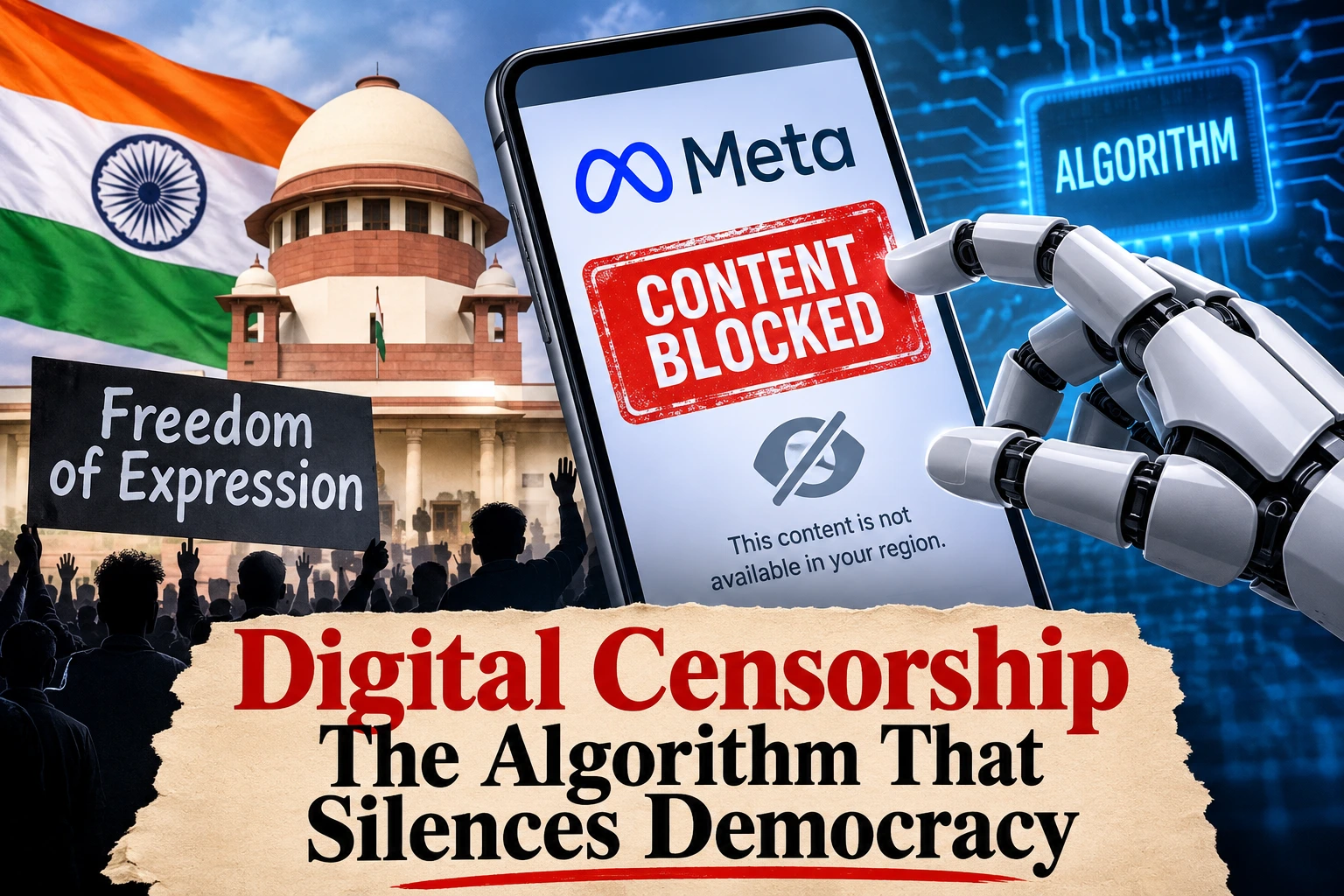
Automated content restrictions in India raise serious questions about freedom of expression, political accountability and the growing power of technology companies to shape democratic debate.
(By Sarah Abraham)
There was a time when governments seeking to silence their critics had to confront them directly. Censorship required a pen, police action required legal authority, and prosecution at least demanded an argument. The digital age, however, has introduced a far more convenient instrument: an algorithm capable of suppressing dissent before the public even gets an opportunity to examine it.
India’s latest confrontation with Meta highlights the constitutional challenges emerging from the growing use of automated content restrictions.
According to Reuters, Meta restricted access to 5.44 million items of content in India during the first six months of 2026, compared with just 41,357 during the preceding six months. The sharp increase followed amendments to India’s information technology rules, which require digital platforms to remove unlawful content within three hours and use automated systems to identify identical material.
Meta maintains that the increase reflects automated enforcement rather than a corresponding rise in government requests. While this distinction may appear technically reassuring, it raises important political and constitutional questions.
Governments do not necessarily need to increase the number of censorship orders when automated systems can multiply their effects.
The youth wing of India’s opposition Congress Party has challenged the regulations in court, alleging that automated restrictions have suppressed political content, including posts featuring Rahul Gandhi. These allegations remain subject to judicial determination. Nevertheless, the controversy raises a much broader question that extends beyond the political fortunes of Congress or the Bharatiya Janata Party (BJP): who has the authority to determine the boundaries of democratic expression?
There is, of course, a legitimate argument for regulating digital platforms. Incitement, communal hatred, financial fraud and deliberately harmful misinformation can threaten public safety and social stability. No responsible government can afford to ignore these challenges.
However, there is a significant constitutional difference between preventing demonstrable harm and creating a system capable of suppressing politically inconvenient opinions.
The danger lies partly in the limitations of automated enforcement. Identical words do not necessarily carry identical meanings or intentions. A journalist quoting an inflammatory statement to expose its implications performs a different function from someone spreading the same statement to encourage hatred. A historian documenting propaganda is not necessarily promoting it. Satire may deliberately adopt the language of authoritarianism to criticize those who exercise power.
An algorithm may recognize identical content, but it cannot always understand context, intention or public interest.
India’s regulations provide for human supervision and periodic assessments of automated systems. However, the effectiveness of these safeguards must be evaluated against the scale and speed of enforcement. When millions of restrictions are imposed within months, meaningful human oversight cannot simply be assumed.
Technology companies face their own difficult choices. Platforms that resist government directives risk losing legal protections against liability for user-generated content. Compliance, on the other hand, can expose them to accusations of participating in censorship.
The commercial pressures are considerable. A technology company serving hundreds of millions of users in a major market must weigh its legal responsibilities against its commercial interests. Constitutional principles, however, cannot be reduced to calculations of business convenience.
Global technology companies have acquired unprecedented influence over public communication. With that influence comes a responsibility to ensure transparency, procedural fairness and accountability.
Pakistan, too, must carefully examine the relationship between digital regulation, national security and freedom of expression. Across South Asia, governments have invoked security, stability and public morality to justify greater control over information. These objectives may be legitimate, but the methods used to achieve them require independent constitutional scrutiny.
Freedom of expression is not a privilege reserved for agreeable citizens. Its constitutional importance becomes most evident when opinions are unpopular, inconvenient or embarrassing to those exercising political power.
Automated restrictions should therefore be accompanied by clear explanations, accessible appeal procedures, independent oversight and transparent disclosures about the authorities responsible for initiating them. Political journalism, documentary evidence and legitimate public-interest reporting deserve particular protection.
The fundamental question is not whether technology should play a role in governance. It already does, and its role will continue to expand. The real question is whether technology will remain subject to constitutional principles or whether those principles will increasingly be sacrificed for administrative convenience.
Democracy is inherently an inconvenient enterprise. It accommodates disagreement, tolerates criticism and allows citizens to question even the most powerful public figures. These are not weaknesses that technology needs to correct. They are essential safeguards against the concentration and misuse of power.
A government that mistakes silence for public agreement may eventually discover that it has merely weakened the very channels through which citizens could express their dissatisfaction peacefully.
The ultimate measure of digital progress is not how efficiently a government can remove a citizen’s words.
It is how securely that citizen can challenge the government itself.