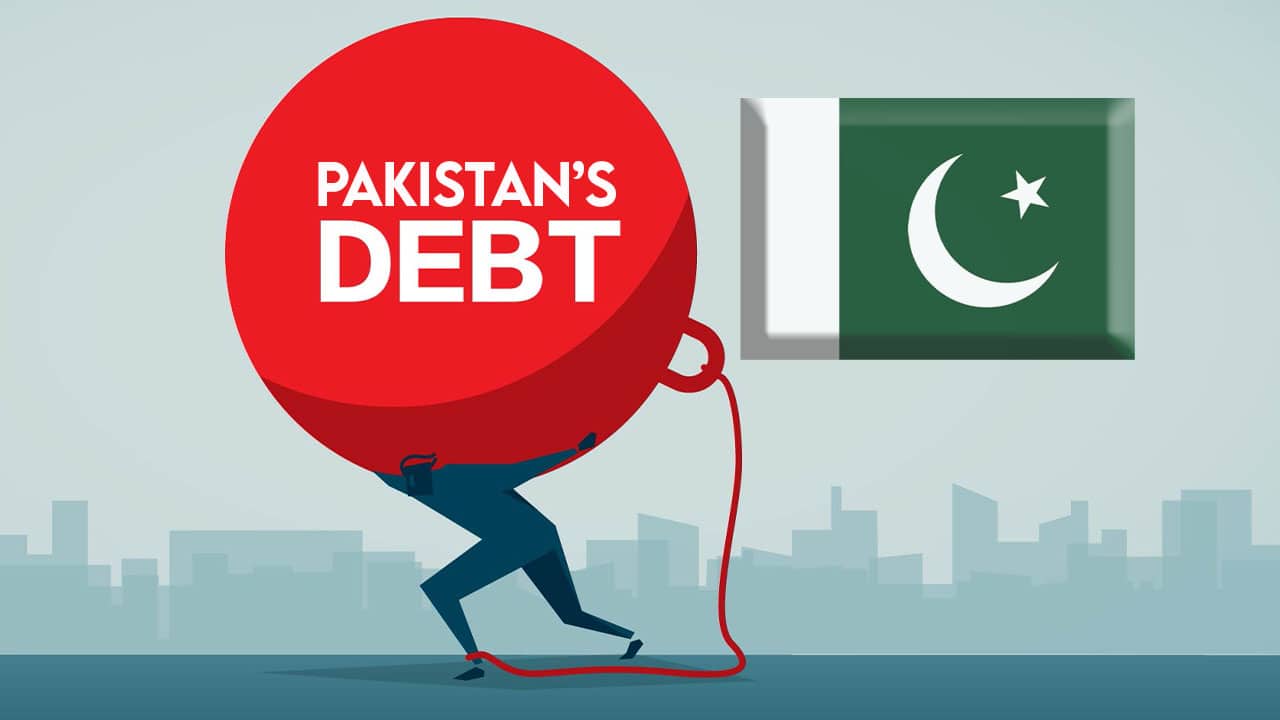
Pakistan’s federal government debt has touched a fresh high. The State Bank of Pakistan confirmed the number this month, and it is not a small jump. Officials, economists, and ordinary citizens are all watching the same figure with growing unease.
Pakistan government debt reached Rs83.642 trillion by the end of June 2026, according to fresh data from the State Bank of Pakistan. That marks a 7.4 percent increase compared to June 2025. On a month-on-month basis, debt rose from Rs81.955 trillion in May 2026 to the current level, a 2.1 percent jump in just thirty days.
The pace of borrowing works out to roughly Rs15.8 billion added to the national debt every single day. Domestic debt now stands at Rs59.441 trillion, up 9.1 percent from a year earlier, while the rest sits in external liabilities owed to foreign lenders and multilateral institutions.
Background
Pakistan’s debt story did not begin this year. The country has borrowed heavily for decades to plug budget shortfalls, fund development spending, and service older loans. Parliament tried to put guardrails on this behaviour back in 2005 through the Fiscal Responsibility and Debt Limitation Act, a law meant to force governments to keep public debt within a defined share of the economy.
The Act was amended in 2021 to tighten disclosure requirements. Under the revised rules, the Ministry of Finance must publish an annual Debt Policy Statement and a Debt Bulletin, laying out exactly how much the government owes, to whom, and on what terms. The goal was transparency. In practice, the reports have repeatedly shown Pakistan overshooting its own legal limits.
The most recent Debt Policy Statement 2026 put public debt at 70.7 percent of GDP, far above the 56 percent ceiling Parliament had set for the year. That is not a minor technical breach. It represents years of deficits piling on top of each other, with interest payments now eating into money that could otherwise fund schools, hospitals, or infrastructure.
Details
Breaking down the June 2026 numbers gives a clearer picture of where the pressure is coming from. Central government domestic debt increased to Rs59.441 trillion, a 9.1 percent rise year-on-year. Within that figure, long-term domestic debt grew from Rs45.653 trillion to Rs48.446 trillion, while short-term debt jumped from Rs8.756 trillion to Rs10.928 trillion.
That shift toward short-term borrowing matters. Short-term debt has to be rolled over more frequently, which exposes the government to interest rate swings and refinancing risk. Analysts have flagged this pattern before, warning that leaning too heavily on treasury bills and short-tenor instruments can make debt management harder during periods of monetary tightening.
On the external side, earlier State Bank figures for April 2026 showed central government external debt at Rs23.84 trillion, split between long-term obligations of Rs19.73 trillion and short-term debt of Rs4.11 trillion. A reclassification effective February 2026 moved a portion of long-term external debt into the short-term category, which partly explains the jump in that segment.
Per capita debt has also climbed. Earlier this year, the Finance Division put the figure at roughly Rs325,000 per citizen, based on total public debt of Rs81.374 trillion in the first half of FY26. Every child born in Pakistan today effectively inherits a share of that burden before ever paying a rupee in tax.
A World Bank Debt Heat Map assessment, released around the same time as the Debt Policy Statement, raised a separate concern: Pakistan did not publish its Annual Debt Bulletin on schedule, and gaps remained in how some debt indicators were reported. The Bank’s findings echoed longstanding calls, including from a US government report, for stronger parliamentary oversight of how Pakistan tracks and reports its borrowing.
Quotes
The Ministry of Finance has largely framed the rising rupee figures as a function of inflation and exchange rate movement rather than a standalone crisis. In an earlier statement on debt management, the ministry argued that absolute debt numbers naturally increase over time and that debt-to-GDP is the more meaningful gauge of sustainability, not the headline rupee total.
Separately, a senior debt management official pointed to progress on early repayments, noting that Pakistan’s debt-to-GDP ratio had eased from around 74 percent in FY22 to closer to 70 percent by late 2025, which the official described as evidence of strengthening fiscal fundamentals. Independent analysts covering the sector have been less optimistic, pointing out that the debt-to-GDP ratio climbed back above 70 percent in the latest Debt Policy Statement, suggesting any improvement has been uneven rather than a settled trend.
Impact
The immediate impact shows up in the federal budget. Debt servicing already consumes one of the largest single shares of government spending, ahead of defence and development combined in several recent budget cycles. Every rupee spent on interest payments is a rupee unavailable for public services.
There is also a regional and global dimension. Pakistan remains under an IMF programme, and its lenders watch debt sustainability closely when deciding on future disbursements. A widening gap between legal debt ceilings and actual borrowing levels can complicate negotiations and raise questions about compliance with programme conditions.
For ordinary households, the effects arrive indirectly but persistently. Higher government borrowing tends to push up domestic interest rates, tighten credit for businesses, and add pressure on the currency. Combined with inflation, this squeezes household budgets even when people have no direct connection to government finances.
Global comparisons put Pakistan’s situation in perspective. The United States, whose debt famously crossed the $35 trillion mark in mid-2024, now carries a gross national debt approaching $40 trillion. But the US economy is roughly forty times larger than Pakistan’s, so the debt-to-GDP comparison, not the raw dollar figure, is what actually determines fiscal stress. On that measure, Pakistan’s position is considerably more precarious.
Conclusion
Pakistan’s government debt shows little sign of slowing down heading into the second half of 2026. With debt-to-GDP already above the legal ceiling and short-term borrowing on the rise, the coming Debt Policy Statement will be closely watched for signs of course correction.
Much depends on whether the government can hold primary surpluses, avoid fresh off-budget borrowing, and stick to the fiscal consolidation path it has repeatedly promised Parliament and the IMF. Until then, the daily debt clock in Islamabad keeps ticking upward, at close to Rs16 billion every single day.
Frequently Asked Questions
Which country is 35 trillion dollars in debt?
The United States is the country most associated with crossing the $35 trillion debt mark. Its gross national debt passed that threshold in July 2024, and by August 2026 it had climbed further, sitting close to $39.8 trillion. The US carries the largest sovereign debt in absolute dollar terms of any country in the world, though its debt-to-GDP ratio, while high, is not the highest globally. Comparing raw debt figures across countries can be misleading without also looking at the size of each economy.
How much is Pakistan in debt now?
As of June 2026, Pakistan’s federal government debt stood at Rs83.642 trillion, according to State Bank of Pakistan data. That figure had risen by 7.4 percent compared to the same month a year earlier and by 2.1 percent compared to May 2026 alone. Broken down, domestic debt made up the larger share at Rs59.441 trillion, while the remainder was owed to external creditors. In dollar terms, Pakistan’s total public debt has hovered around the $290 billion mark through much of 2026.
What was the total debt of Pakistan in the year 2026?
Pakistan’s total public debt moved higher throughout 2026, climbing from roughly Rs80 trillion at the start of the year to Rs83.642 trillion by June. Along the way, monthly readings showed the figure crossing Rs81 trillion in April, nearing Rs82 trillion soon after, and continuing upward through the middle of the year. The government’s own Debt Policy Statement 2026 confirmed that this pushed the debt-to-GDP ratio to around 70.7 percent, well above the 56 percent limit set under the Fiscal Responsibility and Debt Limitation Act.