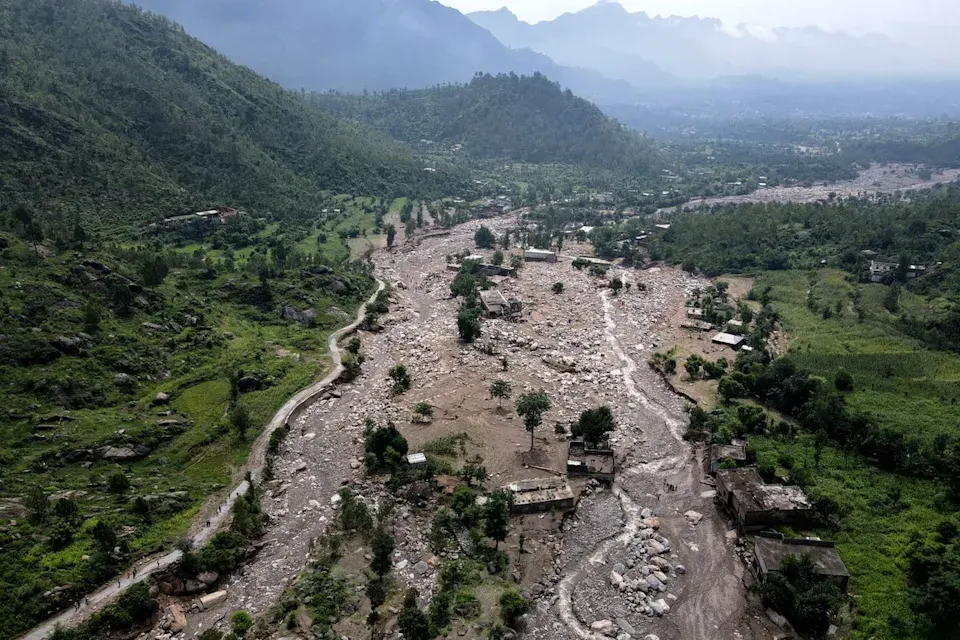
Pakistan is once again facing a wave of destruction as flash floods sweep through the northern and mountainous belts of the country. Heavy monsoon rains have triggered dangerous flooding in Buner, Battagram, Abbottabad, Shangla, Mansehra and Skardu, forcing authorities to issue fresh alerts. The situation has renewed fears among residents who are still recovering from previous flood disasters in the same region. Reports from Khyber Pakhtunkhwa (KPK) confirm that swollen streams, overflowing rivers and sudden cloudbursts have damaged roads, homes and public infrastructure. Rescue teams have been deployed on an emergency basis to reach cut-off communities. Local administrations have warned that more rain is expected in the coming days, keeping the entire northern belt on high alert.
Background
Northern Pakistan has a long and painful history with flash floods, especially during the monsoon season that runs from June through September. The mountainous terrain of Buner, Battagram, Shangla and Abbottabad makes these districts particularly vulnerable to sudden water surges whenever heavy rain falls upstream. Last year’s floods remain fresh in public memory, when Buner recorded the highest casualties in the province after cloudbursts triggered massive flash flooding across multiple districts. Buner had emerged as the worst-affected district, with a large number of lives lost within just two days, alongside significant injuries and dozens still reported missing at the time. That disaster left lasting scars, with damaged schools, destroyed homes and broken roads still under repair in many villages. This year’s monsoon season began with a similarly worrying pattern. Rain-related incidents since late June 2026 had already pushed the death toll past one hundred nationwide, with hundreds more injured and homes damaged across affected regions. Meteorological authorities had continued warning citizens about further wet spells throughout the season.
Details
The current spell of Pakistan flash floods has intensified over the past several days, with multiple cities and districts reporting flooding, landslides and infrastructure damage. In Shangla, continuous rainfall over three days caused water levels in local streams, seasonal torrents and natural springs to rise sharply, with reports of minor landslides emerging from different parts of the district. The situation has not remained confined to the mountains alone. The Flood Forecasting Division of the Pakistan Meteorological Department warned of possible urban flooding in six major Punjab cities, including Lahore, Rawalpindi, Gujranwala, Faisalabad, Sialkot and Gujrat, due to expected torrential rains. This forecast has already begun to materialize, with flooding scenes reported from Islamabad and Rawalpindi as well.
Gilgit-Baltistan has also remained under threat throughout the season. The National Disaster Management Authority identified Hunza, Nagar, Skardu, Shigar, Astore and Diamer as areas facing flooding and landslide risks, while Upper and Lower Chitral were declared highly vulnerable. Officials had also cautioned that accelerated glacier melting was expected to significantly increase water flow in rivers and streams across these regions. Abbottabad has repeatedly been named among the districts facing heightened flood risk this season. Authorities identified Chitral, Upper Dir, Abbottabad, Shangla, Khyber, Orakzai, Kohat, Tank and both North and South Waziristan as areas facing a low to moderate flood threat as monsoon rains continued to batter the region. Water accumulation on the Karakoram Highway has repeatedly disrupted travel and stranded commuters. The National Disaster Management Authority has continued to issue advisories on a near weekly basis throughout the season, tracking rainfall patterns and flood risk across Punjab, Khyber Pakhtunkhwa, Gilgit-Baltistan and Azad Kashmir. These advisories reflect an unusually active and prolonged monsoon spell affecting nearly every province.
Quotes
District administration officials in Abbottabad have repeatedly advised residents to avoid unnecessary travel along flood-prone routes and to stay away from swollen water channels. Disaster management authorities in Gilgit-Baltistan have urged the public to remain alert near riverbanks, nullahs and landslide-prone mountain roads, warning that conditions can change within minutes during heavy downpours. Environmental experts monitoring the region have pointed out that climate change has made these events more frequent and unpredictable. Officials tracking the situation in Buner and Shangla have described the recurring pattern of flooding as a warning sign that infrastructure in these districts remains poorly equipped to withstand repeated monsoon shocks.
Impact
The regional impact of these Pakistan flash floods extends far beyond immediate property damage. Roads connecting remote mountain communities to district headquarters have been repeatedly cut off, delaying the delivery of essential supplies and medical assistance. The Karakoram Highway, a critical trade and travel route, has faced multiple closures this season due to flooding and landslides. Agricultural land across the affected districts has also suffered, threatening the livelihoods of farming communities that depend on seasonal crops. Tourism, an important economic activity in areas like Skardu, Naltar and the Galiyat region, has taken a hit as authorities repeatedly advise travelers to avoid landslide-prone routes during the ongoing monsoon spell. On a broader scale, the flooding highlights Pakistan’s continued vulnerability to climate-driven disasters. The country has faced a series of devastating flood events in recent years, placing significant strain on national disaster response resources and long-term reconstruction budgets.
Conclusion
With the monsoon season not yet over, authorities are bracing for further spells of heavy rain across northern Pakistan and parts of Punjab in the coming weeks. Disaster management agencies have urged residents in Buner, Battagram, Shangla, Mansehra, Abbottabad and Skardu to remain cautious, avoid unnecessary travel near riverbanks and nullahs, and follow official advisories closely as weather patterns remain unpredictable. Relief and rescue operations are expected to continue in the affected districts over the next several days, with teams working to reach isolated communities that remain cut off due to damaged roads and washed-out bridges. Emergency shelters and medical camps are likely to stay operational in the worst-hit areas until floodwaters recede and basic infrastructure is restored.
Provincial and federal authorities are also expected to review existing early warning systems in light of the repeated flooding seen in KPK and Gilgit-Baltistan over the past two monsoon seasons. Officials have acknowledged that reconstruction work from previous flood events, including damaged roads, schools and bridges in Buner and Shangla, remains incomplete, raising concerns about the region’s ability to withstand fresh disasters. Experts warn that without long-term investment in flood infrastructure, better drainage systems in urban centers, and stronger early warning networks in mountainous districts, northern Pakistan will likely continue facing similar disasters in the years ahead. Climate researchers have repeatedly pointed to the increasing frequency of extreme rainfall events as a signal that disaster preparedness needs to become a permanent, year-round priority rather than a seasonal response. As the current spell continues to unfold, all eyes remain on the Pakistan Meteorological Department’s forecasts and the NDMA’s evolving advisories for the rest of the monsoon season.
Frequently Asked Questions
Which areas are flooded in Punjab?
Punjab has faced urban flooding warnings and rain-triggered flooding in several major cities during the recent monsoon spell. Districts along the Ravi, Sutlej, Chenab and Jhelum rivers have historically been the most affected, with cities such as Lahore, Rawalpindi, Gujranwala, Faisalabad, Sialkot and Gujrat placed on alert due to torrential rain forecasts. Riverine areas near Multan, Muzaffargarh, Jhang and Layyah also remain vulnerable during periods of heavy upstream rainfall, particularly when water levels rise at barrages such as Marala and Balloki. Low-lying urban neighborhoods in Lahore and Rawalpindi have additionally reported waterlogging and street flooding whenever rainfall intensity crosses a certain threshold within a short span of time, which continues to strain the drainage capacity of these cities during peak monsoon weeks.
What is the biggest flood in Pakistan history?
The 2022 Pakistan floods are widely regarded as the most devastating in the country’s modern history. Triggered by extreme monsoon rains combined with melting glaciers following a severe heatwave, the disaster affected more than 33 million people and caused an estimated 40 billion dollars in damage. Over a million homes were destroyed or damaged, roughly 150 bridges and thousands of kilometers of roads were washed away, and the government declared a national emergency, calling for international humanitarian assistance to manage the scale of destruction. The floods primarily struck Sindh, Balochistan, Khyber Pakhtunkhwa and southern Punjab, submerging entire villages and displacing millions of families for months, making it one of the costliest natural disasters recorded anywhere in the world that year.
In which city of Pakistan is there heavy rainfall?
Heavy rainfall this monsoon season has been reported across several cities and districts, particularly in northern Pakistan. Abbottabad, Shangla, Buner, Battagram and Mansehra in Khyber Pakhtunkhwa have experienced intense downpours, while Islamabad, Rawalpindi and parts of central Punjab have also recorded heavy rain leading to urban flooding and disrupted traffic. Gilgit-Baltistan districts, including Skardu, Hunza and Nagar, have similarly faced heavy rain combined with glacier melt, increasing flood and landslide risks along key highways. Meteorological authorities have continued to issue rolling advisories for these regions, indicating that rainfall intensity is expected to remain elevated in the mountainous north through the final stretch of the monsoon season.