

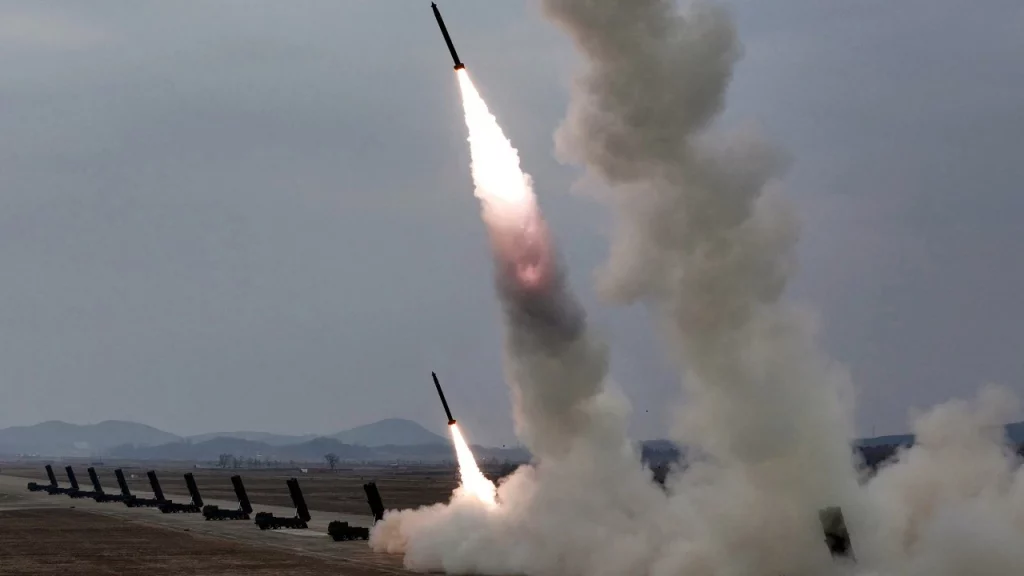

In a fresh escalation of North and South Korea conflict today, North Korea launched several projectiles including a short-range ballistic missile into the Yellow Sea on Tuesday, May 26, 2026. This marks Pyongyang’s eighth weapons demonstration of 2026 and its first launch in 37 days. South Korea, the United States, and Japan have all gone on high alert, with North Korea and South Korea tensions now at one of their most dangerous points in years.
Background: Why Are North Korea and South Korea Fighting?
To understand why North Korea and South Korea are fighting, one must look back more than seven decades. The Korean War of 1950–1953 ended not with a peace treaty but an armistice meaning the two nations are technically still at war. The heavily fortified Demilitarized Zone (DMZ) separating them remains one of the most militarized borders on earth.
North Korea and South Korea have fundamentally different political systems, military alliances, and strategic goals. The South is a democratic state backed by the United States and Japan, while the North remains a hereditary authoritarian state under Kim Jong Un that views nuclear weapons as its ultimate guarantee of survival. This ideological divide is at the core of the ongoing South Korea and North Korea conflict.
Over the past several years, Kim has pushed North Korea toward a credible nuclear strike capability against the US and its allies, modernizing his arsenal with solid-fuel missiles that are easier to conceal, faster to launch, and harder to intercept. Short-range ballistic missiles sent to Russia for use in Ukraine have been battle-tested, giving him real-world data on how US and Western interceptors perform.
Details: What Happened on May 26, 2026
The latest chapter of North Korea conflict today unfolded in the early afternoon Korean time. South Korea’s Joint Chiefs of Staff confirmed they detected the launches of “several projectiles,” including a short-range ballistic missile, into the Yellow Sea from the North Korean city of Chongju at around 1:00 pm local time.
The missiles flew approximately 80 kilometres. Seoul’s military said it was analysing their specifications and flight range and had “strengthened surveillance and vigilance in preparation for possible additional launches.”South Korea, its main security partner the United States, and Japan were “maintaining a state of full readiness” and closely sharing intelligence, Seoul’s military said.
It was North Korea’s first weapons launch since April 19, when it fired multiple short-range missiles in what state media described as a demonstration of cluster bomb warheads. The frequency of these tests underlines how North Korea conflict today is not an isolated incident but part of a deliberate and sustained pattern of provocation.
Has North Korea Attacked South Korea Recently?
The question of has North Korea attacked South Korea recently requires some context. While North Korea has not launched a direct military strike on South Korean territory in recent months, its actions constitute a steady pattern of aggression.
North Korea launched multiple rounds of ballistic missiles in April 2026, just days after South Korean President Lee Jae Myung expressed regret over an incident involving drones that crossed into North Korean airspace. Pyongyang launched missiles from near Wonsan toward waters off its east coast, and South Korea’s national security council held an emergency meeting urging North Korea to stop acts that violate UN Security Council resolutions.
North Korea said its April testing spree involved various new weapons systems, including ballistic missiles armed with cluster-bomb warheads, as it pushes to expand nuclear-capable forces aimed at rival South Korea.
These consistent provocations keep North and South Korea conflict today in a permanent state of low-grade crisis, even when full-scale military exchanges are not occurring.
North Korea Enemies List: Who Does Pyongyang Consider a Threat?
Understanding the North Korea enemies list is key to grasping why the South Korea and North Korea conflict persists. Pyongyang’s official posture identifies several nations as existential adversaries.
North Korean leader Kim Jong Un has publicly called the United States his country’s “biggest enemy” and “the biggest stumbling block to the development of our revolution,” vowing to advance his nuclear arsenal regardless of who holds power in Washington.
North Korean short-range and medium-range ballistic missiles could target South Korea, Japan, and US forces in the region. According to the 2026 Annual Threat Assessment, North Korea is “investing in nuclear-capable systems to deter the US, challenge regional missile defenses, and hold targets in South Korea at risk.”
In March 2026, North Korea also warned Japan against deploying long-range missiles in the Kyushu region, saying such capabilities would bring “constant escalation of tension” in Northeast Asia and accusing Japan of continuing a past history of aggression.
So when asking are North Korea and South Korea enemies, the answer is yes but North Korea’s enemies list extends far beyond Seoul to include Washington, Tokyo, and any nation that supports the US-led regional security architecture.
South Korea and North Korea: Who Is More Powerful?
The question of South Korea and North Korea who is more powerful depends entirely on what type of power is being measured.
In conventional military terms, South Korea holds significant advantages. It operates advanced fighter jets, precision-guided munitions, and a highly trained professional army. Its defence industry produces cutting-edge weapons and its economy the world’s 12th largest allows for sustained military investment. The United States maintains approximately 28,500 troops on South Korean soil, adding enormous deterrent weight to Seoul’s side.
However, when it comes to nuclear capability and asymmetric weapons, North Korea holds the upper hand. North Korea’s rapidly expanding arsenal puts it in a stronger geopolitical position than at any other time in its history. Kim has tested missiles with cluster bombs and decoys as his military attempts to develop systems that can penetrate US and South Korean defenses.
North Korea will likely significantly expand its arsenal of nuclear warheads, possibly reaching 290 warheads by 2035, according to South Korean estimates. An expanded North Korean nuclear force could require the United States and South Korea to reevaluate their ability to counter North Korean nuclear capabilities.
So on raw conventional power, South Korea leads. On nuclear deterrence and willingness to use asymmetric force, North Korea remains a uniquely dangerous adversary.
Quotes: What Officials Are Saying
South Korea’s Joint Chiefs of Staff confirmed that missiles were fired from Jongju city on the North’s west coast, adding that South Korea’s military had bolstered its surveillance posture and is closely exchanging related information with the US and Japan.
Analysts note that the importance of North Korea’s nuclear arsenal as a deterrent has only grown following recent geopolitical developments, including strikes on other nations’ nuclear facilities, which Kim Jong Un has used to justify further acceleration of his own weapons programme.
North Korean leader Kim Jong Un has focused on expanding his nuclear and missile arsenals since his nuclear diplomacy with President Trump collapsed in 2019. Trump has repeatedly expressed his desire to resume talks with Kim, but Pyongyang has so far ignored the overtures and urged Washington to drop demands for the North’s nuclear disarmament as a precondition for talks.
Impact: Regional and Global Consequences
The North and South Korea conflict today has ripple effects well beyond the Korean Peninsula. Every missile test by Pyongyang forces South Korea, Japan, and the United States into emergency consultations, disrupts regional air and sea traffic, and raises the specter of miscalculation.
North Korea continues overt nuclear enrichment and long-range missile development in violation of UN Security Council resolutions. China and Russia have blocked efforts by the US and its partners in the UN Security Council to tighten sanctions over Pyongyang’s weapons tests.
Analysts note that a reduced emphasis on the US nuclear umbrella could create security gaps in deterrence credibility. North Korea may also be testing new command structures through provocations, probing for weaknesses in the US-South Korea alliance.
The South Korea and North Korea conflict also has direct economic implications. South Korea is a major global exporter of semiconductors, automobiles, and electronics. Any serious escalation on the Korean Peninsula would send shockwaves through global supply chains and financial markets.
Conclusion: What Comes Next
The May 26 missile launch is the eighth weapons test North Korea has conducted in 2026, and analysts do not expect Pyongyang to slow down. Analysts have said the diplomatically isolated state may be trying to take advantage of eroding international norms to cement its nuclear status.
The North Korea and South Korea conflict is unlikely to be resolved through diplomacy in the near term. With Kim Jong Un dismissing denuclearization talks and the US-South Korea military alliance remaining firm, the two Koreas are locked in a long-term standoff that occasional missile launches only deepen.
For the Korean Peninsula and the wider region, the central challenge remains unchanged: how to deter North Korea from further escalation while keeping the door open to dialogue before the North Korea conflict today becomes something far more dangerous tomorrow.
FAQs
Why is North Korea so powerful?
North Korea’s power rests primarily on two pillars: its nuclear weapons programme and its willingness to use extreme measures that most nations would not consider. Despite being one of the world’s poorest countries by GDP, Pyongyang has built a nuclear arsenal that can threaten not just South Korea but potentially the entire continental United States. Kim Jong Un has made nuclear and missile development the central priority of his regime, diverting vast national resources into weapons even as ordinary citizens face severe hardship. North Korea is also militarily powerful in terms of sheer troop numbers it maintains one of the world’s largest standing armies with over one million active personnel. Its special forces, chemical weapons stockpiles, and cyberwarfare capabilities further complicate any military response from its adversaries.
How far can North Korean missiles go?
North Korea’s missile capabilities span a wide range. Short-range ballistic missiles like the KN-23 can cover the entire Korean Peninsula. Medium-range missiles can reach Japan and US military bases in the Pacific. Most significantly, North Korea’s intercontinental ballistic missiles including the Hwasong-17 have demonstrated the theoretical range to strike the continental United States, estimated at over 13,000 kilometres when launched on a standard trajectory. In January 2026, North Korea tested hypersonic missiles that flew approximately 1,000 kilometres into the Sea of Japan. As Pyongyang continues testing and refining its missiles, including solid-fuel variants that are faster to deploy and harder to detect, the threat envelope continues to expand.
Who has 90% of the world’s nuclear weapons?
The United States and Russia together hold approximately 90% of the world’s nuclear warheads. Both nations maintain arsenals numbering in the thousands Russia holds the largest stockpile globally, estimated at around 5,580 warheads, while the United States has approximately 5,044. The remaining nuclear-armed states China, France, the United Kingdom, India, Pakistan, Israel, and North Korea together account for a relatively small fraction of the global total. However, even a small nuclear arsenal like North Korea’s is considered a serious strategic threat because it can cause catastrophic damage even with a limited number of weapons. North Korea is estimated to currently possess between 40 and 50 nuclear warheads, with projections suggesting it could reach 290 by 2035.