

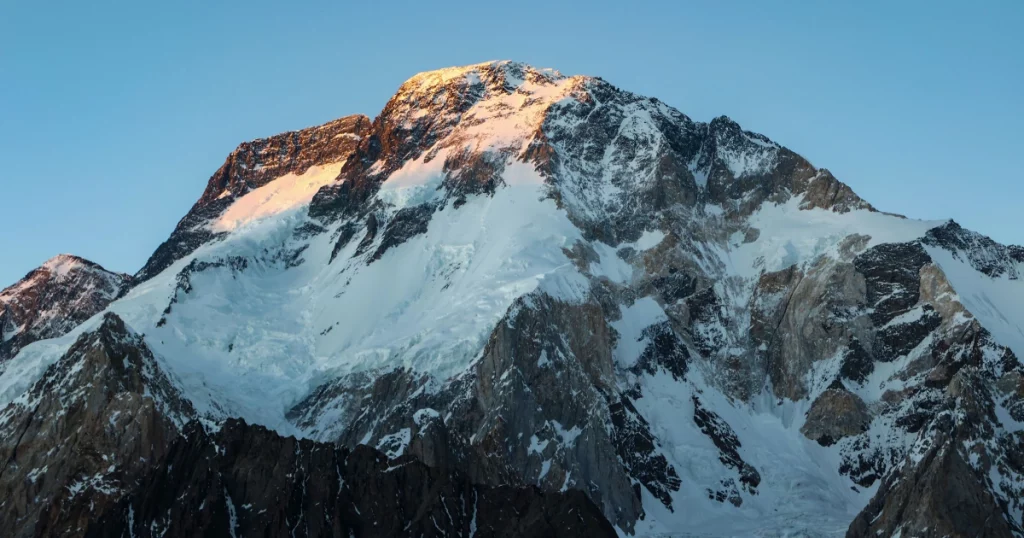

On July 30, 2026, a powerful avalanche struck Broad Peak, the world’s 12th-highest mountain standing at 8,047 metres, in Pakistan’s Karakoram Range. The disaster hit around 9:20 in the morning, somewhere between Camp II and Camp III at approximately 6,579 metres on the mountain’s West Ridge route.
The impact immediately cut off all communication with a 10-member international climbing team. The group included five Nepali climbers led by Nirmal “Nims” Purja, Pakistani climber Sohail Sakhi from Hunza, Omani mountaineer Nadhira, American climber Mallory Geis, Chinese climber Mr. Wang, and one additional foreign climber. No contact has been re-established with any of them since the avalanche struck.
Who Is Nims Purja
Nirmal “Nims” Purja, widely known as Nims Dai or Nimsdai, is one of the most celebrated mountaineers alive today. He made history in 2019 by climbing all of the world’s 14 peaks over 8,000 metres in just over six months a feat that was chronicled in the hit Netflix documentary “14 Peaks: Nothing Is Impossible.”
In 2024, Purja became the fastest person to summit all 14 of the peaks without supplementary oxygen. He was on Broad Peak as part of his ambitious “Hat Trick Campaign” an attempt to climb all 14 eight-thousanders three times.
The avalanche occurred only days after Nims completed his 57th successful ascent of an 8,000-metre peak with an oxygenless climb of Gasherbrum II on July 21. He was nearing the finish line of one of mountaineering’s most extraordinary personal projects when disaster struck.
Purja spent 16 years serving in the British army, including in the Brigade of Gurkhas and the elite Special Boat Service of the Royal Navy. His combination of military toughness and mountaineering brilliance made him one of the most recognised figures in high-altitude climbing worldwide.
The Full List of Missing Climbers
The missing climbers include Purja, along with Nepali climbers Pur Bahadur Gurung, Kili Pemba Sherpa, Nima Sherpa, Gyalu Sherpa and Nawang Thindu Sherpa. The team also includes Pakistani climber Sohail Sakhi, Chinese climber Wang Zhong, American climber Mallory Geis, and Omani climber Ahmed Abdullah Al Harthy.
The expedition was a multi-nationality team assembled through Elite Exped, the guiding company led by Purja. According to Elite Exped’s standard Broad Peak programme, climbers spend 46 days in Pakistan, including rest days, acclimatisation hikes, trekking in, and summiting. For many on the team, this Pakistan peak expedition represented years of preparation and dreaming.
Rescue Operation Underway
Four bodies have been recovered by ground teams so far, said Irfan Arshad Khan, president of the Alpine Club of Pakistan. They have not yet been identified. The discovery of the bodies has brought the gravity of this Karakoram tragedy into sharp focus for the global climbing community.
In a sign that offers some hope, Purja’s GPS tracker was showing movement, according to his business partner Mingma Gyabu Sherpa, also known as Mingma David. A rescue team of experienced Sherpa mountaineers left Nepal on a Friday afternoon flight, carrying specialised long-line helicopter rescue equipment.
Bad weather grounded helicopters during the critical first hours, forcing rescuers to mount an initial ground search instead. The delay in helicopter access significantly slowed the response and may have reduced the window for survivors.
Official Statements
“The entire team has reportedly been out of communication since the avalanche,” said Karrar Haidri, senior vice-president of the Alpine Club of Pakistan, in an official statement.
The Alpine Club added that it is working with government authorities and rescue agencies to mobilise all available resources. “Every possible effort is being made to ensure that helicopter support and all available rescue resources are mobilised at the earliest opportunity, subject to weather and operational conditions,” the statement said.
Thaneshwar Guragain, general manager of Seven Summit Treks, said rescue operations in Pakistan move far more slowly than in Nepal, since they are run mainly by the military rather than through the kind of immediate private helicopter response Nepal allows. Helicopters require multiple clearance procedures, he explained, meaning that bad weather and bureaucratic timelines combined to cost precious hours.
About Broad Peak and Pakistan Peak Expeditions
Broad Peak sits at the heart of the Karakoram Range in Gilgit-Baltistan, Pakistan. The 12th-tallest peak in the world is considered slightly less technically difficult than notorious neighbours like K2, but it is prone to harsh and unpredictable weather. In 2013, three Iranian climbers died on descent after summiting Broad Peak.
For those interested in a Pakistan peak expedition, Broad Peak sits within one of the most concentrated clusters of extreme altitude mountains on Earth. The range is home to K2, Gasherbrum I, Gasherbrum II, and Nanga Parbat all of which attract elite climbers on Pakistan peak expedition packages every summer.
Pakistan peak expedition cost and Pakistan peak expedition price vary significantly depending on the peak chosen. A guided Broad Peak expedition package typically runs between USD 8,000 and USD 15,000 per climber, not including international flights. Laila Peak expedition packages in the Hushe Valley are considerably more affordable, with Laila Peak expedition cost ranging from USD 2,500 to USD 5,000. A Laila Peak expedition is often recommended for intermediate climbers, while Pastore Peak expedition packages offer a stunning alternative in the Shigar Valley for those building Karakoram experience.
Any serious Pakistan peak expedition itinerary for an 8,000-metre peak includes weeks of acclimatisation, multiple rotation climbs, and a summit push window dependent entirely on weather. Pakistan peak expedition maps show the complex approach routes through glaciers that make logistics both spectacular and demanding. The tragic events on Broad Peak serve as a reminder that even the most experienced mountaineers face serious risk on every Pakistan peak expedition.
Global Impact and Significance
This disaster has shocked the international mountaineering community deeply. While interest in expeditions on Pakistan’s five 8,000-metre peaks has grown significantly in recent years, the range remains extremely isolated with limited facilities for communication or helicopter rescue.
The incident has reopened conversations about the safety protocols surrounding high-altitude guided expeditions and whether more robust rescue infrastructure is needed in Pakistan’s mountains. Guragain said hope of finding the missing climbers alive was narrowing sharply with time.
Nepal’s government responded swiftly. Mingma David confirmed that Nepal’s Ministry of Foreign Affairs and Ministry of Tourism coordinated emergency visas to allow the specialised rescue team to reach Pakistan immediately. Nepal’s ambassador to Pakistan, Rita Dhital, also confirmed that Pakistan had mobilised helicopters, drones, and ground teams.
What Comes Next
Rescue operations are expected to continue into the coming days, subject to improving weather conditions in the Karakoram. The Alpine Club of Pakistan has confirmed that all available military and civilian resources are being directed toward the search.
The mountaineering world is watching closely. If Purja’s GPS movement signals are accurate, there remains hope. But with four bodies already recovered and weather conditions unpredictable at extreme altitude, the situation remains deeply uncertain and desperately serious.
Frequently Asked Questions (FAQs)
Which is the killer mountain in Pakistan?
K2, standing at 8,611 metres in the Karakoram Range of Pakistan, is widely regarded as the deadliest mountain in the world. Unlike Mount Everest, which sees many more climbers each year, K2 has a fatality rate that historically exceeds 25 percent of all summit attempts. The mountain is brutally technical, battered by severe storms, and offers almost no margin for error on the descent. It claimed 11 lives in a single day in August 2008 in one of mountaineering’s worst disasters. Pakistan’s Nanga Parbat, the world’s ninth-highest peak, earned the grim nickname “Killer Mountain” in the early 20th century after a series of catastrophic expeditions wiped out entire climbing teams before the mountain was finally summited. Both peaks sit within Pakistan’s extraordinary range of eight-thousanders and remain among the most respected and feared destinations in world mountaineering.
Which is the easiest 7000m peak to climb?
Among the world’s 7,000-metre peaks, Mera Peak in Nepal at 6,476 metres is frequently cited as beginner-friendly, but among true 7,000-metre summits, Lenin Peak in Kyrgyzstan and Aconcagua in Argentina are often considered the most accessible for experienced high-altitude trekkers making the step up to genuine seven-thousanders. Within Pakistan, Spantik, also known as Golden Peak, at 7,027 metres in the Karakoram is one of the more approachable 7,000-metre peaks for climbers with solid technical skills and prior experience at altitude. A Pakistan peak expedition to Spantik typically follows a non-technical route on its normal line and remains significantly less dangerous than the neighbouring eight-thousanders. Pakistan peak expedition packages to Spantik are popular among those building toward the bigger Karakoram peaks like Broad Peak or K2.
Who was the first Pakistani to climb K2?
The first Pakistani national to summit K2, the world’s second-highest mountain, was Ashraf Aman, who reached the top on August 10, 1977, as part of a Japanese-Pakistani joint expedition. This was a historic moment for Pakistan’s mountaineering history and signalled the country’s growing presence on its own extraordinary peaks. Since then, Pakistani high-altitude porters and guides, particularly from communities in Hunza, Shimshal, and Hushe, have become internationally recognised for their exceptional skill and endurance on the world’s most demanding mountains. Today, Pakistani climbers and support staff play an essential role in virtually every Pakistan peak expedition to the Karakoram’s eight-thousanders, including expeditions to Broad Peak, where Thursday’s avalanche struck.