

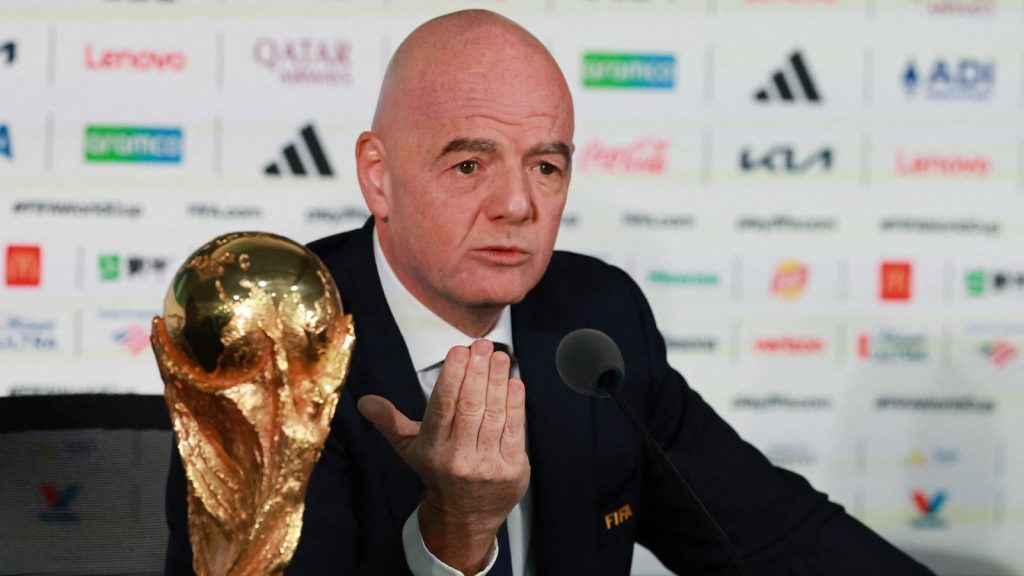

FIFA is pressing ahead with its controversial plan to bring in outside FIFA investors despite a unanimous vote by UEFA’s 55 member nations to boycott all FIFA competitions, including the World Cup, if the proposal moves forward. The standoff has triggered the most serious governance clash in modern football history, less than two weeks after Spain lifted the World Cup trophy.
Background
FIFA President Gianni Infantino announced the outline of what is FIFA’s investment plan on Tuesday, revealing intentions to create a new commercial subsidiary called FIFA Forward Enterprise, or FFE. Under the proposal, FIFA would retain majority control while selling roughly a 20 percent minority stake to outside investors in a company reportedly valued near $20 billion.
The plan would hand the new subsidiary control over broadcasting, sponsorship, ticketing, and licensing rights tied to the World Cup and other FIFA-run tournaments. FIFA has been working alongside JP Morgan to structure the deal, and reports indicate Thrive Eternal, a private equity firm founded by Joshua Kushner, brother of Jared Kushner, is expected to lead the group of FIFA investors involved.
Infantino gave the organization’s 211 member associations until September 19 to approve the deal, reportedly offering an initial payout of $20 million to each federation that backs the plan. That timeline set the stage for Thursday’s emergency meeting, when UEFA’s full membership rejected the proposal outright.
Details
UEFA’s 55 member associations voted unanimously during a virtual emergency meeting in Geneva to boycott every FIFA competition, men’s and women’s World Cups included, unless the investment plan is abandoned entirely. The federation said in a statement that no part of the World Cup should ever be surrendered to private investors, describing the tournament as one of football’s greatest sporting legacies built over generations by players, national teams, and supporters.
UEFA went further than a simple rejection, demanding binding assurances that FIFA will never again attempt to open its governance or competitions to private ownership. The federation called the process “governance by intimidation,” pointing to the September deadline and the proposed federation payouts as pressure tactics rather than genuine consultation.
CONCACAF, the governing body for North and Central America and the Caribbean, also rejected the plan during its own meeting Thursday, though the 41-member confederation stopped short of threatening a boycott. The Asian Football Confederation issued a sharply worded letter to its 47 members warning that the proposal could never succeed without support from all six regional football confederations.
Despite the mounting opposition, FIFA has remained defiant. In a statement responding directly to UEFA’s boycott vote, the organization said nobody is selling football and that such a move is not something FIFA would ever entertain. FIFA argued that no single entity, including UEFA, can claim to represent all 211 member associations and insisted each federation should be allowed to review the plan and decide its own position democratically.
The dispute also carries political undertones. Speculation about the FIFA investors involved has drawn attention to Infantino’s relationship with US President Donald Trump, particularly given Thrive Eternal’s ties to the Kushner family. Critics argue that private investors seeking returns could eventually pressure FIFA to expand tournaments further or increase the frequency of the World Cup, potentially straining player welfare.
Quotes
UEFA’s statement was unambiguous in tone, declaring that the World Cup cannot be treated as an investment product and stating plainly that the tournament is not for sale. The federation added that no UEFA national team would participate in any FIFA competition for as long as the proposal remained alive.
FIFA pushed back firmly, stating that the FFE subsidiary was proposed solely to give member associations meaningful ownership of football’s commercial opportunities in their own countries, without compromising the spirit or governance of the sport.
Britain’s Sport Minister Lisa Nandy voiced support for the boycott, calling it a principled decision and arguing that football belongs to fans rather than billionaire investors. England’s Football Association echoed the sentiment, saying it stands shoulder to shoulder with European teams and that the World Cup belongs to football and always will.
Impact
The clash carries major sporting weight given Europe’s dominance in the men’s game. UEFA nations currently hold six of the top ten spots in FIFA’s global rankings, and European teams made up six of the eight quarterfinalists and three of the four semifinalists at this year’s World Cup. A genuine boycott would hit future tournaments hard.
The timing adds further pressure. The FIFA U-20 Women’s World Cup begins September 5 in Poland, just two weeks before Infantino’s own deadline, with several UEFA nations, including host country Poland, Spain, Portugal, Italy, France, and England, scheduled to compete. The 2027 Women’s World Cup in Brazil looms as an even bigger flashpoint if the standoff isn’t resolved.
Beyond sport, the dispute has drawn political figures into the debate. EU Sport Commissioner Glenn Micallef publicly praised UEFA’s stance on governance, while questions about FIFA investors tied to the Trump-connected Kushner family have added a geopolitical dimension to what was already a fraught governance fight.
Conclusion
With FIFA showing no sign of backing down and UEFA holding firm on its boycott threat, the standoff appears headed toward a prolonged confrontation ahead of the September 19 deadline. Much will depend on whether the Asian, African, and South American confederations align with UEFA or side with Infantino, since FIFA’s one-nation-one-vote system means Europe alone cannot block the plan without broader support.
For now, both sides remain entrenched. The future of FIFA’s investment plan, and potentially the makeup of the next Women’s World Cup and Under-20 tournaments, hangs in the balance.
Frequently Asked Questions
Why is FIFA selling to private investors?
FIFA has framed the plan as a way to generate significant new revenue that can be reinvested back into football development, arguing that outside capital would help fund growth across all 211 member associations rather than benefiting only the wealthiest federations. President Gianni Infantino has also suggested the deal would let member associations take meaningful ownership stakes in the commercial side of the sport in their own countries. Critics, however, argue the real motivation involves major upfront payouts to member federations, roughly $20 million each under the current proposal, which some see as an effort to secure votes ahead of FIFA’s presidential election next March.
Why is UEFA boycotting FIFA?
UEFA argues that allowing private investors to hold a stake in the World Cup fundamentally compromises the tournament’s integrity and governance, turning what it considers football’s greatest shared legacy into a commercial investment product. The federation has also criticized the lack of transparency in how the deal was structured, saying there was zero clarity about who would financially benefit from the arrangement. UEFA further objected to the process itself, describing FIFA’s tight September deadline and proposed cash incentives to member federations as pressure tactics rather than a legitimate, democratic decision-making process.
How much is the FIFA World Cup worth?
While there’s no single definitive valuation for the World Cup itself, the new commercial subsidiary at the center of this dispute, FIFA Forward Enterprise, has reportedly been valued at approximately $20 billion, with FIFA proposing to sell around a 20 percent stake to private investors. The tournament’s broader commercial value comes from broadcasting rights, sponsorships, ticketing, and licensing deals that have grown substantially in recent years, particularly following the expansion of the men’s World Cup to a larger format. This scale of commercial value is precisely what has made the prospect of private ownership so contentious among football’s governing bodies.