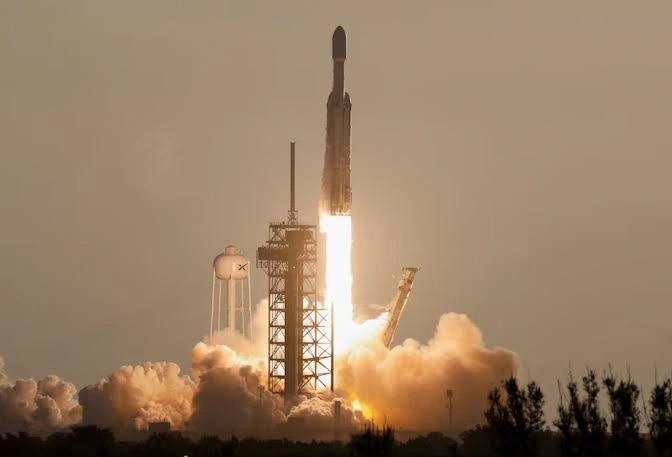
FLORIDA: NASA’s next-generation Nancy Grace Roman Space Telescope has successfully launched into space, beginning a major mission to investigate dark energy, black holes, exoplanets and some of the Universe’s biggest unanswered questions.
The powerful Nancy Grace Roman Space Telescope lifted off from Kennedy Space Center in Florida on Sunday morning aboard a SpaceX Falcon Heavy rocket. Around 30 minutes after launch, the telescope separated from its launch vehicle and began its journey toward an orbiting position roughly one million miles (1.6 million kilometres) from Earth.
NASA says the telescope will provide enormous panoramic views of the cosmos, with a field of vision around 100 times larger than that of the Hubble and James Webb Space Telescopes.
“Roman is going to change the way we look at the Universe,” NASA administrator Nicky Fox said.
Nancy Grace Roman Space Telescope Begins Deep-Space Mission
The Nancy Grace Roman Space Telescope will spend approximately 100 days travelling to its observation point before beginning its scientific mission.
From its position far beyond the Moon, the telescope will survey huge areas of the sky and collect data that scientists hope will improve their understanding of how the Universe evolved.
One of its major objectives is studying dark energy, the mysterious phenomenon believed to be responsible for the accelerating expansion of the Universe. Scientists also hope Roman will provide new insights into galaxies, black holes and the structure of the cosmos.
Project manager Jackie Townsend described the launch as “glorious” during a news conference after liftoff.
“The ride was magnificent. It put us right where we wanted to be,” she said.
The telescope’s location will also be important for its observations. Astronomer Jenifer Millard explained that Roman will operate roughly four times farther from Earth than the Moon, helping reduce interference from infrared light emitted or reflected by Earth and the Moon.
Roman Telescope to Search for Thousands of Exoplanets
A major part of the Nancy Grace Roman Space Telescope mission will involve searching for planets beyond our solar system, known as exoplanets.
Nicky Fox said Roman could discover tens of thousands of new exoplanets, with the potential to identify as many as 100,000.
The enormous survey capability of the telescope will allow scientists to study distant planetary systems on a scale that previous observatories could not easily achieve.
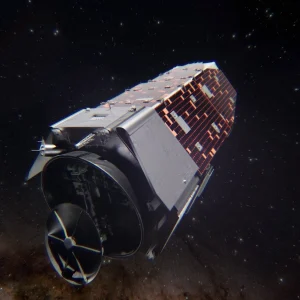
The search for exoplanets is also closely connected to one of astronomy’s most profound questions: whether humanity is alone in the Universe.
“Why do we care so much about exoplanets?” Fox said. “Because one of our main goals at NASA is answering the question, ‘Are we alone in the universe?’”
The telescope’s exceptionally wide field of view means it will be able to examine vast portions of the sky while searching for distant worlds and other astronomical objects.
NASA Roman Telescope Could Transform Astronomy
The successful launch marks the beginning of an ambitious scientific programme that could reshape researchers’ understanding of the Universe.
Unlike telescopes designed primarily to observe small regions in extraordinary detail, the Nancy Grace Roman Space Telescope is built to survey enormous sections of the sky. Its combination of wide-field imaging and infrared capabilities will enable scientists to investigate cosmic phenomena across vast distances.
US President Donald Trump also joined NASA’s news conference remotely to congratulate the scientists and engineers behind the mission.
With its journey now underway, scientists will spend the coming months preparing the Nancy Grace Roman Space Telescope for its observations. Once operational, the telescope is expected to produce huge quantities of data that could help answer fundamental questions about dark energy, planetary systems, galaxies and the origins and evolution of the Universe.
The mission could ultimately provide astronomers with one of the most comprehensive surveys of the cosmos ever conducted.