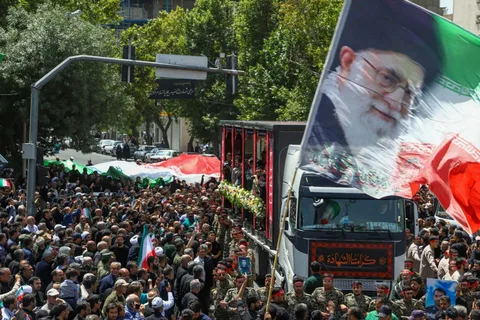
Iran has opened a seven-day state funeral for former Supreme Leader Ayatollah Ali Khamenei, more than four months after he was killed. Ceremonies began on July 3 in Tehran and will move through Qom, Najaf, and Karbala before burial in Mashhad on July 9.
Millions of mourners are expected across Iran and neighboring Iraq. Officials describe it as one of the largest logistical operations in the Islamic Republic’s history, involving government workers, universities, labor unions, and religious volunteer groups.
Background
Khamenei, 86, was killed on February 28, 2026, in a joint US-Israeli air strike on his residential compound in Tehran. The strike came on the opening day of the war between Iran, Israel, and the United States.
Several members of his family were killed alongside him in the attack. Iranian state media confirmed his death the following morning.
The funeral was originally planned for early March but was delayed for more than four months. Iranian officials attributed the postponement to ongoing wartime conditions and security concerns surrounding a ceremony expected to draw huge public crowds.
Khamenei had led Iran since 1989, when he succeeded Ayatollah Ruhollah Khomeini, the founder of the Islamic Republic. Over 37 years, he shaped the country’s military and paramilitary structure, including the Revolutionary Guard.
What Is Happening Now
The funeral program runs from July 3 through July 9. It opened with a ceremony in Tehran for foreign dignitaries to pay their respects.
Public farewell events followed on July 4 and 5, with Khamenei’s coffin lying in state at the Grand Mosalla, a major prayer complex in Tehran built to hold large crowds. Processions then move to Qom, before continuing into Iraq for stops in Najaf and Karbala.
The body will return to Iran for final burial at the shrine of the eighth Shia imam in Mashhad on July 9. Coffins of several family members killed alongside him are being carried through the same ceremonies.
Security has been tightened significantly. Authorities have imposed temporary airspace restrictions over Tehran and Mashhad during the ceremonies.
Mojtaba Khamenei’s Role
Khamenei’s son, Mojtaba Khamenei, succeeded him as Supreme Leader and is now Iran’s top religious and political authority. He has largely stayed out of public view since the war began.
According to regional reporting, Mojtaba is expected to skip most public funeral appearances due to ongoing security threats and surveillance concerns. This will be the first major state ceremony held under his leadership, even without his direct presence at every stage.
International Attendance
Iran’s foreign ministry says it expects guests from roughly 100 countries, including heads of government, parliamentary speakers, and foreign ministers.
Pakistani Prime Minister Shehbaz Sharif, who has played a mediating role in US-Iran talks, is attending. Georgian President Mikheil Kavelashvili is also expected, along with senior officials from Russia, China, and India rather than their heads of state.
Two senior Taliban officials from Afghanistan, including the acting foreign minister, are also attending.
Quotes From Officials
Iranian President Masoud Pezeshkian called on citizens to attend “regardless of ethnicity, religion, personal preference, or political affiliation,” describing the turnout as a response to what he called the “logic of terror and violence.”
Parliament Speaker Mohammad Bagher Qalibaf said the funeral was meant to show the world that Iran’s people would not stay silent in the face of the strike that killed Khamenei.
Foreign ministry spokesperson Esmaeil Baghaei confirmed the scale of international attendance, saying Iran expected delegations from around 100 countries.
Reports of Pressure to Attend
Iran International has reported complaints from residents in Tehran describing pressure to participate in the funeral. Some business owners said they were warned by Basij members that shops opening during the mourning period would be sealed.
One resident said the city’s Grand Bazaar was ordered closed until Thursday. A gym owner reported instructions to shut down for the full mourning period.
These accounts have not been independently verified by Iranian state authorities, who have not commented publicly on the claims.
Regional and Diplomatic Impact
The funeral is unfolding alongside fragile diplomacy. Talks between the United States and Iran toward a longer-term peace arrangement have continued in Qatar, led by US special envoy Steve Witkoff.
Negotiations have been strained. Reports indicate renewed strikes between US and Iranian forces in the days before the funeral, raising concern about the durability of the ceasefire.
An Iranian military commander publicly warned the United States and Israel against any attack during the funeral period, underscoring how tense the security situation remains even as mourning ceremonies proceed.
The scale of the funeral is widely seen as a message from Tehran to both domestic and international audiences: that the state has endured the war and intends to honor its former leader as a symbol of continuity.
Conclusion
Iran’s funeral for Ali Khamenei closes a four-month period of uncertainty following his killing at the start of the 2026 war. Burial in Mashhad on July 9 will mark the formal end of ceremonies, though the political and diplomatic aftermath is likely to continue.
Attention now turns to how Mojtaba Khamenei governs going forward, and whether the fragile ceasefire holds as US-Iran talks continue in the weeks ahead.
Frequently Asked Questions
Did Ayatollah Khomeini fall out of his coffin? This event involved Ayatollah Ruhollah Khomeini, Iran’s first Supreme Leader, not Ali Khamenei. During Khomeini’s 1989 funeral, mourners rushed the funeral procession and the crowd’s crush reportedly caused his body to briefly fall from an open casket before officials regained control. It is a separate historical incident from Khamenei’s 2026 funeral and is not connected to the current ceremonies.
What is the largest attended funeral in history?
Historical estimates suggest that Khomeini’s 1989 funeral in Iran drew one of the largest crowds ever recorded for a single event, with some estimates citing several million mourners. Other funerals frequently cited among the largest include those of Indian independence leader C. N. Annadurai and Egyptian President Gamal Abdel Nasser. Exact crowd figures from decades-old events are difficult to verify precisely, and estimates vary by source.
Who is Iran’s Supreme Leader now?
Mojtaba Khamenei, son of Ali Khamenei, succeeded his father as Supreme Leader following his death in February 2026. He has kept a low public profile since taking on the role, largely due to security concerns tied to the ongoing conflict with the United States and Israel.