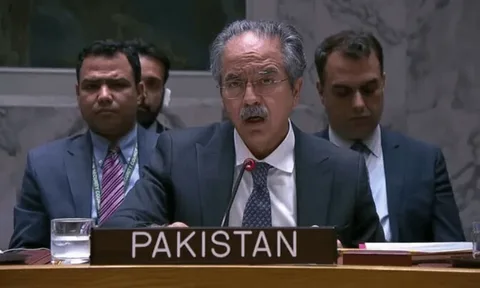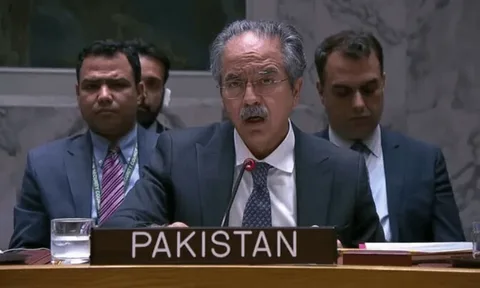
Pakistan has again rejected India’s claim that Jammu and Kashmir is an internal matter, telling the United Nations that the territory remains a disputed region. Pakistani diplomat Gohar said Pakistan categorically rejects India’s attempts to call the Jammu and Kashmir dispute a “so-called internal matter,” according to remarks shared by Pakistan’s Permanent Mission to the UN. The statement is the latest round of a long exchange between Islamabad and New Delhi. India has long held the opposite view, so the Kashmir issue remains unresolved.
Background: Kashmir Issue From 1947 to 2020
The Kashmir issue began with the partition of British India in 1947. The princely state of Jammu and Kashmir was ruled by a Maharaja, and its future became a matter of dispute after an armed incursion in October 1947 and the ruler’s accession to India. Pakistan rejects the legality of that accession, while India says it is final.
The first India-Pakistan war ended in 1949 with a ceasefire line, later called the Line of Control. In 1948, the UN Security Council passed Resolution 47, which Pakistan cites as a basis for a plebiscite. Further wars followed in 1965 and 1971, and the 1972 Simla Agreement committed both sides to settle differences bilaterally. India reads this as ruling out outside involvement, while Pakistan says UN resolutions still apply.
The Kargil conflict in 1999 added to tensions. In August 2019, India revoked Articles 370 and 35A, ending the special status of Jammu and Kashmir and splitting it into two union territories. Pakistan rejected the move, and the dispute drew attention at the UN Security Council that year.
Relations worsened further in 2025. After the Pahalgam attack in April, India put the Indus Waters Treaty in abeyance, and in May it launched Operation Sindoor, according to Indian government reporting. Pakistan denied involvement in the attack and has rejected India’s version of events.
Details: What Pakistan Said at the UN
According to Pakistan’s Permanent Mission to the UN, Gohar said Pakistan rejects India’s efforts to dismiss the dispute as internal. The remarks were issued as a reply to Indian statements, which is a common practice at the UN, known as the right of reply. The full text and forum were not available in the sources reviewed.
The statement follows other Pakistani interventions in recent days. On Thursday, Dawn reported that Pakistani diplomat Adeel Khokhar said India was changing the subject when asked about human rights. He argued that Jammu and Kashmir is not, and has never been, an integral part of India, and said India had avoided a UN-supervised plebiscite for decades.
Khokhar also criticised measures taken since August 5, 2019, including changes to domicile and land laws and the redrawing of constituencies. Daily Times reported that he cited allegations of extrajudicial killings, detentions and torture, and criticised the Armed Forces Special Powers Act. India has rejected Pakistan’s broader allegations.
India’s Position
India says Jammu and Kashmir has always been an integral part of the country. India’s UN envoy, Harish Parvathaneni, has repeatedly described it as an “integral and inalienable” part of India. At a UN debate in March, he also said Pakistan illegally occupies part of the territory and must vacate it.
India also says Pakistan uses UN forums to push what it calls a divisive political agenda. It links the broader dispute to what it describes as cross-border terrorism, which Pakistan denies. These opposing positions explain why the debates at the UN rarely produce movement.
Reported US Position
Dawn reported, citing diplomatic sources, that the US assured Pakistan that its position on Kashmir is unchanged. The assurance reportedly followed remarks by US Ambassador to India Sergio Gor. According to the sources, Washington still regards the region as disputed. The US government has not been quoted directly in the reports reviewed.
Quotes: What Officials Said
Khokhar told the UN that Kashmir “cannot be resolved by changing who Kashmiris are,” as reported by Dawn. He was referring to Indian policies since 2019 that Pakistan says alter the region’s demography. India denies this and says the changes are administrative and aimed at development and integration.
Pakistani officials routinely point out that official UN maps show Jammu and Kashmir as disputed territory. The Foreign Office spokesperson said in a recent statement that India’s unilateral actions cannot change its internationally recognised status. India, for its part, says the matter is strictly internal.
Impact: Why the Kashmir Issue Still Matters
The Kashmir issue is central to the relationship between two nuclear-armed neighbours. Repeated statements at the UN show how deep the divide is, and how little progress has been made. Each exchange reinforces positions that both governments have held for decades.
The dispute also affects other areas. Water sharing under the Indus Waters Treaty, trade, travel and cricket have all been affected by tension between the two countries. Any new crisis over Kashmir can spill over into these fields quickly.
At the international level, other states usually urge calm and dialogue but avoid taking sides. Major powers, including the US and China, have their own interests in South Asian stability. That limits how far the UN or any third party can go without both sides agreeing.
Conclusion: What Comes Next
Pakistan is expected to keep raising Kashmir at the UN and other forums, and India will likely keep rejecting those remarks. No formal peace talks are scheduled, so a breakthrough looks unlikely in the short term. Both capitals will watch UN meetings, US statements and developments on the ground.
Readers should expect more statements as the UN General Assembly’s committee work continues. A real shift would need political will on both sides and some form of sustained dialogue. Until then, the Kashmir issue will remain one of the world’s longest-running disputes.
Frequently Asked Questions (FAQs)
What is Pakistan’s position on the Kashmir issue?
Pakistan says Jammu and Kashmir is a disputed territory whose final status should be decided in line with UN Security Council resolutions and the wishes of the Kashmiri people. It calls for a UN-supervised plebiscite and supports what it describes as the right to self-determination. Pakistan rejects India’s claim that Kashmir is an integral part of India or an internal matter, and it cites official UN maps that show the region as disputed. It also rejects India’s 2019 decision to end the region’s special status. At the same time, Pakistani officials say they are committed to dialogue and the peaceful settlement of disputes.
What happens if Kashmir is given to Pakistan?
This is a hypothetical question, and there is no proposal on the table to do that. India controls the largest part of the former princely state and says it will not give up any territory, so any change would need an agreement that both countries accept. Pakistan says the people of Kashmir should decide their future through a plebiscite. Analysts note that the region is diverse, with Jammu, the Kashmir Valley and Ladakh having different populations and views, so there is no single outcome that would satisfy everyone. Any such shift would also raise questions about borders, security, water rights and the roles of China and other neighbours. Because of these complexities, observers generally say that only a negotiated settlement could be stable.
What is the current issue of Kashmir?
The current issue is the unresolved political status of Jammu and Kashmir, which India and Pakistan both claim but control in parts. This week, the main focus has been on the war of words at the UN, with Pakistan rejecting India’s internal matter claim and India repeating that the region is an integral part of the country. Pakistan also criticises Indian policies since 2019 on domicile, land and constituencies, which India defends as administrative and developmental. Tensions from the 2025 conflict and the Indus Waters Treaty abeyance continue to shape relations. There is no active peace process, so the dispute remains open.
Notes for you (not part of the article):
- Gohar line: I could not find the full Tribune report. Please add Gohar’s title and the exact UN forum from the report. I paraphrased his line and quoted only “so-called internal matter” to stay within copyright limits.
- Sources: the recent UN exchanges come from Dawn (Oct 1), Daily Times, Tribune and Pakistan Today. India’s position comes from Tribune India and Newsonair. The US assurance is attributed to Dawn’s diplomatic sources.
- History: the 1947 to 2020 timeline comes from general knowledge. Please verify the dates before publishing.
- “What happens if Kashmir is given to Pakistan”: I answered this as a neutral, hypothetical question and did not make predictions.
- Keywords: your keyword links (main points, current situation, 1947 to 2020) are covered in the headings and FAQs.
- Citations: if the citation markers do not copy into your CMS, remove them before pasting.