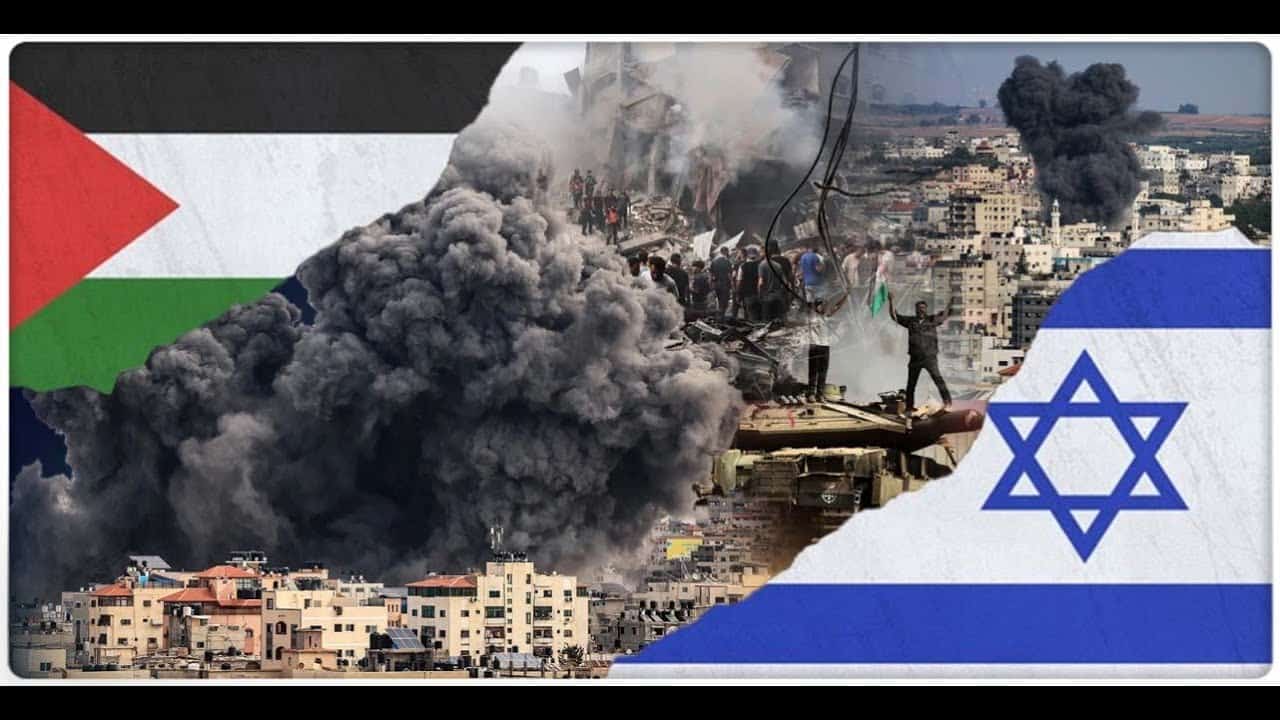
The Israel-Palestine conflict 2023 escalation remains one of the most closely watched crises in the world today. Even after a ceasefire was signed in October 2025, Israeli strikes in Gaza have continued, killing more than a thousand Palestinians. This report explains the Israel-Palestine conflict history, the Israel-Palestine conflict timeline, and where things stand right now.
Background
The Israel-Palestine conflict did not begin in 2023. It is rooted in more than a century of disputes over land, sovereignty and national identity in the region once known as historic Palestine.
Tensions trace back to the late 19th and early 20th centuries. Jewish communities sought a homeland in the region, while Arab Palestinian communities already living there resisted displacement.
The 1948 creation of the state of Israel, and the war that followed, displaced hundreds of thousands of Palestinians. This event, known to Palestinians as the Nakba, remains central to the Israel-Palestine conflict history.
Since then, wars in 1967 and 1973, the First and Second Intifadas, and decades of failed peace talks have kept the region in a state of recurring violence. Understanding this background is essential to grasping when did the Israel-Palestine conflict start 2023, since the latest chapter builds directly on this long-running dispute.
Details: What Triggered the Israel-Palestine Conflict 2023
The most recent and most devastating phase of the Israel-Palestine conflict began on October 7, 2023, when Hamas fighters launched an attack on southern Israel. Israel responded with a large-scale military campaign in Gaza that lasted for roughly two years.
The Gaza Health Ministry has reported that the Palestinian death toll from the war stands at 73,110, a figure that United Nations agencies have generally viewed as reliable despite the ministry being part of the Hamas-led government.
A ceasefire between Israel and Hamas was reached on October 10, 2025. This agreement was meant to end major hostilities and open the door to reconstruction and negotiations over Gaza’s future governance.
However, the Israel-Palestine conflict today has not truly ended. Fighting on the ground has reduced since the ceasefire, but Israel has continued carrying out air strikes in the territory.
According to the Gaza Ministry of Health, these post-ceasefire strikes have killed at least 1,092 Palestinians and wounded more than 3,507 people. On the Israeli side, reports indicate that four Israeli soldiers have been killed by militants in Gaza since the truce began.
Talks between Israel and Hamas are ongoing but difficult. Israel and Hamas remain deadlocked in indirect talks over implementing the second phase of the ceasefire deal, which includes the group’s disarmament and Israeli army withdrawals.
A Recent Flashpoint: The Killing of a Gaza Aid Worker
One incident from this week illustrates how fragile the situation remains. Mohammed al-Wahidi, a 57-year-old public relations director for the Egyptian Relief Committee in Gaza, was killed along with three others in an Israeli air strike on a taxi.
The strike happened on the eve of the Egypt versus Argentina World Cup match, a game al-Wahidi had helped organize a public screening for. Al-Wahidi was among the first to help clear rubble, reopen roads and build camps for displaced families after the war.
The three others killed in the strike included the taxi driver and two young siblings, aged 10 and 8. The Palestinian Centre for Human Rights identified a fourth victim as 30-year-old Ahmed Jehad Rajab Doghmosh.
The incident has drawn international attention because of how it intersected with the World Cup, a rare source of joy for displaced Gaza residents. It also highlights how ceasefire violations continue to affect civilians who are not combatants.
Quotes
Al-Wahidi’s son, Fawaz, described his father’s work to Reuters, saying his father tried hard to bring some comfort to displaced people despite the destruction around them.
The Israeli military stated it targeted a Hamas militant travelling in the vehicle and said it was reviewing claims that uninvolved civilians were harmed. A spokesperson said the Israel Defense Forces regrets any harm to uninvolved individuals.
The Egyptian Relief Committee, in a statement, described al-Wahidi as a respected figure known for his efforts in community reconciliation and support for displaced Palestinian families.
Egyptian national football coach Hossam Hassan also spoke out publicly during the tournament. Before facing Argentina, he made an appeal on behalf of the Palestinian people, asking the global sports community to help amplify their situation.
Impact of the Israel-Palestine Conflict Today
The Israel-Palestine conflict continues to have wide regional and global consequences. Egypt, Qatar, Turkey and the United States have all played mediating roles in ceasefire negotiations, showing how the crisis extends far beyond the immediate parties.
Humanitarian organizations report that nearly the entire population of Gaza, roughly two million people, has been displaced multiple times. Most now live in temporary shelters, damaged buildings or tents along the coast.
Globally, the conflict continues to shape diplomatic relationships across the Middle East and beyond. Protests, diplomatic statements and online discussion, including widespread debate on platforms like the Israel-Palestine conflict Reddit community, reflect how divided public opinion remains on the issue.
Regionally, the unresolved second phase of the ceasefire, covering Hamas disarmament and an Israeli troop withdrawal, means the risk of renewed large-scale conflict has not disappeared. Analysts note that incidents like the al-Wahidi strike could further complicate already fragile negotiations.
Conclusion
The Israel-Palestine conflict 2023 to 2026 period shows that a signed ceasefire does not always mean an end to violence on the ground. While the October 2025 agreement reduced large-scale warfare, sporadic strikes and civilian casualties continue to be reported regularly.
Negotiations over the second phase of the deal, including disarmament and troop withdrawal, will likely determine whether the region moves toward lasting stability or another cycle of escalation. Continued mediation from Egypt, Qatar and other regional powers will remain central to future developments.
For now, families in Gaza, including those who mourned Mohammed al-Wahidi this week, continue to live with the daily uncertainty that has defined the Israel-Palestine conflict for generations.
Frequently Asked Questions
What is the main issue between Israel and Palestine?
The core issue is a long-running dispute over land, sovereignty and self-determination. Palestinians seek statehood over territory that includes Gaza and the West Bank, while Israel maintains its own claims to security and control over parts of the same land. This has resulted in decades of wars, uprisings and failed peace negotiations, with the current crisis being the deadliest and most closely watched phase in recent history.
Why exactly are Israel and Palestine fighting?
The current fighting escalated dramatically after Hamas launched an attack on southern Israel in October 2023, prompting a large-scale Israeli military campaign in Gaza. Even though a ceasefire was reached in October 2025, disputes remain unresolved over issues such as Hamas’s disarmament, Israeli troop withdrawal, governance of Gaza after the war, and continued Israeli strikes that Palestinian officials say violate the truce.
Who owned the land first, Israel or Palestine?
This is one of the most disputed historical questions tied to the region. Jewish historical and religious ties to the land date back thousands of years, while Palestinian Arab communities have lived continuously in the region for many centuries as well. Modern territorial claims trace back to competing national movements in the early 20th century, followed by the 1948 creation of Israel, which displaced large numbers of Palestinians. Because both communities have deep historical connections to the same territory, there is no single, universally agreed answer, and the question remains a central point of the ongoing conflict.