

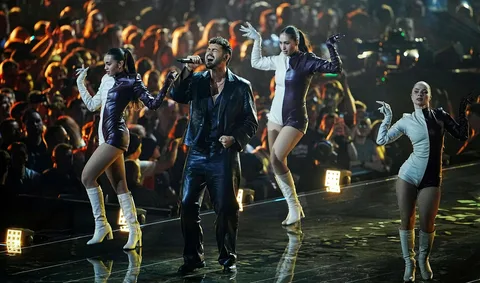

The Eurovision Song Contest 2026 has become one of the most politically charged editions in the competition’s 70-year history. Spain, Slovenia, Iceland, Ireland, and the Netherlands led a push to remove Israel from the contest, and when they were unsuccessful, quit in protest leaving just 35 nations in the competition and marking the largest boycott in Eurovision history. At the center of it all stands one young Israeli singer named Noam Bettan, performing his song “Michelle” in front of a divided world.
Background: What Is the Eurovision Song Contest?
The Eurovision Song Contest is the world’s longest-running international music competition, watched by hundreds of millions of viewers annually. The Eurovision Song Contest was created after World War II to give nations a chance to compete peacefully, and Israel is one of several countries from outside Europe to take part.
Israel has a rich Eurovision history dating back decades. Israel began participating in the Eurovision Song Contest in 1973 and won in 1978, 1979, 1998, and 2018. For Israeli audiences, the contest carries deep cultural pride and national significance. It has always been far more than a pop music show.
This year marks the 70th edition of the contest, held in Vienna, Austria. The contest’s slogan may be “united by music,” but the 2026 installment has been divided over Israel’s participation and its ongoing conduct in the war in Gaza. The tension has overshadowed the music in a way rarely seen before.
Who Is Noam Bettan? Israel’s Eurovision 2026 Singer
Noam Bettan is Israel’s representative at the Eurovision Song Contest 2026. His upbeat track “Michelle,” sung in French, English, and Hebrew, contains no political message but Israel’s very participation has sparked major political controversy.
Bettan, who was born to a family of French immigrants and grew up in Ra’anana, is a soft-spoken performer with a genuine passion for music. He has approached this competition with remarkable composure despite the pressure surrounding him. Few Eurovision contestants in history have carried such an enormous burden into the arena.
Bettan had to rehearse for five weeks amid missile attacks during the period of the Operation Roaring Lion war. Yet he remained focused and upbeat throughout the preparation process. He described his goal simply: to give people the feeling of freedom through music.
Noam Bettan Qualifies for the Eurovision Final Despite Chanting
The Eurovision semifinal in Vienna became a dramatic and historic moment. Noam Bettan performed “Michelle” over the sounds of “Stop the genocide” chanting in the Wiener Stadthalle, which could be heard on the live broadcast at the start of the song.
Austrian public broadcaster ORF had made the decision not to use anti-booing technology during the show. Despite the disruption, Bettan celebrated qualifying for the grand final after his semifinal performance garnered enough points to advance, with four activists removed from the event hall by security for continuing to disturb the audience.
Bettan later said that boos were quickly drowned out by support and that he felt he was simply “just singing to Israel.” His composure under extraordinary pressure won widespread admiration, even from those who disagree with his country’s politics.
The Eurovision Boycott 2026 Why Five Countries Walked Away
The Eurovision boycott of 2026 is unlike any the contest has seen before. Immediately after Israel’s participation was confirmed by the EBU in December last year, some countries, politicians, and musical artists began calling for a boycott of the contest.
Dutch broadcaster AVROTROS, representing the Netherlands, accused Israel of “proven interference” in last year’s contest while also citing its “serious violation of press freedom” during the Gaza war, saying that “under the current circumstances, participation cannot be reconciled with the public values that are fundamental to our organisation.”
Ireland said it would not take part either, with its broadcaster RTE citing “the appalling loss of lives in Gaza and humanitarian crisis” as the reason for its boycott. Spain’s Prime Minister Pedro Sanchez publicly argued that just as Russia was expelled from Eurovision after its invasion of Ukraine, Israel should also be removed.
This year’s boycott is happening at the same time as Palestinians mark Nakba Day, which commemorates when more than 700,000 Palestinians either fled or were forced to flee after the state of Israel was founded in 1948. The timing has added further symbolic weight to the political debate surrounding the contest.
The EBU’s Decision and Israel’s Warning
The European Broadcasting Union refused to hold a vote on ejecting Israel, despite the pressure from multiple member countries. The attempt to remove KAN from the contest was described by Israeli broadcaster officials as a cultural boycott and a harmful decision for freedom of creation and freedom of expression.
However, Israel was not without fault either in the eyes of Eurovision organizers. The EBU sent a direct warning to Israel over an ad campaign featuring Bettan in a number of languages calling for people to vote for him 10 times, saying it was “not in line with our rules nor the spirit of the competition.”
Israel’s public broadcaster quickly pulled the campaign from social media and maintained that it had not broken any rules of the competition. The incident highlighted how aggressively both sides of this debate are willing to push boundaries. Eurovision has never quite navigated a situation this politically layered.
Past Eurovision Winners and Israel’s Record
Israel’s relationship with the Eurovision Song Contest is long and decorated. The country has won the contest four times, and each victory has been celebrated passionately across the nation. Even in difficult years, Israeli audiences have rallied behind their representatives with enormous enthusiasm.
Last year’s Israeli Eurovision song was sung by a survivor of the Hamas attack and won second place in the competition, but broadcasters accused Israel of trying to manipulate the public vote, and Eurovision changed its voting rules for this year.
This year, in addition to the return of semifinal juries, votes have been capped at 10 per person instead of 20, and the EBU promised to crack down on disproportionate promotion campaigns. These reforms were a direct response to concerns raised about the 2025 contest and Israel’s televote performance. The new rules are designed to make the voting process fairer and more transparent.
Eurovision 2026 Odds Who Is the Favorite to Win?
With 35 countries competing in the Eurovision Song Contest final on May 16, bookmakers have given their verdict on who is most likely to win. The answer might surprise viewers focused only on the Israel controversy.
Finland are the 6/4 favorites with Ladbrokes to win Eurovision 2026 in Vienna, with Linda Lampenius and Pete Parkkonen’s “Liekinheitin” impressing in rehearsals at the Wiener Stadthalle ahead of the May 16 final. Greece sit second in the market at 7/2, with Denmark at 6/1. The United Kingdom are listed as outsiders at 150/1.
Finland is the clear leader on the Eurovision 2026 prediction markets, with their song combining classical music, pop, and rock a combination that has historically resonated with Eurovision audiences. The Finnish duo have generated enormous social media momentum leading into the final. If the betting markets are right, it could be Finland’s night on Saturday.
Global and Cultural Impact of the Eurovision Boycott
The 2026 Eurovision boycott is being watched closely far beyond the world of pop music. Governments, human rights organizations, and cultural institutions across Europe are all following the story closely. What makes the 2026 boycott different is the broader geopolitical context narratives around global conflicts are now being fought on the airwaves, on social media, and in public spaces.
The country’s future participation is bound to remain fiercely contested, particularly if Bettan wins and Israeli broadcaster KAN gets to host Eurovision next year. The possibility of Eurovision being held in Israel in 2027 is something that several European broadcasters have already signaled they could not support. The debate over Israel Eurovision participation is far from over.
Vienna police said they are preparing for protests and will deploy increased security around the event, as in the past two years large pro-Palestinian protests have taken place outside Eurovision venues. The city is bracing for significant demonstrations on Grand Final night. European public opinion on the matter remains deeply divided.
Conclusion What Happens After Eurovision 2026?
The Eurovision Song Contest 2026 will end on May 16 with a winner crowned in Vienna. But the political questions it has raised will outlast the final scoreboard. In the past, when geopolitics has clashed with music at Eurovision, it’s typically been the music that prevailed. Whether that holds true this year remains to be seen.
Noam Bettan has already done something remarkable: he has reached the Eurovision grand final despite extraordinary opposition, public protests, and geopolitical pressure that would have broken many performers. His song “Michelle” carries no political message. But the stage he is standing on carries the weight of history.
The Eurovision Song Contest was built on a dream of peace and unity across borders. In 2026, it is being forced to confront the limits of that dream and the answer it gives will shape the competition for years to come.
FAQs
Who did Gaza originally belong to?
The question of Gaza’s historical ownership is complex and deeply contested. Gaza has been inhabited for thousands of years and has been controlled by many civilizations, including the ancient Egyptians, Philistines, Romans, Byzantines, and Ottoman Turks. In the 20th century, Gaza was under British Mandate rule, then Egyptian administration after 1948, before being occupied by Israel in 1967. The Palestinian people have long claimed Gaza as part of their homeland. International law today regards Gaza as part of the occupied Palestinian territories. The political and historical dispute over sovereignty remains one of the central unresolved conflicts in the Middle East.
Who is the favorite to win Eurovision 2026?
Finland are the favorites to win Eurovision 2026 at 1/1 (even money). If they are successful, it would be the first victory for the Finns since heavy metal band Lordi triumphed with “Hard Rock Hallelujah” in 2007. Greece are next in the winner market, followed by Denmark. Beyond the top three, France and Australia are also considered outside contenders for the Eurovision 2026 crown. The Grand Final takes place on May 16 in Vienna, Austria.
Why is the Netherlands not in Eurovision 2026?
Dutch broadcaster AVROTROS announced a boycott of Eurovision 2026, accusing Israel of “proven interference” in last year’s contest and citing serious concerns about press freedom violations during the Gaza war. The Netherlands stated that participating alongside Israel could not be reconciled with the public values fundamental to their broadcasting organization. They joined Ireland, Spain, Slovenia, and Iceland in withdrawing from the Eurovision Song Contest, forming the largest coordinated boycott in the competition’s history.