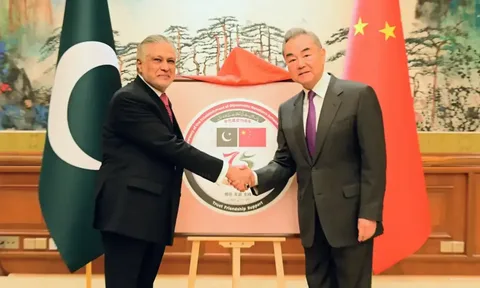
Hormuz transit talks have received China’s most direct and consequential diplomatic endorsement yet — with Beijing stating that US-Iran diplomatic engagement leading to the restoration of Strait of Hormuz commercial transit would serve global interests while simultaneously expressing explicit support for Pakistan’s emerging role as a potential additional mediator in a conflict whose energy security consequences China is experiencing more directly than any other major economy.
Hormuz transit talks Chinese backing reflects Beijing’s extraordinary exposure to the Strait of Hormuz closure — with approximately 40 to 50 percent of China’s total crude oil imports having historically transited the Strait making the QatarEnergy LNG force majeure declaration and the effective commercial shipping closure the most directly damaging single consequence of the Iran war 2026 for China’s energy security and economic stability.
Hormuz transit talks Pakistan mediator endorsement from China is the most diplomatically significant new development in the conflict’s resolution architecture — with Beijing’s backing for Islamabad’s potential mediating role giving Pakistan’s initiative the great power sponsorship that would significantly enhance its credibility with both Washington and Tehran as an additional diplomatic channel complementing the Qatar back-channel that has been the conflict’s primary mediation mechanism.
Background: China’s Strategic Interest in Hormuz
Why Hormuz Transit Talks Matter Most to China
Hormuz transit talks Chinese urgency is grounded in an energy security dependency that makes the Strait of Hormuz more strategically significant for Beijing than for any other major economy — with China having built its extraordinary industrial growth on the assumption of reliable Gulf oil access that the Iran war has now placed in fundamental jeopardy.
Hormuz transit talks Chinese economic exposure data is stark — China imports approximately 10 to 11 million barrels of crude oil per day making it the world’s largest oil importer by a significant margin. Of this total approximately 4 to 5 million barrels per day have historically arrived through the Strait of Hormuz — with Saudi Arabian Emirati Kuwaiti Iraqi and Iranian crude all transiting the waterway to reach Chinese refineries.
Hormuz transit talks Chinese economic consequence calculation shows that the Strait closure is costing China approximately $2 to $3 billion per week in additional energy costs through spot market premium purchases Cape rerouting additional costs and the economic activity disruption caused by supply uncertainty across China’s industrial supply chains.
Hormuz transit talks Chinese political calculation therefore places Hormuz transit restoration among Beijing’s most urgent foreign policy priorities — higher than its desire to maintain strategic ambiguity about the Iran conflict and potentially higher than its calculation that a prolonged US-Israeli military engagement serves Chinese strategic interests by consuming American military resources and political capital.
China’s Dual Position
Hormuz transit talks Chinese diplomatic positioning reflects the tension between 2 competing strategic interests — the desire to support Iran as an anti-US partner and the need to restore Hormuz transit that China’s energy security requires regardless of which party to the conflict is responsible for the disruption.
Hormuz transit talks China has resolved this tension by framing its Hormuz transit restoration advocacy as serving all parties’ interests — positioning Hormuz freedom as a global commons concern rather than a concession to US-Israeli demands — while simultaneously providing Iran with the intelligence support and diplomatic cover that Russia China help Iran battlefield analysis has documented.
Hormuz Transit Talks — China’s Position
What Beijing Is Saying
Hormuz transit talks Chinese foreign ministry statement delivered by spokesperson Lin Jian represents Beijing’s most explicit public statement on the conflict’s resolution pathway since hostilities began — with the statement endorsing US-Iran talks specifically as the mechanism for Hormuz transit restoration while maintaining China’s stated opposition to the US-Israeli strikes that caused the crisis.
Hormuz transit talks Chinese statement structure reflects careful diplomatic calibration — with Beijing simultaneously calling for Hormuz freedom restoration through US-Iran dialogue acknowledging Iran’s right to respond to the strikes that violated its sovereignty endorsing Pakistan’s mediation role and positioning China as a constructive international actor rather than a partisan of either side despite the intelligence support to Iran that Western intelligence agencies have documented.
Hormuz transit talks Chinese US-Iran talks endorsement is the most practically significant element of the statement — with Beijing’s backing for direct Washington-Tehran dialogue providing diplomatic cover for both parties to engage in the direct communication that the Qatar back-channel has been facilitating indirectly but that no direct US-Iran talks format has yet been established.
Hormuz transit talks Chinese Pakistan mediator endorsement adds a second diplomatic track to the resolution architecture — with Beijing’s support for Islamabad potentially opening a channel that complements Qatar’s existing mediation role and that may have specific advantages given Pakistan’s relationships with both the US military establishment and Iran’s political leadership.
Pakistan as Mediator — Beijing’s Endorsement
Why China Backs Pakistan for Hormuz Transit Talks
Hormuz transit talks Pakistan mediator Chinese endorsement reflects Beijing’s assessment of Pakistan’s specific qualifications for a mediating role in the Iran conflict — with Islamabad possessing several characteristics that make it potentially effective in ways that complement rather than duplicate Qatar’s existing mediation function.
Hormuz transit talks Pakistan Iran relationship is the most important qualification — with Pakistan and Iran sharing an approximately 900 kilometre border a significant Shia Muslim population in Pakistan a history of pragmatic bilateral engagement and the specific credibility with Iranian decision-makers that comes from Pakistan’s longstanding policy of maintaining functional relations with Tehran despite US pressure.
Hormuz transit talks Pakistan US relationship provides the complementary qualification — with Pakistan’s status as a US security partner its hosting of the Quad-adjacent dialogues and its extensive US military cooperation history giving Islamabad credibility with Washington that purely anti-American actors cannot possess.
Hormuz transit talks Pakistan nuclear state status may also be relevant — with Iran’s nuclear ambitions having been one of the conflict’s primary causes and Pakistan as an acknowledged nuclear state potentially having specific credibility in conversations about nuclear programme status and verification that non-nuclear mediators lack.
Hormuz transit talks Pakistan China relationship creates the structural condition for Beijing’s endorsement — with Pakistan’s status as China’s most strategically important bilateral partner giving Beijing the confidence that Islamabad’s mediation would be conducted in ways consistent with Chinese strategic interests including Hormuz freedom restoration.
Pakistan’s Emerging Mediation Role
Hormuz transit talks Pakistan mediation emergence reflects a significant evolution in Islamabad’s foreign policy positioning during the Iran war — with Pakistan having initially maintained strict neutrality while managing its own Pakistan-Afghanistan border crisis and now being drawn into the diplomatic architecture of the conflict’s resolution by the combination of Chinese encouragement and the specific value of Pakistan’s relationship network.
Hormuz transit talks Pakistan prime minister’s office has not made a formal public announcement of a mediation initiative — maintaining the deliberate ambiguity that effective mediation typically requires in its early stages when publicity can undermine the back-channel work that produces results. China’s public endorsement of the Pakistan mediator role represents a departure from this quiet diplomacy approach that may reflect Beijing’s assessment that public pressure for Hormuz transit talks needs to be increased.
Hormuzan — The Strait’s Geographic Context
Understanding Hormuzan
Hormuzan is the ancient name for the region surrounding the Strait of Hormuz — derived from the name of the island of Hormuz that sits in the strait’s approaches and that gave the waterway its modern name. Understanding the Hormuzan geographic context helps explain why Hormuz transit talks involve such extraordinary complexity and why Hormuz freedom is so difficult to guarantee through purely diplomatic means.
Hormuzan region encompasses the northern shore controlled by Iran — whose Bandar Abbas port Qeshm Island and extensive IRGC naval facilities give Tehran the geographic advantage in any Strait of Hormuz confrontation. The southern shore is controlled by Oman — specifically the Musandam Peninsula the exclave of Omani territory whose rocky mountains rise dramatically from the strait’s southern edge and whose geographic position makes Oman the other sovereign state whose cooperation is essential for any Hormuz transit talks framework.
Hormuzan geographic reality makes Hormuz freedom inherently dependent on Iranian acquiescence — because the Strait’s northern shipping lanes run through Iranian territorial waters and the IRGC’s ability to deploy drone boats sea mines and naval patrol assets from its extensive Hormuz base infrastructure gives Iran the practical ability to threaten transit regardless of the international legal framework that prohibits such interference.
Hormuzan Omani dimension is the frequently underappreciated element of Hormuz transit talks — with Oman having maintained functional relations with Iran throughout the conflict and serving as an additional diplomatic back-channel whose Hormuz geographic position gives it both standing and leverage in any Hormuz freedom negotiation.
Hormuz TSS — The Traffic Separation Scheme
What Is the Hormuz TSS
Hormuz TSS — Traffic Separation Scheme — is the internationally recognised maritime traffic management system that governs commercial vessel navigation through the Strait of Hormuz — establishing the specific routing lanes speeds and procedural requirements that vessels transiting the waterway must follow under the international maritime law framework administered by the International Maritime Organization.
Hormuz TSS establishes 2 designated shipping lanes — an inbound lane and an outbound lane — each approximately 3 kilometres wide running through the Strait’s narrowest navigable section. Between these lanes sits a separation zone that vessels must not cross — creating the structured traffic flow that allows the approximately 20 million barrels of oil equivalent passing through the Strait each day to do so with minimal vessel conflict.
Hormuz TSS international legal basis derives from the United Nations Convention on the Law of the Sea — UNCLOS — which establishes the right of transit passage through international straits and the specific obligations that strait states including Iran and Oman have to facilitate rather than impede that transit passage.
Hormuz TSS current status under the Iran war is effectively suspended — with commercial shipping companies having abandoned Hormuz TSS routing due to the combination of Iranian drone boats sea mines and military threat that makes operating within the designated lanes an unacceptable safety and insurance risk regardless of the transit passage rights that UNCLOS guarantees.
Hormuz transit talks restoration framework would need to address how the Hormuz TSS is reactivated following the conflict — including the mine-clearing operations that must precede safe resumption of TSS-compliant navigation and the confidence-building measures that would persuade shipping companies and their insurers that TSS route safety has been genuinely restored.
Hormuz Freedom — The International Legal Principle
The Right of Transit Passage
Hormuz freedom is the international legal principle guaranteed by UNCLOS Article 38 — which establishes that all ships and aircraft enjoy the right of transit passage through straits used for international navigation and that states bordering such straits including Iran must not impede the exercise of the right of transit passage.
Hormuz freedom legal basis is therefore not contested at the level of international law — with the right of transit passage being one of the most clearly established principles in UNCLOS and with Iran having been a party to UNCLOS discussions even though its formal ratification status is disputed. Every major maritime nation including China the United States all EU member states and the vast majority of UN member states recognises Hormuz freedom as a fundamental principle of international maritime law.
Hormuz freedom practical enforcement is the challenge that no international legal framework has been able to resolve — because the practical ability to threaten Hormuz transit through drone boats sea mines and military harassment gives Iran a de facto veto over Hormuz freedom that international legal rights cannot overcome without the physical security conditions that allow commercial shipping companies to transit with confidence.
Hormuz freedom restoration through Hormuz transit talks therefore requires not just legal reaffirmation of rights that are already legally clear but the physical security arrangements — mine-clearing confidence-building measures and IRGC naval restraint guarantees — that translate legal rights into practical navigational safety.
Hormuz freedom Chinese advocacy reflects Beijing’s self-interest in transit restoration alongside its stated commitment to international law — with China having been a consistent advocate for UNCLOS and for freedom of navigation principles in the South China Sea context and now applying those principles consistently to the Hormuz transit talks advocacy.
US-Iran Talks — What Beijing Is Calling For
The Chinese Proposal
Hormuz transit talks Chinese US-Iran talks endorsement calls for direct diplomatic engagement between Washington and Tehran — moving beyond the Qatar back-channel’s indirect communication framework to the kind of direct US-Iran dialogue that has not occurred since the JCPOA negotiations and that both sides have so far avoided in the current conflict.
Hormuz transit talks US-Iran direct talks Chinese proposal reflects Beijing’s assessment that the Qatar back-channel’s indirect communication framework is insufficient for the kind of complex multi-issue negotiation that Hormuz transit restoration and conflict resolution requires — with direct talks allowing the kind of precise diplomatic exchange that intermediary communication inevitably distorts.
Hormuz transit talks US-Iran talks format Chinese suggestion does not specify whether such talks should be bilateral or multilateral — leaving open the possibility of a P5+1-style multilateral format that would include China Russia and European states as parties to the diplomatic framework rather than purely as observers to a bilateral process.
Hormuz transit talks US-Iran talks preconditions question is the most practically significant diplomatic obstacle — with Iran requiring security guarantees before engaging in direct talks that would appear to legitimise the US military action that Tehran describes as illegal aggression and with the US being unwilling to agree to preconditions that constrain its military options before talks have even begun.
Hormuz transit talks sequencing question — whether Hormuz freedom must be restored as a precondition for talks or through talks — is one of the key diplomatic issues that China’s backing for Pakistan’s mediation is designed to help resolve through the creative ambiguity that a new mediator with different relationships can introduce into a diplomatic process that Qatar’s existing framework has not yet unblocked.
Quotes on Hormuz Transit Talks
Chinese Foreign Ministry spokesperson Lin Jian stated that China supported the resumption of US-Iran diplomatic dialogue as the most effective pathway to restoring Hormuz transit — adding that Hormuz freedom was a matter of global economic security that affected every nation dependent on Gulf energy and that China supported Pakistan’s potential role as a mediator given Islamabad’s unique relationships with all parties to the conflict.
Pakistani Foreign Minister Ishaq Dar confirmed that Pakistan had been in contact with multiple parties to the Iran conflict about a potential mediation role — declining to confirm specific details while acknowledging China’s expressed support for Pakistan’s initiative and stating that Islamabad would pursue any diplomatic pathway that could contribute to Hormuz transit talks and conflict resolution.
US State Department spokesperson confirmed that the administration had received China’s Hormuz transit talks statement and Pakistan mediator endorsement — adding that the US remained open to any diplomatic framework that produced genuine Iranian compliance with international law including Hormuz freedom restoration but that direct US-Iran talks would require Iranian reciprocal commitments that had not yet been offered.
Iranian Foreign Minister Abbas Araghchi responded to Hormuz transit talks Chinese statement — welcoming Beijing’s continued diplomatic engagement while reiterating that Hormuz freedom restoration was contingent on the cessation of US-Israeli strikes that had caused the crisis in the first place and that Iran would not participate in any negotiating framework that treated Hormuz closure as a problem separate from the military aggression it was responding to.
Qatar’s Prime Minister Sheikh Mohammed bin Abdulrahman Al Thani stated that Qatar welcomed China’s support for Hormuz transit talks and Pakistan’s potential mediation role — adding that the more diplomatic channels available to facilitate resolution the greater the probability of success and that Qatar would coordinate with Pakistan to ensure complementary rather than competing mediation efforts.
International Maritime Organization Secretary-General Arsenio Dominguez stated that the IMO stood ready to support any Hormuz transit talks framework that included technical working groups on Hormuz TSS restoration mine-clearing coordination and shipping safety certification — adding that the IMO’s technical expertise in maritime traffic management made it the natural institutional partner for the practical implementation of any Hormuz freedom restoration agreement.
Impact: Hormuz Transit Talks Consequences
For Diplomatic Resolution Architecture
Hormuz transit talks China-Pakistan dimension adds a potentially significant new element to the conflict’s resolution architecture — with Beijing’s diplomatic weight behind Islamabad’s initiative giving the Pakistan mediator role a great power sponsorship that may open doors in both Washington and Tehran that Qatar’s mediation cannot access as effectively.
Hormuz transit talks multilateral mediation architecture — Qatar’s existing back-channel complemented by Pakistan’s emerging initiative supported by China with Oman’s geographic back-channel in the background and the Guterres UN framework providing institutional legitimacy — represents the most comprehensive diplomatic resolution infrastructure that the conflict has yet developed.
Hormuz transit talks convergence of multiple diplomatic tracks around the shared objective of Hormuz freedom restoration creates the possibility of mutually reinforcing pressure on both parties that single-track mediation cannot generate — with each track addressing different aspects of the parties’ concerns and different dimensions of the diplomatic package that a settlement requires.
For Global Energy Markets
Hormuz transit talks Chinese endorsement has provided the most positive energy market signal since the conflict began — with Brent crude falling and European LNG futures easing modestly as markets priced in the increased probability of Hormuz freedom restoration through the multilateral diplomatic architecture that China’s statement has strengthened.
Hormuz transit talks QatarEnergy LNG force majeure reversal would be the most immediately impactful energy market consequence of successful Hormuz transit restoration — with QatarEnergy having stated it would immediately resume contract deliveries once Hormuz TSS safety conditions were restored and shipping insurance markets returned to commercially viable premium levels.
Hormuz transit talks restoration timeline market assessment suggests that even a credible ceasefire framework announcement — without waiting for actual Hormuz TSS mine-clearing completion — would produce significant energy price normalisation as futures markets priced in the probability rather than waiting for the certainty of physical Hormuz freedom restoration.
For China-US Relations
Hormuz transit talks Chinese diplomatic activism represents a significant evolution in Beijing’s Iran conflict posture — from the studied neutrality of the conflict’s early weeks through the documented intelligence support to Iran to the now explicit diplomatic advocacy for conflict resolution that serves Chinese energy security interests regardless of its geopolitical framing.
Hormuz transit talks Chinese US-Iran talks endorsement provides Washington with an opportunity to engage constructively with Beijing’s diplomatic initiative — potentially creating a framework for US-China cooperation on Iran conflict resolution that could partially restore the working relationship that the broader US-China strategic competition has damaged.
Frequently Asked Questions
Can Iran Legally Close the Strait of Hormuz?
No — Iran cannot legally close the Strait of Hormuz under international law. UNCLOS Article 38 guarantees the right of transit passage through international straits used for international navigation — a right that applies to all nations and cannot be unilaterally revoked by a strait state regardless of the political or military circumstances. Iran has never formally declared a legal closure of the Strait — instead using drone boats sea mines and military threats to create de facto conditions making commercial Hormuz transit commercially uninsurable and operationally dangerous without making a formal closure declaration that would be an unambiguous violation of UNCLOS and an act of war against every nation dependent on the waterway. Hormuz transit talks therefore address not the legal right to close the Strait — which Iran does not have — but the practical ability to threaten transit through military means that Iran very much possesses and that the Hormuz TSS framework cannot protect against without the physical security conditions that only Iranian restraint or military defeat of Iran’s threat capabilities can provide.
Who Legally Owns the Strait of Hormuz?
No single nation legally owns the Strait of Hormuz — with sovereignty over the waterway being shared between Iran which controls the northern shore and Oman which controls the southern shore through its Musandam Peninsula exclave. The Strait’s shipping lanes run through the territorial waters of both nations — with the inbound lane running through Omani territorial waters and the outbound lane running through Iranian territorial waters under the Hormuz TSS routing scheme. Under UNCLOS both Iran and Oman have sovereignty over their respective territorial waters within the Strait but are obligated to permit transit passage under the international strait provisions that override normal territorial sea sovereignty for internationally navigated waterways. Hormuz freedom therefore depends on both nations’ compliance with their UNCLOS transit passage facilitation obligations — with Oman having been a consistent supporter of Hormuz freedom throughout the current conflict while Iran’s practical interference with Hormuz transit has been the crisis that Hormuz transit talks are attempting to resolve.
Can the Strait of Hormuz Be Bypassed?
The Strait of Hormuz can be partially bypassed through alternative pipeline infrastructure but cannot be fully replaced as an export route for the Gulf region’s oil and gas production. Saudi Arabia’s East-West Pipeline — the Petroline — runs from the Eastern Province oil fields to the Red Sea port of Yanbu providing a bypass capacity of approximately 5 million barrels per day — significant but covering only a fraction of the approximately 19 to 21 million barrels per day that normally transit the Strait. The UAE’s Abu Dhabi Crude Oil Pipeline — ADCOP — provides an additional bypass capacity of approximately 1.5 million barrels per day to the port of Fujairah on the Gulf of Oman outside the Strait. Total available bypass pipeline capacity of approximately 6 to 7 million barrels per day against normal Strait transit volumes of 19 to 21 million barrels per day leaves a bypass deficit of approximately 13 to 15 million barrels per day that cannot be rerouted regardless of how quickly alternative pipeline infrastructure is utilised. LNG exports from Qatar cannot currently be bypassed at all — with Qatar having no pipeline export routes and its LNG tankers being entirely dependent on Strait of Hormuz transit to reach global markets. This is why QatarEnergy LNG force majeure and Hormuz transit talks are so directly connected — Qatar’s entire LNG export capability depends on Hormuz freedom restoration.
Conclusion
Hormuz transit talks have reached their most diplomatically consequential moment — with China’s explicit endorsement of US-Iran dialogue and Pakistan’s mediating role adding a new and potentially decisive element to the multilateral resolution architecture that has been developing around the conflict’s most economically damaging consequence.
Hormuz freedom restoration is the single development that would most rapidly and most comprehensively reduce the Iran war’s global economic damage — with Brent crude QatarEnergy LNG force majeure and the global inflation trajectory all responding to Hormuz TSS restoration more dramatically than to any other single diplomatic development.
Hormuzan geography makes Hormuz freedom ultimately dependent on Iranian political decision rather than military capability — with Iran retaining the physical ability to threaten transit even after 25 days of the most intensive US-Israeli strike campaign in modern military history. This reality is both the case for Hormuz transit talks and the strongest argument that those talks need the creative diplomatic architecture that China’s Pakistan mediator endorsement is helping to build.
The Strait is 33 kilometres wide. The diplomatic distance between where the parties are and where Hormuz freedom restoration requires them to be is wider still. But the direction of travel — with China adding its weight to the multilateral mediation architecture — is for the first time pointing toward closure rather than expansion of that gap.