

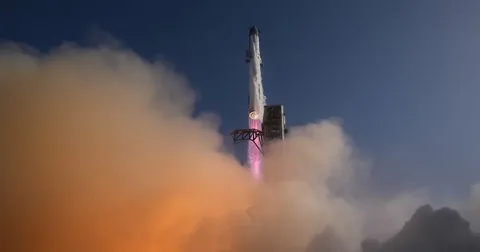

A piece of a SpaceX rocket is believed to have crashed into the Moon after drifting through space for more than a year. The object was identified as the second stage of a Falcon 9 rocket used during a lunar mission in January 2025.
The rocket stage was expected to strike the Moon at extremely high speed near Einstein Crater. Because the predicted impact area is difficult to observe from Earth, scientists said confirmation could take several hours or require later analysis of telescope images.
Background: How a Falcon 9 Rocket Reached a Lunar Collision Course
The incident is unusual because the rocket stage was not originally sent toward the Moon as a weapon or intentionally directed into the lunar surface.The Falcon 9 rocket was used in January 2025 to launch Firefly Aerospace’s lunar lander. After completing its role in the mission, the second stage remained in space instead of returning to Earth.
Usually, rocket stages from missions to lower Earth orbits eventually re-enter the atmosphere and burn up. However, missions involving the Moon can leave hardware on very different trajectories.In this case, the rocket stage was left without enough fuel to control its future path. Over time, gravitational forces and changes in solar activity affected its trajectory and placed it on a course that was expected to intersect with the Moon.
What Happened to the SpaceX Falcon 9 Stage?
The object involved was the second stage of a SpaceX Falcon 9 rather than the reusable first-stage booster that is normally associated with Falcon 9 landings.The second stage is responsible for carrying a payload after the first stage separates. It continues firing its engine to place the spacecraft or satellites into their required orbit.
For the January 2025 lunar mission, the stage had to operate under different conditions from a typical satellite launch. Once its work was completed, it continued moving through space without the ability to make major trajectory corrections.According to reports, the abandoned stage weighed around four metric tons and was roughly the size of a school bus. It was traveling at an estimated 8,690 kilometers per hour, or about 5,400 miles per hour, when it was expected to reach the Moon.
Why Did the Falcon 9 Crash Moon Story Become Important?
The Falcon 9 crash moon story has attracted attention because accidental impacts involving large pieces of human-made hardware on the Moon remain relatively uncommon.The Moon has no thick atmosphere capable of burning up incoming objects in the same way Earth’s atmosphere can destroy many smaller pieces of space debris.
That means a large rocket stage approaching the lunar surface can remain intact for much longer before striking the ground.The expected impact was also not considered a danger to people on Earth. Scientists said the event was unlikely to create any direct threat to human populations, satellites around Earth or ordinary space activity.
Where Was the Rocket Expected to Hit?
Scientists predicted that the rocket stage would hit near Einstein Crater, located toward the western limb of the Moon.The location made the event particularly difficult to observe directly from Earth. Spacecraft orbiting the Moon were also not expected to be positioned to capture the impact live.
Instead, researchers may need to examine later images from telescopes and lunar spacecraft to determine whether the impact happened exactly where predicted.A confirmed impact could potentially help researchers study how large objects interact with the lunar surface and what kind of dust plume such a collision produces.
Falcon 9 Rocket Model and How It Works
The Falcon 9 rocket model is a two-stage orbital launch vehicle developed and operated by SpaceX.Its first stage contains nine Merlin engines and is designed to provide the majority of the thrust required to leave Earth’s atmosphere. After separation, the first stage can return and land for reuse.
The second stage uses a Merlin Vacuum engine and continues the mission after separation. It places satellites, spacecraft or other payloads into their intended orbit.SpaceX has repeatedly demonstrated the reusable nature of the Falcon 9 first stage. Recent SpaceX missions show Falcon 9 boosters launching payloads and returning to droneships or landing zones after stage separation.
Falcon 9 Rocket Launch and Reusability
A typical Falcon 9 rocket launch begins with the nine Merlin engines of the first stage generating enough thrust to lift the vehicle away from Earth.
After a few minutes, the first stage separates from the second stage. On missions designed for recovery, the first stage performs controlled maneuvers and eventually lands.The second stage then continues the journey with its Merlin Vacuum engine.SpaceX’s current Falcon 9 missions continue to demonstrate this approach. For example, the company’s June 2026 missions included Falcon 9 launches carrying payloads to orbit while recovering the first-stage boosters.
Falcon 9 Launch Today: Why People Search for It
Searches for Falcon 9 launch today often increase whenever SpaceX has a scheduled mission, particularly because Falcon 9 launches have become a regular part of the global spaceflight calendar.Unlike the rocket stage involved in the lunar incident, most modern Falcon 9 missions are carefully planned around specific orbital destinations.SpaceX publishes mission information that includes launch times, launch locations, stage separation and landing details. Recent Falcon 9 missions have launched from both Florida and California.
Falcon 9 Rocket Launch Date and Mission History
The Falcon 9 rocket launch date connected to this incident goes back to January 2025, when the rocket launched Firefly Aerospace’s lunar lander.That mission was different from the many Falcon 9 flights that place satellites into low Earth orbit.The lunar destination required the rocket’s second stage to follow a trajectory that ultimately left it in space rather than allowing it to naturally return to Earth.This difference helps explain why a piece of a familiar launch vehicle could remain in space for more than a year and later become a potential lunar impactor.
Falcon 9 Rocket Speed Explained
The Falcon 9 rocket speed changes throughout a mission because the vehicle accelerates as it climbs and burns fuel.During the reported lunar impact, however, the important figure was the speed of the abandoned second stage as it approached the Moon.The rocket stage was estimated to be traveling at approximately 8,690 kilometers per hour. At that velocity, an impact with the lunar surface would generate a significant amount of energy and could throw lunar dust and surface material into the surrounding area.
Falcon 9 Rocket Engine Technology
The Falcon 9 rocket engine system is built around SpaceX’s Merlin engine family.The first stage uses nine Merlin engines, while the second stage uses a single Merlin Vacuum engine optimized for operation in space.The engines are a key part of Falcon 9’s ability to perform controlled launches and, for the first stage, repeated landings.SpaceX’s official mission information shows that the second-stage engine starts after the first and second stages separate, allowing the vehicle to continue delivering its payload to orbit.
What Experts and SpaceX Said
SpaceX director Julianna Scheiman explained that a combination of solar activity and gravitational forces had placed the rocket stage on a path toward the Moon.
Astronomer Bill Gray, who tracks objects in space and developed widely used astronomical software, said the event could have some scientific value because researchers might learn more from the impact.At the same time, Gray noted concerns about how leftover space hardware is managed after missions.SpaceX has also indicated that it and NASA are discussing ways to reduce the possibility of similar lunar impacts in future missions.
How Rare Are Rocket Impacts on the Moon?
Human-made objects have reached the lunar surface before, both intentionally and accidentally.In 2022, a Chinese rocket stage crashed into the Moon after completing a lunar-related mission. NASA has also deliberately crashed spacecraft and rocket stages into the lunar surface to study the resulting impacts.
During the Apollo era, NASA intentionally directed Saturn V stages toward the Moon so scientists could study seismic effects and the behavior of lunar material.The difference in this case is that the Falcon 9 stage was not deliberately targeted at the Moon. Its trajectory developed through a combination of its original mission path and later gravitational effects.
Impact on Future Space Missions
The incident could increase attention on the management of space hardware after missions, especially as lunar exploration becomes more frequent.NASA’s Artemis program is expected to support more human and robotic activity around the Moon in the coming years.As more spacecraft travel to lunar orbit and the lunar surface, avoiding uncontrolled objects could become increasingly important.NASA and SpaceX are therefore examining ways to reduce the likelihood of future pieces of space hardware ending up on unintended lunar trajectories.
What This Means for Space Junk
Space junk is already a major concern around Earth, where thousands of objects and fragments travel at extremely high speeds.The lunar environment is different, but the basic problem of abandoned hardware remains relevant.An uncontrolled rocket stage may not threaten people directly, but it can complicate future exploration if spacecraft or astronauts need to operate in the same region.The Falcon 9 incident demonstrates that the consequences of a launch can continue long after the original mission has ended.
Conclusion
The Falcon 9 crash moon incident highlights an unexpected side of modern space exploration. A rocket stage launched more than a year earlier for a lunar mission was left drifting through space before gravitational and solar influences placed it on a collision course with the Moon.The impact was expected near Einstein Crater, but immediate confirmation was difficult because the location was not easily visible from Earth. Scientists will likely rely on later observations and spacecraft data to establish the outcome.The event is unlikely to pose any danger to people on Earth, but it offers an important reminder about the growing amount of hardware humans are sending beyond our planet.As lunar exploration expands, responsible planning for rocket stages and other space debris could become an increasingly important part of future missions.
FAQs
What are Falcon 9 rockets used for?
Falcon 9 rockets are primarily used to launch satellites, spacecraft, cargo and other payloads into orbit. SpaceX has also used Falcon 9 for crew and cargo missions associated with the International Space Station, as well as commercial and scientific missions.The rocket’s reusable first stage allows SpaceX to recover and fly boosters multiple times, helping reduce the cost and turnaround time associated with orbital launches. Recent SpaceX missions continue to use Falcon 9 for satellite deployments and other payloads.
What was so special about Falcon 9?
One of the most important features of Falcon 9 is its reusable first stage. Instead of allowing the entire booster to be discarded after launch, SpaceX can guide the first stage back to a landing zone or droneship.This approach has changed the economics and frequency of orbital launches. The Falcon 9 design also separates the first and second stages, allowing the second stage to continue accelerating the payload after the main booster has completed its part of the mission.The rocket involved in the Moon incident is especially notable because it was the second stage that remained in space, rather than one of Falcon 9’s routinely recovered first-stage boosters.
Has the Falcon 9 hit the Moon yet?
Reports indicate that the Falcon 9 second stage was believed to have impacted the Moon after traveling toward the lunar surface. However, immediate visual confirmation was difficult because the predicted impact location was near the Moon’s western limb and was not expected to be visible directly from Earth.Scientists planned to examine telescope observations and other available data to confirm the impact and determine whether a new lunar crater or dust plume could be identified.Therefore, it is more accurate to describe the event as a believed or expected Falcon 9 lunar impact until observations provide definitive confirmation.