US Grounds All Flights for Hours as Officials Blame Aging Air Traffic Systems
The November 13 nationwide ground stop has revived a hard debate over funding, old equipment and who is responsible.
Staff Report | Pakistan Chronicle, South Asian Chronicle and Desi TV USA | November 14, 2026
By Kainat Rajput and Tariq Nehal khan
WASHINGTON: The Federal Aviation Administration (FAA) stopped departures at every U.S. airport on Friday after a communications failure hit its air traffic control network. It was the biggest ground stop since the 2023 outage of the NOTAM alert system, and it stranded thousands of passengers just before the Thanksgiving travel season.
What Happened on Friday
Radar and communications data became unstable on Friday afternoon, with more than 3,500 aircraft in the sky. Pilots and controllers followed emergency procedures, and officials say every airborne plane landed safely. The airspace reopened shortly after 8 p.m. Eastern. FlightAware counted nearly 5,000 cancellations on Friday and almost 800 more for Saturday.
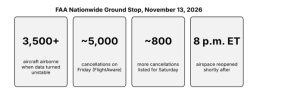
Figure 1: Key numbers from the November 13 ground stop. Sources: FAA briefings and FlightAware figures reported by ABC News. Graphic created for this article.
What Officials Said
Transportation Secretary Sean Duffy told reporters at the White House that old switches and routers became overloaded with data and began sending inconsistent information. He described a network built on 1980s-era copper wiring and pointed to control towers that are close to a century old. “We didn’t think we would have this kind of outage,” he admitted.
Homeland Security Secretary Markwayne Mullin said investigators had found no sign of a cyberattack or foreign threat, though he later conceded that nothing was completely certain yet. He suggested newer technology may have overwhelmed the older system. Duffy countered that none of the new equipment went down. The two accounts do not fully match, and the FAA’s root-cause review is still open.
The Money: What Congress Approved and What Is Missing
The claim that Congress gave nothing is not accurate. In July 2025, lawmakers approved $12.5 billion as a down payment on the Brand New Air Traffic Control System, known as BNATCS, which is due to be finished by the end of 2028. The plan calls for 5,170 new network connections, 27,625 radios, 462 digital voice switches and 612 radars. In their latest letter, Duffy and White House budget director Russell Vought said 68 percent of the old copper network has already been replaced with fiber.
Most of that first payment goes to the plumbing. About $4.75 billion is set aside for telecommunications, $3 billion for radar replacement and $1.9 billion for a new air route traffic control center, the first new one since the 1960s. Work of this kind is slow and mostly invisible to passengers, which is partly why the public notices it only when something breaks.
The FAA has said from the start that the down payment would not be enough. Senator Eric Schmitt introduced the Modern Skies Act on September 28 to add $30 billion: about $10 billion for digital architecture, $10 billion for towers and facilities, and $10 billion for airports. Duffy and Vought renewed that request this week. Duffy has said President Trump backs it, and American, Delta, United and Southwest have voiced support. After the outage, Duffy went further and said he wants $50 billion. Republicans control both chambers until January, when Democrats take over the House, so the lame-duck session is the administration’s window.
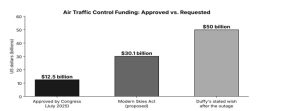
Figure 2: Funding approved versus funding requested. The $50 billion figure is Secretary Duffy’s stated target, not a bill before Congress. Sources: DOT, FAA and press reports. Graphic created for this article.
Why an Executive Order Cannot Fix This Quickly
Many readers ask why President Trump has not simply signed an executive order for the more than 44,000 flights handled each day. The short answer is that the Constitution gives Congress the power of the purse. A president cannot create tens of billions of dollars by order, and an emergency declaration can only redirect money Congress has already appropriated, usually with legal challenges attached. Even with unlimited cash, new radars, voice switches and fiber lines must be installed while live traffic keeps flying, which takes years.
Accountability and the Road Ahead
The FAA says the BNATCS contract was built to reward results and hold the prime integrator responsible for missed deadlines and performance problems. The Transportation Department chose Peraton for that role. Former Transportation Secretary Pete Buttigieg said he is rooting for a quick fix, but asked why the system’s backups did not prevent an outage of this size.
For readers in Pakistan and across the diaspora, the episode raises an obvious question: how does the world’s largest economy still run critical safety systems on decades-old equipment? The answer has less to do with wealth than with budgets and timing. Modernization needs years of steady funding, and Washington has paid for it in installments. Officials warn that until the next installment passes, aging equipment could fail again.
Sources: ABC News live coverage; Advocate.com White House briefing report; NPR member stations; FAA BNATCS fact sheet (Dec. 2025); Executive Gov and Washington Examiner on the Modern Skies Act; Reuters via Devdiscourse on the Nov. 13 funding letter; Travel Weekly on Peraton.