

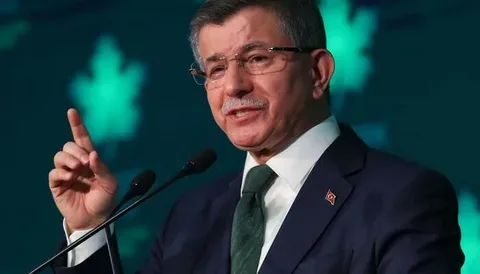

Turkey news today centers on former Prime Minister Ahmet Davutoglu, who announced Wednesday that he is withdrawing from party politics entirely and dissolving his opposition Future Party. The move ends the political career of a man once seen as the architect of modern Turkey’s foreign policy strategy.
Background
Davutoglu served as Turkey’s foreign minister from 2009 to 2014 before becoming prime minister under President Recep Tayyip Erdogan. He was widely credited during that period with shaping Turkey’s “soft power” approach to regional diplomacy, expanding the country’s influence across the Middle East and Balkans.
His relationship with Erdogan deteriorated after he was replaced as prime minister in 2016. Three years later, in 2019, Davutoglu formally broke with the ruling AK Party and launched the Future Party, positioning it as a conservative alternative built on reform and accountability.
The Future Party never achieved the breakthrough Davutoglu had hoped for. Founded in 2019, it only entered parliament in 2023 through an alliance with the main opposition Republican People’s Party, eventually securing just four seats, a modest result that fell well short of building an independent conservative bloc capable of challenging Erdogan’s AKP.
Details
In a written statement posted online, Davutoglu said he and senior party figures had decided to withdraw from party politics and end the Future Party’s activities entirely, describing the move as necessary to avoid becoming part of what he called a “polluted political climate.” He was careful to frame the decision as principled rather than defeatist.
Turkey news live today has centered on Davutoglu’s insistence that this was not a surrender. He wrote that the decision represented a moral line rather than an abandonment of politics, describing it instead as a call for the country to rethink its approach to political life altogether.
Davutoglu pointed to broader dysfunction in Turkey’s political system as the underlying reason for his exit, arguing the country’s politics had become trapped between an excessive concentration of power on one side and a fragmented, ineffective opposition on the other. He noted that Turkey’s electoral system had made political alliances almost unavoidable for smaller parties like his own.
His party had first attempted an alliance of three conservative parties back in 2021, an effort that ultimately failed. It later joined the CHP-led opposition bloc ahead of the 2023 elections, a strategy Davutoglu said was intended to prevent political revenge stemming from Turkey’s deep polarization and to encourage broader social reconciliation.
The dissolution leaves Turkey’s fragmented opposition landscape even thinner. The country currently has close to 190 registered political parties, though only a small handful hold genuine electoral influence or parliamentary representation, a reality that made the Future Party’s four seats notable even as the broader project fell short of its founder’s ambitions.
Quotes
Davutoglu wrote in his statement that the decision to withdraw from party politics was not one of surrender, but rather a decision to draw a moral line, adding that it was not an abandonment of politics but instead a call for everyone to rethink how politics is practiced in Turkey.
He also directly criticized the country’s institutions, saying Turkey’s political system had reached an impasse defined by polarization, fragmentation, and declining ethical standards, a critique he had leveled at both the ruling party and parts of the opposition in recent years.
Political analysts covering Turkey news headlines today noted that Davutoglu’s exit closes a chapter for one of the last major figures from the AKP’s founding generation to have broken publicly with Erdogan and attempted to build an independent political path.
Impact
Davutoglu’s departure is unlikely to reshape Turkey’s political landscape dramatically in the short term, given the Future Party’s limited parliamentary footprint. Still, his exit removes one of the more prominent critics of Erdogan from active politics, potentially narrowing the range of voices within Turkey’s conservative opposition.
The move also underscores ongoing struggles facing Turkey’s broader opposition movement, which continues to grapple with fragmentation even as newer political forces, including a recently launched New Party, attempt to build support and raise funds independently of state financial backing.
On the international front, Turkey’s foreign policy legacy that Davutoglu helped build, including efforts to mend ties with neighbors like Israel, Russia, and Egypt during his time in office, continues to shape how analysts assess Turkey’s regional posture today, even as day-to-day diplomacy has evolved considerably since his time leading the foreign ministry.
Conclusion
With Davutoglu now formally stepping away from active politics, attention turns to how Turkey’s remaining opposition parties adjust heading into future election cycles. His exit adds to a broader pattern of consolidation and fragmentation that continues to define Turkish politics, and analysts will be watching whether any of his former Future Party colleagues try to regroup under a new banner.
Frequently Asked Questions
What is the political situation of Turkey?
Turkey’s political landscape remains highly centralized around President Recep Tayyip Erdogan and the ruling AK Party, which has held power since 2002 and shifted the country to a presidential system following a 2017 referendum. The opposition remains fragmented across nearly 190 registered parties, with only a small number holding meaningful parliamentary representation, a dynamic underscored by Ahmet Davutoglu’s recent decision to dissolve his own Future Party. Political analysts frequently describe Turkey’s current climate as polarized, with tensions between the government and opposition figures, media restrictions, and periodic legal actions against opposition politicians continuing to shape domestic politics.
Is Turkey safe to go to right now?
Turkey remains a major global tourism destination, welcoming tens of millions of visitors annually to cities like Istanbul, Antalya, and Cappadocia, and most travel advisories from Western governments continue to rate the country as generally safe for standard tourism with normal precautions. That said, some governments advise increased caution near the Syrian border and in southeastern provinces due to ongoing regional security concerns, and travelers are generally encouraged to stay alert in crowded public spaces given past isolated incidents, including a 2026 shooting attack near the Israeli consulate in Istanbul. As with most international travel, checking official government travel advisories shortly before a trip is the most reliable way to get current, location-specific guidance.
What problems is Turkey facing?
Turkey continues to navigate a mix of economic and political challenges, including persistently high inflation, a weakened lira, and rising living costs that have squeezed household budgets in recent years. Politically, the country faces ongoing tension between the ruling AKP and a fragmented opposition, compounded by concerns from rights groups over press freedom, judicial independence, and the treatment of opposition politicians and civil society figures. Turkey also continues to manage complex regional relationships, including its role in Syria, its evolving ties with Israel, and its position within NATO, all of which intersect with its domestic political and economic pressures.