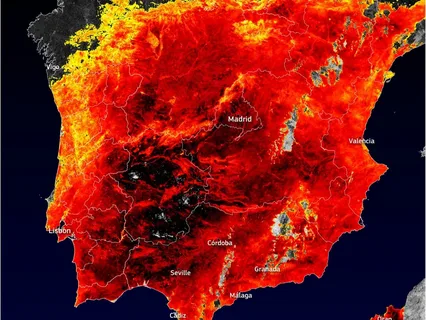
The strongest heat dome so far in 2026 is delivering mid-summer heat to millions of people well ahead of schedule across Western Europe. The United Kingdom, France, Spain, Portugal, Germany, and Italy are all reeling under what forecasters are calling a historic, record-shattering heatwave Europe 2026. Temperatures are running far above seasonal norms, and new May records are falling across the continent with more extremes still to come.
Background
Europe has been warming faster than any other continent on Earth. According to the EU’s Copernicus Climate Change Service, 2025 was the third-hottest year on record, both globally and in Europe, and the past three years 2024, 2023, and 2025 were the hottest ever recorded globally.
A 2025 study published in the Proceedings of the National Academy of Sciences found that atmospheric patterns that lock in extreme weather, such as heat domes, have nearly tripled since the 1950s due to human-driven climate change. A Super El Niño that officially began in 2026 is also shifting the planetary jet stream, raising the risk of more intense and prolonged heatwaves across Europe.
What Is a Heat Dome?
A heat dome is a high-pressure system that warms air as it compresses it toward the ground, trapping heat over a wide area. In the current Europe heat dome 2026, a massive plume of scorching air originating from northern Africa is locked in place over western Europe by a powerful high-pressure block. This system prevents cloud formation and vertical airflow, allowing temperatures to build day after day with no relief in sight.
Heat domes lead to temperatures consistently soaring well above what is normal, drying out the ground and increasing the chance of wildfires. The UK’s Met Office defines a heatwave as an extended period of hot weather relative to expected conditions for that area and time of year. A heat dome is what creates and sustains those heatwave conditions.
Countries Hit Hardest
Spain is among the worst affected countries. The State Meteorological Agency AEMET has warned that temperatures described as “extraordinarily high for this time of year” will continue across the country throughout the week, with peaks of between 36°C and 38°C forecast for the Guadiana and Guadalquivir regions from Wednesday to Friday.
In the United Kingdom, England, Wales and Northern Ireland recorded their highest temperatures of 2026 on Sunday, which was also the UK’s hottest May day for at least 79 years. Kew Gardens in west London recorded 32.3°C, Cardiff 27.4°C and Armagh 23.4°C.
France has already broken its May record of 30.5°C, as temperatures have peaked in the low 30s each day since Thursday, and higher is still to come. Temperatures more than 10 degrees above average are expected in places until the weekend, and parts of the southwest could reach 37°C to 38°C.
Italy recorded 31°C to 34°C on Sunday, and it was 30°C to 33°C in Germany, around the Alps, and in parts of the Balkans. The heatwave in Europe is affecting virtually every corner of the western half of the continent.
Expert Quotes
AEMET spokesperson Rubén del Campo described the situation in stark terms: “Full-on summer heat is the phrase that best describes the weather we will see across most of Spain over the coming days.”
Weather forecaster Ioanna Vergini of WFY24 told Euronews Earth that the European summer is not just getting hotter it is getting longer at both ends. “What we used to call a July phenomenon is now arriving in mid-May,” she warned. “Climate attribution studies estimate that June heatwaves in Europe are around 10 times more likely today than they were in pre-industrial conditions, and the same trajectory is becoming visible for May.”
Forecasters at Severe Weather Europe warned that temperatures are soaring 12 to 16 degrees above long-term climatological norms, calling this “the strongest heat dome so far in 2026.”
Impact: Health, Wildfires, and Infrastructure
The Europe heatwave 2026 is raising urgent public health concerns across the region. Extreme heat leads to dehydration, dizziness, and in more severe cases heat exhaustion can progress to heat stroke. High relative humidity during a heatwave can also significantly affect the body. Governments across the continent have issued public health advisories urging people to stay hydrated, avoid outdoor activity during peak midday hours, and seek cool or air-conditioned spaces.
Europe is already facing an increase in wildfires, and El Niño could make the situation worse. Droughts and higher temperatures create perfect conditions for wildfires to spread. In recent years, large wildfires have ravaged Greece, Spain, and parts of Italy, and this trend is expected to continue.
More than two thirds of the most severe heatwaves in Europe since 1950 have occurred since 2000. By 2050, about half of the European population may be exposed to high or very high risk of heat stress during summer, particularly in Southern Europe and increasingly in Eastern Europe and Western and Central Europe.
Europe Heatwave 2026 Forecast: What Comes Next?
The heatwave in western Europe will peak on Monday and Tuesday before the highest temperatures are confined to France, Spain and Portugal later in the week. However, these three countries are set for the most prolonged hot spell, with conditions remaining well above normal well into early June.
The air mass will be even hotter in the coming days for many countries as the heat dome aloft intensifies further. Because this pattern restricts vertical mixing and cloud cover, maximum and minimum temperatures alike will challenge historical monthly records across hundreds of stations in Western Europe.
For Europe, El Niño means higher summer temperatures, intense heatwaves, and unpredictable weather shifts. Europe is already warming faster than any other continent, and according to the European Environment Agency’s 2024 climate report, extreme heat once a rarity is now becoming a common occurrence.
Frequently Asked Questions
Will it be a hot summer in 2026?
Yes. The Europe heat dome 2026 is already shattering May records across multiple countries before summer has even officially begun. With a developing Super El Niño and long-term warming trends accelerating, meteorologists expect an exceptionally hot June, July, and August across most of the continent this year.
Is 2026 going to be hotter than 2025?
It is very likely. The EU’s Copernicus Climate Change Service confirmed that 2025 was the third-hottest year on record globally and in Europe. With May 2026 already breaking records and a Super El Niño now active, climate scientists believe 2026 is on track to rival or surpass 2025. Whether it tops 2024’s all-time record will depend on how El Niño develops through the middle of the year.
Is there a heat dome in Europe right now?
Yes. Western Europe is sweltering under a heat dome warm air trapped under a strong area of persistent high pressure. The first major heat event of 2026 has come unusually early: temperatures in May rarely rise above 30 degrees as far north as France and Germany, large parts of which are experiencing temperatures 10 to 15 degrees above the climate average.
Conclusion
The Europe heat dome 2026 is a stark, real-time reminder of how dramatically the continent’s climate is shifting. What was once considered an extreme summer event is now arriving in May, breaking records from London to Madrid. For the tens of millions living under this heatwave in Europe, staying safe hydrated, cool, and informed is the immediate priority.
The broader challenge remains clear. Without urgent and meaningful action on climate change, heatwaves of this scale will only become more frequent, more intense, and more deadly across Europe and the rest of the world in the years ahead.