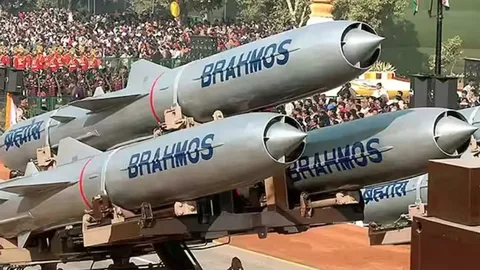
Indonesia and India have officially signed a contract for the BrahMos missile export, making Jakarta the third international customer for the supersonic cruise missile after the Philippines and Vietnam. The agreement was announced during Prime Minister Narendra Modi’s state visit to Jakarta. The deal was signed between BrahMos Aerospace and the Indonesian Ministry of Defence, though neither government has released the full contract value yet.
Background
Discussions between India and Indonesia over the BrahMos missile export have been ongoing since 2020. Indonesia’s Defence Minister at the time, Prabowo Subianto, first raised the issue with his Indian counterpart Rajnath Singh. Since then, Jakarta has steadily moved toward finalising a purchase agreement.
Reports earlier this year suggested a deal worth close to $450 million was close to being signed. One battery had already been discussed in phases, with plans to scale up the arrangement further. Indonesia’s growing interest in coastal defence systems, especially land-based anti-ship missiles, pushed the negotiations forward this year.
The announcement came as part of a wider set of agreements signed during Modi’s four-day visit, his fourth trip to the Southeast Asian nation. Modi and Indonesian President Prabowo Subianto signed twenty memorandums of understanding across sectors including defence, critical minerals, education, and healthcare.
Details
The BrahMos missile export contract to Indonesia was formally signed on 7 July, following months of reports that both sides were finalising terms. The agreement was struck between BrahMos Aerospace and the Indonesian Ministry of Defence during a ceremony in Jakarta.
Neither side has disclosed the exact contract value, the number of missile units to be delivered, or the delivery schedule. This mirrors the pattern followed with earlier BrahMos export customers, where financial details were only released gradually.
The BrahMos full form stands for a combination of the Brahmaputra and Moskva rivers, representing the joint India-Russia origins of the missile programme. It is produced by BrahMos Aerospace, a joint venture between India’s Defence Research and Development Organisation (DRDO) and Russia’s NPO Mashinostroyeniya, established in 1998.
The BrahMos missile speed reaches nearly Mach 2.8, or almost three times the speed of sound, making it one of the fastest cruise missiles operational anywhere in the world today. The BrahMos missile range for the export version stands at approximately 290 kilometres, allowing coastal defence forces to strike targets well within their exclusive economic zones.
In terms of BrahMos missile cost, the Philippines’ 2022 contract for three missile batteries was valued at around $375 million. Indonesia’s deal is expected to follow a broadly similar cost structure, though final figures have not been confirmed publicly.
Indonesia joins the BrahMos missile export list, which currently includes the Philippines and Vietnam as confirmed or discussed customers. Other nations, including Malaysia, the UAE, Chile, Argentina, and South Africa, have expressed varying degrees of interest in the missile system over recent years.
Quotes
BrahMos Aerospace’s Director General, Dr. Jaiteerth R. Joshi, has previously described the missile system as a landmark achievement for India’s defence exports. He stated that the programme has helped establish BrahMos as a leading global defence and aerospace entity with a growing international footprint.
During earlier deliveries to the Philippines, Indian Navy Chief Admiral R Hari Kumar noted that the induction of BrahMos systems strengthens partner nations’ maritime capability. He added that such exports contribute to collective maritime security across the wider region.
Indian government sources confirmed that a series of MoUs were signed alongside the missile agreement, covering critical minerals, natural resources, healthcare, pharmaceuticals, education, and space cooperation between the two nations.
Impact
The BrahMos missile export to Indonesia carries significant regional weight. Southeast Asian nations have been steadily expanding coastal defence capabilities amid growing concerns over assertive maritime activity in the South China Sea.
For India, the deal reinforces its position as an emerging global arms exporter. Defence exports have become a central pillar of India’s foreign policy strategy, particularly across the Indo-Pacific region where multiple nations are seeking to diversify beyond traditional Western suppliers.
For Indonesia, acquiring the BrahMos system enhances its ability to project deterrence along critical maritime routes, including areas near the Strait of Malacca. The system’s mobility and multi-platform launch capability, from land, sea, and air, gives Jakarta a flexible coastal defence option.
The agreement also strengthens the India-Indonesia Comprehensive Strategic Partnership, a relationship both leaders elevated during Modi’s earlier 2018 visit to Jakarta. Analysts note that defence cooperation of this scale typically leads to further joint training programmes and logistics support arrangements between the two militaries.
Conclusion
With the contract now signed, attention turns to the release of further details, including the number of missile batteries involved and the delivery timeline. Based on past export patterns with the Philippines, deliveries typically begin months to years after the initial signing, depending on production schedules and logistical arrangements.
Indonesia’s move to expand its BrahMos inventory is expected to encourage further Southeast Asian nations to consider similar coastal defence acquisitions. As regional security dynamics continue to evolve, the BrahMos missile export programme appears set to remain a central feature of India’s defence diplomacy in the years ahead.
FAQs
How many BrahMos missiles does India produce?
India, through BrahMos Aerospace, has continuously scaled up production capacity to meet both domestic and export requirements. The Indian Navy alone has expressed intent to procure more than 200 BrahMos missiles to boost indigenisation within its armed forces. Exact annual production figures are not publicly disclosed by BrahMos Aerospace or the Indian government, as this is considered sensitive defence information. However, new manufacturing facilities have been inaugurated in recent years specifically to support rising export demand from countries such as the Philippines, Vietnam, and now Indonesia.
Can the S-400 missile system stop BrahMos?
The S-400 is designed primarily as a long-range air defence system capable of intercepting aircraft, drones, and certain ballistic and cruise missiles. However, BrahMos flies at nearly three times the speed of sound and often follows a low-altitude flight path that reduces radar detection time. This combination of speed and altitude makes interception significantly more difficult for most existing air defence systems, including the S-400, though defence analysts note that interception probability depends heavily on radar positioning, missile trajectory, and reaction time available to defenders.
Does Russia produce BrahMos missiles?
BrahMos is a joint venture missile system, developed collaboratively by India’s Defence Research and Development Organisation (DRDO) and Russia’s NPO Mashinostroyeniya. While the missile’s design and core propulsion technology trace back to Russian-origin systems, the majority of production and assembly now takes place in India through BrahMos Aerospace facilities. Reports indicate that a large percentage of the missile’s components, sometimes cited as over 80 percent, have been indigenised within India, reducing direct dependency on Russian manufacturing for export orders.