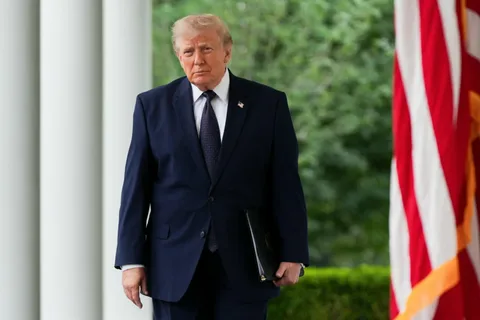
President Donald Trump announced on Wednesday that he will formally request the Birthright Citizenship Supreme Court case be reheard. The move follows a 6-3 ruling last month that struck down his executive order limiting automatic citizenship. Legal experts call the rehearing bid a long shot given the court’s rare history of granting such requests.
Background
Trump signed an executive order on his first day back in office last year, seeking to end automatic citizenship for children born in the United States to parents who are not citizens or green-card holders. The order directly challenged decades of settled interpretation under the 14th Amendment.
The policy triggered immediate legal challenges across multiple states. Civil rights organizations and immigrant advocacy groups argued the order violated the Constitution’s Citizenship Clause. The case eventually made its way to the nation’s highest court, where oral arguments were heard in April.
On June 30, the Birthright Citizenship Supreme Court ruling went against the administration. The justices ruled 6-3 that children born on U.S. soil are automatically citizens under the 14th Amendment, regardless of their parents’ immigration status. The decision reaffirmed the long-standing framework established by the 1898 case United States v. Wong Kim Ark.
Details
Chief Justice John Roberts wrote the majority opinion, stating that children born in the United States are citizens at birth and that the framers of the amendment intended the promise to extend to every person born on American soil. The ruling was widely seen as a decisive defeat for one of Trump’s signature immigration policies.
Rather than accept the outcome, Trump announced this week that he intends to ask the Birthright Citizenship Supreme Court panel to reconsider its own decision. In a post on his social media platform, Trump argued that the ruling was incorrect and claimed that citizenship was effectively being sold to foreign nationals.
The president pointed to reports of billboards near the U.S.-Mexico border advertising delivery packages at hospitals, which he described as evidence of a scam tied to birthright citizenship. Texas officials had separately raised concerns about a private medical center allegedly marketing maternity services to foreign nationals seeking citizenship for their newborns.
Trump also urged Republican lawmakers in Congress to pursue new legislation restricting birthright citizenship. However, most constitutional scholars note that changing the rule permanently would likely require a constitutional amendment rather than an ordinary statute, since the Supreme Court’s majority opinion rested squarely on the text of the 14th Amendment itself.
Court watchers note that the U.S. Supreme Court almost never agrees to rehear a case it has already decided. Historical data shows the court has not granted a rehearing of an argued case in decades, and the last reversal of an already-decided argued case dates back to the mid-20th century.
Quotes
Legal analysts have been skeptical of the rehearing request’s chances of success. A former Florida state attorney described the effort bluntly as unlikely to go anywhere procedurally.
Chief Justice Roberts, in the original majority opinion, emphasized that the 14th Amendment’s framers extended citizenship broadly to those born on American soil, describing it as a promise the court intended to uphold.
Impact
The Birthright Citizenship Supreme Court dispute carries significant weight beyond U.S. borders, drawing attention from immigration policy watchers, legal scholars, and foreign governments monitoring how America defines citizenship. Countries with large diaspora populations in the United States are closely tracking the case, since any shift in policy could affect thousands of families.
Domestically, the ruling has become a flashpoint in the broader immigration debate. Public opinion polling consistently shows strong majority support among Americans for maintaining birthright citizenship as currently interpreted under the 14th Amendment. Immigrant rights groups have hailed the court’s decision as a major victory protecting constitutional guarantees.
At the same time, the political fight is unlikely to fade quickly. Trump has continued to make immigration restriction a central pillar of his administration’s agenda, and this latest rehearing request signals that the fight over the 14th Amendment birthright citizenship clause is far from settled in the political arena, even though the legal question appears largely closed for now.
Financial and administrative uncertainty also lingers for hospitals, state agencies, and families navigating citizenship documentation while the political rhetoric continues. Agencies responsible for issuing birth certificates and passports have had to adjust guidance multiple times as the case moved through the courts.
Conclusion
Given the Supreme Court’s historical reluctance to revisit its own rulings, most legal experts expect the rehearing request to be denied. Still, the case underscores how central the birthright citizenship debate has become to Trump’s broader immigration platform.
Attention now shifts to Congress, where Trump has called on Republican lawmakers to pursue new legislative restrictions, and to state-level responses addressing the alleged advertising practices near the southern border. Whether any of these efforts gain traction remains to be seen, but the Birthright Citizenship Supreme Court saga is expected to remain a major talking point in American politics through the rest of the year.
Frequently Asked Questions
Do you get birthright citizenship in the USA?
Yes. Under the 14th Amendment’s Citizenship Clause, any child born on United States soil is automatically granted U.S. citizenship at birth, regardless of the immigration status of their parents. This interpretation was reaffirmed by the Supreme Court’s June ruling, which struck down an executive order attempting to narrow this long-standing constitutional guarantee. The principle has been in place since the landmark 1898 case United States v. Wong Kim Ark and continues to apply nationwide.
What happens if a foreigner has a baby in the USA?
If a foreign national gives birth while physically present in the United States, the newborn automatically becomes a U.S. citizen under current constitutional interpretation. This citizenship is granted regardless of whether the parents are in the country legally, on a visa, or without documentation. The child can later sponsor family members for immigration once they reach adulthood, although this process takes many years and involves separate legal requirements.
Does Melania Trump have dual citizenship?
Melania Trump was born in Slovenia and became a naturalized United States citizen in 2006. Reports have indicated she also retained her Slovenian citizenship, which would technically make her a dual citizen. Slovenia permits dual citizenship for individuals who acquire it before naturalizing elsewhere, so this arrangement is generally considered legally consistent with both countries’ citizenship laws.