
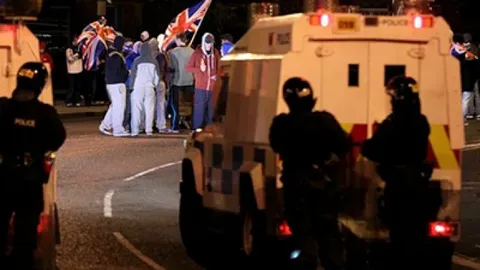
The streets of Belfast look nothing like normal right now. Belfast riots today have erupted across multiple parts of Northern Ireland, with protesters clashing violently with police in scenes that have shocked the country and drawn international attention. Water cannons, riot officers, and armored vehicles have all been deployed as demonstrations turned ugly across several neighborhoods.
What started as anger over a Belfast knife attack has grown into something much harder to contain. Rioting in Belfast spread through the night roads blocked, bins set alight, property damaged as anti-immigration sentiment collided with deep economic frustration and a political establishment that many protesters feel is simply not listening.
Background
The spark for the latest Belfast riots today came from reports about a Belfast knife attack allegedly involving a foreign national. Those claims spread through local media and across social media faster than any official account could keep up with, and the anger that followed did not wait for confirmed facts.
Northern Ireland has been here before not in exactly this form, but the underlying ingredients are familiar. Political identity, economic pressure, and immigration debate have all contributed to periods of serious unrest in the past. What makes the current situation distinctive is the speed at which it escalated and the extent to which online platforms shaped the public narrative before authorities could respond.
The Belfast riots reason is being argued about fiercely across political circles. Some politicians are pointing directly at misinformation circulating online. Others are acknowledging, more cautiously, that public frustration has been building for a long time and that the knife attack was not the cause of that frustration it was the trigger.
People searching for Belfast riots wiki and Belfast riots 2026 wiki are trying to piece together a history that is genuinely complex. Analysts are clear that this cannot be reduced to one incident or one grievance. It is a collision of social tension, economic anxiety, and political polarization that has been building quietly for months.
Details of the Belfast Riots Today
The violence escalated sharply late Tuesday and into early Wednesday. Police confirmed that multiple officers were injured as rioting in Belfast intensified and demonstrators pushed against police barricades near government buildings and residential streets. Water cannons came out. Crowd control measures followed. Protesters responded by throwing bottles, fireworks, and other objects at the line of officers.
Eyewitnesses described the atmosphere as chaotic and frightening. Fires burned in the streets. Emergency vehicles tried to navigate through blocked roads. Videos circulating under searches including Belfast knife attack x and Belfast riots today showed masked figures squaring off against riot police while police helicopters tracked the situation from above.
Arrests have already been made, and authorities have made clear that more are coming as CCTV footage and online material from the night are reviewed. Businesses across affected districts pulled down shutters early. Tensions continued well into the night with no clear sign of immediate calm.
Northern Ireland protests today did not stay confined to Belfast. Smaller demonstrations broke out in surrounding towns, and security officials warned that the unrest had the potential to spread further if political leaders failed to act quickly and credibly. Community representatives were out urging residents to step back from the violence and to stop sharing unverified information that was making an already dangerous situation worse.
The Police Service of Northern Ireland was direct in its message: attacks on officers and damage to public property will not be treated lightly, and peaceful protest however strongly felt does not cover violent disorder. Criminal charges are on the table for those identified in the footage.
Political reactions have been predictably split. Some leaders condemned the violence without qualification. Others were more careful, acknowledging that public concern about immigration and personal safety is real, even while rejecting the violence. That careful positioning has itself become part of the political controversy.
Social Media and Online Reaction
By the time police were deploying water cannons, Belfast riots today and Northern Ireland protests today were already trending internationally. Videos, live streams, and accounts of varying accuracy had spread across multiple platforms within hours of the first clashes, and the volume of unverified content made it genuinely difficult for ordinary people to understand what was actually happening.
Authorities made repeated appeals for people to rely on established news sources rather than viral clips or emotionally charged posts from accounts with no editorial accountability. Experts who monitor online dynamics during civil unrest were not surprised by the speed of spread they have been warning about exactly this pattern for years.
Search traffic for Belfast riots wiki, Belfast riots 2026 wiki, and Belfast knife attack x spiked sharply as users around the world tried to find context and background. The internationalization of the story happened faster than most observers expected.
The debate about social media’s role is running in parallel with the debate about the riots themselves. Some commentators argue that platforms are actively making situations like this worse by amplifying emotion and outrage over accuracy and context. Others push back, saying that the anger being expressed online reflects something real that political institutions have been too slow to acknowledge.
Community Impact
For the people actually living in the affected neighborhoods, the riots are not a political debate. They are a frightening disruption to daily life. Families stayed indoors. Roads were impassable. Public transport was rerouted or suspended entirely. Businesses counted damage they had not anticipated and cannot easily absorb.
Community leaders are sounding the alarm about what prolonged unrest does to relationships that have taken years to build between different ethnic, religious, and cultural groups in Northern Ireland. The fear is not just about the violence itself it is about what comes after it. The mistrust, the resentment, the hardening of divisions that makes the next incident more likely and more severe.
Schools and public services in the most affected areas moved quickly to increase security precautions. The practical disruptions getting to work, getting children to school, accessing services piled on top of genuine fear for personal safety.
Human rights organizations have spoken out specifically about the targeting of immigrant and minority communities. Their calls for calm dialogue and responsible leadership have been consistent and urgent, and they are watching carefully to see whether those calls have any effect on the political response.
Government and Police Response
Government officials went public with calls for restraint while emphasizing that the rule of law would be maintained. Behind the scenes, emergency meetings between police commanders and political representatives were convened as the scale of the disorder became clear.
Additional riot-control teams were deployed overnight. Patrols in high-risk areas were increased significantly. Police were unambiguous about their priorities: protect lives and prevent the disorder from spreading further.
Officials also reached out to community leaders, faith organizations, and local representatives the people whose voices carry weight in neighborhoods where government credibility is lower. The hope is that those relationships can help bring the temperature down in ways that police operations alone cannot.
International observers are paying close attention. Northern Ireland carries specific political significance because of its history and because of the peace agreements that brought decades of more serious violence to an end. Any prolonged breakdown of order here is not treated as a local matter it attracts diplomatic attention and raises questions that extend well beyond a single city’s streets.
Political Debate Over the Belfast Riots Reason
The Belfast riots reason has become the defining political question of the moment, and the answers being offered depend almost entirely on who is being asked.Some politicians are focused on immigration policy, arguing that the government has failed to manage public concern and that the riots however wrong in their expression reflect a frustration that has been building without adequate political response. Others are pushing back hard, warning that this framing hands legitimacy to groups whose motivations have nothing to do with legitimate policy debate.
Experts who have studied similar situations elsewhere in Europe are urging caution against simple explanations. Unemployment, inflation, a housing crisis, a sense of economic exclusion, and the accelerant of online misinformation are all part of what produced these scenes. Northern Ireland’s specific political and historical context adds layers of complexity that do not exist elsewhere.
What is clear is that the riots have reignited debates about integration, policing strategy, and social cohesion that have been simmering without resolution for some time. Those debates are not going to be settled quickly.
International Attention
The images coming out of Belfast have circulated globally, and the reaction from international commentators has been significant. Burning streets and police lines in a city that spent decades associated with political violence carry a particular weight that goes beyond what similar images from other locations might produce.
Business groups in Northern Ireland have already raised concerns about the impact on tourism and investment if the unrest continues. International perception of stability matters for economic confidence, and that confidence is not easily rebuilt once it is damaged.
Analysts have also pointed out the parallels between what is happening in Belfast and anti-immigration demonstrations in other parts of Europe. Rising political polarization, economic anxiety, and the organizing power of online communities are creating versions of this story in multiple countries. Belfast is the latest, but probably not the last.
Conclusion
Belfast riots today are not a story that is going to resolve itself quickly or cleanly. What started with a knife attack has exposed tensions that run much deeper than a single incident, and the political, social, and economic pressures driving those tensions have not gone anywhere.
Authorities are working to restore order. Political leaders are under pressure to respond in a way that is both honest about genuine public concerns and firm in its rejection of violence. Community organizations are trying to hold things together at street level while the bigger arguments play out above them.
The next few days will be telling. If calm can be restored and political engagement begins in earnest, there is a path toward de-escalation. If the unrest continues and political responses remain inadequate, Northern Ireland protests today risk becoming something more sustained and more damaging than what the city has seen in recent memory.
FAQs
Why are people protesting in Ireland?
The immediate trigger for the current protests was a Belfast knife attack that generated rapid and intense anger online before the facts were fully established. But the deeper reasons are more complicated. Many protesters say they are frustrated about immigration, public safety, economic hardship, and a political system they feel does not represent their concerns. Analysts consistently point out that the surface-level trigger and the underlying causes are not the same thing the knife attack lit a fire that was already built.
What is the story behind Belfast?
Belfast is the capital of Northern Ireland and carries one of the most complex political histories of any city in the United Kingdom. For much of the twentieth century it was defined by violent conflict between unionist communities predominantly Protestant and broadly supportive of the British connection and nationalist communities predominantly Catholic and broadly supportive of Irish unity. The Good Friday Agreement of 1998 brought that conflict largely to an end, but the political fault lines never disappeared. Economic pressure, immigration debate, and a new generation of online organizing have given those fault lines new expression.
What is the reason behind the protest?
The Belfast riots reason involves several overlapping factors that are difficult to separate cleanly. Anger following the knife attack provided the immediate spark. Frustration over immigration and public safety policy provided the fuel. Economic anxiety housing costs, inflation, unemployment provided the broader context. And misinformation circulating online accelerated everything. Police and government officials are working through all of these dimensions simultaneously, and investigations into both the original attack and the riots themselves are ongoing.