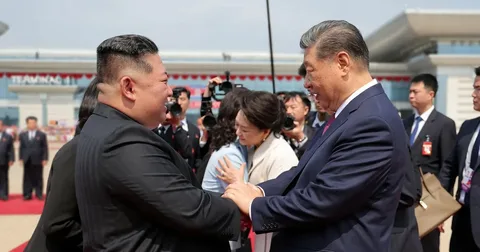
North Korean leader Kim Jong Un held talks this week with Wang Huning, China’s fourth-highest-ranked official, pledging to deepen cooperation between the two countries. The meeting is the latest sign that China North Korea relations 2026 have entered one of their warmest periods in years, raising fresh questions about how far Beijing’s backing of Pyongyang actually extends.
Background
China and North Korea have been formal allies since the 1961 Sino-North Korean Mutual Aid and Cooperation Friendship Treaty, a pact that technically obligates Beijing to provide assistance if North Korea is attacked. That history explains why China supported North Korea in the Korean War in the first place: Chinese troops entered the conflict in 1950 after US-led forces pushed close to the Chinese border, and Beijing has framed the relationship as one built on shared sacrifice ever since.
For decades, the two countries described their bond using the phrase “as close as lips and teeth,” suggesting neither can survive without the other. But the relationship has never been simple. China and North Korea difference in approach has shown up repeatedly, particularly over Pyongyang’s nuclear weapons program, which Beijing has publicly criticized even while continuing to trade with and support the North economically.
This week’s visit follows Chinese President Xi Jinping’s trip to Pyongyang in June, his first in seven years, during which the two sides agreed to expand cooperation in politics, economy, and culture. Wang Huning’s delegation arrived in Pyongyang to build on that agreement, visiting a memorial for Chinese soldiers killed in the Korean War and a mausoleum housing the remains of North Korea’s founding leaders.
Details
According to North Korea’s state-run Korean Central News Agency, Kim told Wang it remained the North’s “steadfast policy” to keep developing what he called the traditional friendly and cooperative relationship between the two nations. Wang responded by reaffirming Beijing’s backing of North Korea’s political system under Kim’s leadership.
The timing of the visit matters. North Korea’s ties with Russia have grown extremely close in recent years, including a mutual defense pact and reports of North Korean troops supporting Russian operations. Many analysts see China’s renewed diplomatic push as an attempt to make sure Beijing doesn’t lose influence over Pyongyang as Moscow’s role grows.
Is China and North Korea friends in the traditional sense, or is this closer to a managed partnership between two governments with overlapping but not identical interests? Most regional analysts describe it as the latter. Beijing values North Korea as a strategic buffer against US military presence in South Korea and Japan, while Pyongyang depends on China for trade, fuel, and diplomatic cover at the United Nations.
As for does China support North Korea or South Korea, Beijing maintains relationships with both. China is South Korea’s largest trading partner, and the two nations keep functioning diplomatic and economic ties despite Beijing’s alliance with Pyongyang.
Quotes
Wang Huning told North Korean officials that China’s “firm support for the cause of Korean socialism led by Comrade General Secretary Kim Jong Un will never be changed,” according to KCNA’s account of the meeting.
Kim, for his part, emphasized continuity in the relationship, describing the deepening of ties with Beijing as a fixed and ongoing priority for Pyongyang rather than a temporary diplomatic gesture tied to any single event.
Earlier in the trip, Wang met with Jo Yong Won, a senior official in North Korea’s ruling Workers’ Party, where he reportedly pledged that the Chinese party and government would follow through on the commitments Xi and Kim made during their June summit.
Impact
The renewed warmth between Beijing and Pyongyang carries weight well beyond the two countries themselves. Would China defend North Korea in a war remains one of the most frequently asked questions among regional security analysts, and this week’s visit does little to resolve the ambiguity. China’s 1961 treaty language technically commits it to military assistance if North Korea faces an unprovoked attack, but Beijing has never clearly stated how it would respond if a conflict were triggered by North Korean aggression instead.
For South Korea and the United States, questions about China vs North Korea who would win in any hypothetical confrontation are largely beside the point, since the two countries are treaty allies rather than adversaries. The more relevant scenario security planners study is a China vs North Korea war framing turned on its head: how Beijing would respond if a conflict broke out between North Korea and outside powers, and whether Chinese support would be political, economic, or military.
Regionally, closer China North Korea relations 2026 also affect how Washington and Seoul plan their own diplomacy. A North Korea backed simultaneously by China and Russia has more room to resist international pressure over its nuclear and missile programs, complicating efforts to bring Pyongyang back to any negotiating table.
Conclusion
With Xi’s June visit and Wang’s follow-up trip completed within weeks of each other, expect continued high-level exchanges between Beijing and Pyongyang in the coming months. Analysts will be watching for any concrete economic agreements or troop-level commitments that clarify how far China is actually willing to go on Pyongyang’s behalf, beyond repeated statements of friendship.
Frequently Asked Questions
Can North Koreans go to China?
Travel between North Korea and China is possible but tightly restricted and controlled by both governments. Ordinary North Korean citizens generally cannot travel freely; most cross-border movement involves state-approved workers, students, diplomats, or officials on sanctioned business, along with a smaller number of people who cross informally near the shared border region. China has periodically tightened or loosened border controls depending on political relations, public health concerns, and North Korea’s own domestic restrictions, which grew especially strict during the pandemic years and have only partially eased since.
Who is the biggest friend of North Korea?
China has traditionally been considered North Korea’s closest and most important international partner, given their shared history, geographic proximity, and decades-old mutual defense treaty. In recent years, however, Russia has emerged as an increasingly significant partner as well, particularly after the two countries signed a mutual defense agreement and deepened military cooperation. Many analysts now describe North Korea as balancing between two major partners, China and Russia, rather than relying on a single dominant ally the way it did for most of the Cold War era.
What is China’s opinion on North Korea?
China’s official position frames North Korea as a close and valued neighbor with whom it shares a long history of cooperation, going back to their alliance during the Korean War. At the same time, Chinese officials have repeatedly voiced concern over North Korea’s nuclear weapons program and have supported some international sanctions in the past, showing that the relationship isn’t purely one-sided support. In practice, Beijing tends to prioritize regional stability, meaning it generally prefers a North Korea that remains intact and under predictable leadership over one that risks collapse or triggers open conflict on China’s border.