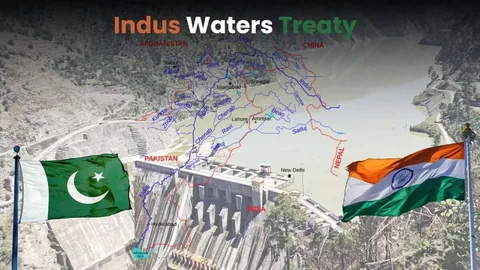
Information Minister Attaullah Tarar said on Wednesday that Pakistan will not let India weaponise water. He maintained that the Indus Waters Treaty (IWT) cannot be changed, revoked or held in abeyance by one side alone. Tarar called the treaty an instrument of peace and stability for the region. His comments come as the Indus Waters Treaty suspended by India in 2025 remains at the centre of tensions between the two countries.
Background: The Indus Waters Treaty 1960
The Indus Waters Treaty 1960 was signed after years of negotiations facilitated by the World Bank. It divides the Indus river system between India and Pakistan and has survived several wars and crises. For decades it was seen as one of the most durable water-sharing deals in the world.
The Indus Waters Treaty main points are simple. India controls the three eastern rivers, the Ravi, Sutlej and Beas, while Pakistan has the three western rivers, the Indus, Jhelum and Chenab. India may use the western rivers only in limited ways, such as run-of-river hydropower, and it must let their waters flow on to Pakistan. The treaty also set up the Permanent Indus Commission to handle disputes and share data.
Pakistan depends heavily on this system, and it receives roughly 80 per cent of the water in the Indus river system. Students searching for Indus Water Treaty UPSC notes will find the same core provisions, since the treaty is a standard topic in South Asian geopolitics and river-sharing studies. The stakes, though, are far more than academic for farmers and cities downstream.
Tensions rose in April 2025, after 26 people were killed in Indian-administered Kashmir. India blamed Pakistan and placed the treaty in abeyance, and Pakistan rejected the accusation and the move. A brief military conflict followed in May 2025, which made the water issue even more sensitive.
Details: What Tarar Said
Speaking at the launch of an Institute of Strategic Studies Islamabad (ISSI) report on the suspension, Tarar said Pakistan believes in peace. He added that it will not allow water to be used as a weapon, and that Pakistan’s position has won support from several countries. The report examines the historical, legal and strategic sides of the suspension.
Tarar described efforts to create controversy around the treaty as highly contemptible. He said they could not be justified legally, diplomatically or morally. In his words, water is a fundamental right of the 240 million people of Pakistan.
He also warned of a wider precedent. If a state could put a binding treaty on hold despite established dispute-resolution mechanisms, Tarar said, the effects would reach transboundary water governance across the world. He urged the international community to take note.
Legal and Diplomatic Moves
Pakistan says the law is on its side. Reports citing the Foreign Office say the Permanent Court of Arbitration ruled on August 31 that the treaty remains in force and that its dispute-settlement mechanisms continue to work. An earlier award in August 2025 also found that the court’s decisions are final and binding on both parties.
Islamabad has also written again to the UN Security Council. It asked the council to press India to implement the treaty fully and comply with the arbitration awards. Pakistan also raised concerns about diversion canals and other projects it calls illegal.
Quotes: What Officials Have Said
Tarar said Pakistan is a peaceful nation but will not allow India to weaponise water. Deputy Prime Minister Ishaq Dar told a Washington seminar last month that the treaty remains valid and binding. He said any attempt to deprive Pakistan of its waters would have profound consequences for regional peace and security.
Prime Minister Shehbaz Sharif has gone further. At the UN General Assembly, he said any attempt to stop or divert Pakistan’s share of the water would be treated as an act of war. Pakistan’s National Security Committee had earlier taken the same position, as noted in the letter to the Security Council.
India’s stance is very different. Home Minister Amit Shah said in June 2025 that India would never restore the treaty. He said water that once flowed to Pakistan would be diverted, including through a canal to Rajasthan. New Delhi has linked the abeyance to its accusations of cross-border terrorism, which Pakistan denies.
Impact: Why the Indus Waters Treaty Suspended Matters
For Pakistan, this is a question of survival as much as diplomacy. Most of its farms depend on the Indus basin, and any disruption could hit crops, power generation and food prices. That is why Pakistani leaders use such strong language when they talk about water security.
Regionally, the dispute adds another risk to an already tense relationship between two nuclear-armed neighbours. Water has now joined Kashmir and terrorism as a flashpoint. Any sign of interference with river flows could quickly raise the stakes.
Globally, experts say the outcome may shape how transboundary water agreements are treated elsewhere. Many countries share rivers under similar frameworks. If one party can pause a treaty on political grounds, others may fear the same could happen to them.
Conclusion: What Comes Next
Pakistan is expected to keep pressing its case at the UN, in legal forums and with friendly capitals. India has shown no sign of changing course, so a quick return to normal cooperation looks unlikely. Any restoration would probably need political talks and confidence-building steps on both sides.
For now, the treaty remains in legal and political limbo. Pakistan says it is fully in force, while India says it is on hold. Observers will watch the next arbitration steps and any new projects on the western rivers.
Frequently Asked Questions (FAQs)
What is the Indus River water treaty?
The Indus Waters Treaty is a water-sharing agreement between India and Pakistan, signed in 1960 with the World Bank’s help. It gives India control of the eastern rivers, the Ravi, Sutlej and Beas, and gives Pakistan the western rivers, the Indus, Jhelum and Chenab. India may use the western rivers for limited purposes, such as run-of-river hydropower, but must allow their waters to flow to Pakistan. The treaty created the Permanent Indus Commission for data sharing and dispute handling, and it provides a three-step process involving the commission, a neutral expert and a Court of Arbitration. It is often described as one of the most durable water-sharing agreements in the world.
Can India stop Indus River water to Pakistan?
Under the treaty, India has no legal right to stop the water of the western rivers, and Pakistan calls any such attempt an act of war. In practice, India has limited storage capacity on these rivers, so it cannot easily cut flows entirely in the short term. Experts say it could still affect the timing of flows through dams, gates and new projects, which may hurt Pakistan during sowing seasons. Indian officials have spoken about diverting water through canals, but building large infrastructure would take years and big investment. Pakistan has taken the matter to the UN Security Council and international courts, arguing that such steps break the treaty.
Did India suspend the Indus Water Treaty?
Yes, India announced in April 2025 that it was placing the treaty in abeyance, after an attack in Indian-administered Kashmir killed 26 people. New Delhi blamed Pakistan for the attack, and Pakistan denied any involvement. Pakistan says the move is illegal because the treaty has no clause allowing one country to suspend or withdraw from it alone. The Permanent Court of Arbitration has ruled, according to Pakistani reports, that the treaty remains in force. India, however, has not restored the treaty, and Home Minister Amit Shah has said it never will. So the accurate description is that India has suspended its participation, while Pakistan insists the treaty is still binding.