India’s National Security Advisor Ajit Doval travelled to Beijing this week for a fresh round of talks on the long-disputed India-China Himalayan border, marking the 25th round of Special Representative-level dialogue between the two nuclear-armed neighbours. The visit comes weeks ahead of a planned BRICS summit in New Delhi that India hopes Chinese President Xi Jinping will attend, and it has renewed public interest in the basic facts of the border itself: what it is called, how long it runs, and why the frontier through Arunachal Pradesh remains one of the most contested stretches of territory in Asia.
Background
The India-China border is not a single, formally agreed international boundary. Instead, the two countries are separated by what is known as the Line of Actual Control, or LAC, a de facto military boundary that emerged after the two nations fought a brief but bloody war in 1962. Because the LAC was never mutually demarcated on the ground or on official maps, India and China frequently interpret its exact path differently, particularly in the western and eastern sectors, leading to recurring patrol face-offs and, on occasion, deadly clashes. The most serious of these came in June 2020, when Indian and Chinese soldiers fought hand-to-hand in the Galwan Valley in Ladakh, an incident that froze high-level diplomatic contact between the two countries for roughly four years.
Details
What is the name of the India-China border?
The border between India and China is officially known as the Line of Actual Control, commonly abbreviated as the LAC. The term dates back to a 1959 letter from then Chinese Premier Zhou Enlai to Indian Prime Minister Jawaharlal Nehru, in which Zhou described a rough boundary combining the McMahon Line in the east with the line of practical control in the west. Unlike a conventional international border, the LAC has no single legal treaty defining its path, which is precisely why disputes over its alignment persist more than six decades later.
India-China border length: how long is it, really?
The length of the India-China border depends heavily on which country is measuring it. India places the LAC’s total length at approximately 3,488 kilometres, stretching from the Karakoram Pass in the northwest to the tri-junction with Myanmar in the east. China, by contrast, estimates the same boundary at only around 2,000 kilometres, a significant discrepancy that reflects the two countries’ fundamentally different claims over where Indian and Chinese-administered territory actually begins and ends. This gap in measurement is itself a symptom of the border’s unresolved status rather than a simple counting error.
India-China border map and sector breakdown
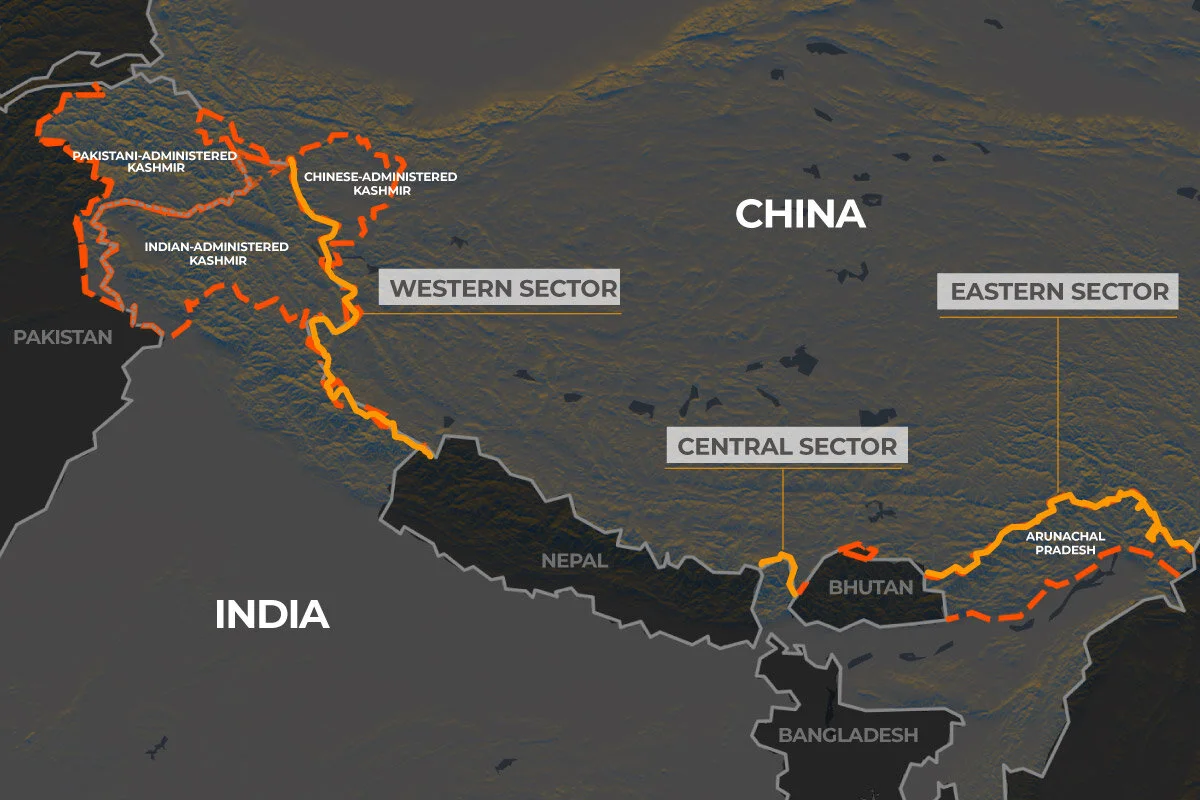
The LAC is conventionally divided into three sectors, each with a distinct geography and level of dispute. The Western Sector covers Ladakh and the Chinese-administered Aksai Chin plateau, and is widely regarded as the most volatile stretch, having produced major stand-offs at Doklam in 2017, Depsang in 2013, and the deadly Galwan clash in 2020. The Middle Sector runs through Himachal Pradesh and Uttarakhand and is both the shortest and least disputed portion of the boundary, spanning roughly 545 kilometres with comparatively few historical flashpoints. The Eastern Sector follows the McMahon Line through Arunachal Pradesh and Sikkim and is considered strategically vital by Beijing, which claims the entirety of Arunachal Pradesh as what it calls “South Tibet.”
The India-China border dispute in Arunachal Pradesh
Arunachal Pradesh sits at the centre of the eastern portion of the border dispute. China claims roughly 90,000 square kilometres of the Indian-administered state, home to more than 1.4 million people, as historically Tibetan territory. Beijing has periodically escalated the dispute through symbolic measures, including publishing standardised Chinese names for locations across Arunachal Pradesh, a practice India has consistently rejected as having no bearing on its sovereignty over the region. The Tawang area, in particular, remains sensitive, since it was a key objective during China’s 1962 military offensive and continues to hold both religious and strategic significance today.
Why talks are happening now
Doval’s visit to Beijing this week formed the 25th round of the Special Representatives’ dialogue on the boundary question, a mechanism co-chaired on the Chinese side by Foreign Minister Wang Yi. According to India’s foreign ministry, Doval met Wang Yi as well as China’s Vice President Han Zheng during the two-day visit, continuing discussions aimed at de-escalation, delimitation, and broader boundary management following the deadly 2020 clash. The talks follow a partial thaw in relations that began with an October 2024 disengagement agreement, under which India regained patrol access to contested points in the Depsang Plains that had been blocked since the Galwan stand-off. This round of talks is widely seen as preparatory groundwork ahead of a BRICS summit scheduled for September 12 and 13 in New Delhi, which Indian officials hope will mark Xi Jinping’s first visit to India in seven years.
Quotes
Officials from both sides have used measured, diplomatic language to describe the goals of the latest round of talks, reflecting the delicate nature of the ongoing thaw and the years of careful, incremental diplomacy that have gone into rebuilding even a basic working relationship after 2020. A Chinese foreign ministry statement said the two sides would, “in accordance with the spirit of the consensus reached by the leaders of the two countries,” continue in-depth communication on the boundary question, language that closely echoes the framework both governments have used since Prime Minister Narendra Modi and President Xi Jinping met on the sidelines of the Kazan BRICS summit in October 2024. That meeting is widely regarded as the turning point that allowed formal Special Representative talks to resume after a five-year hiatus, and officials on both sides have continued to reference it directly whenever announcing new rounds of dialogue. Indian officials have similarly framed the current dialogue around stability rather than resolution, choosing their words carefully given how easily perceived overreach on either side can unsettle the process. India’s foreign ministry confirmed that Doval, serving as India’s Special Representative on the boundary question, arrived in Beijing specifically for structured talks with his Chinese counterpart, describing the visit in procedural rather than triumphant terms, consistent with New Delhi’s broader approach of treating each round as incremental progress rather than a breakthrough moment. Earlier in the normalisation process, India’s External Affairs Minister S. Jaishankar underscored that jointly maintaining “peace and tranquillity in the border areas” remains the essential foundation for any broader improvement in bilateral ties, a phrase that has become a consistent touchstone in official statements from both capitals since the 2020 clash and one that diplomats on both sides now use almost interchangeably when describing the minimum condition for progress.
Chinese officials have also repeatedly stressed cooperation over confrontation in their public messaging, even while maintaining firm territorial positions in private negotiations. Following the 24th round of talks held in New Delhi in 2025, Wang Yi told reporters that the two countries should support “healthy, stable relations,” a notably conciliatory tone given the years of frozen contact that preceded it, and both sides used that meeting to agree on holding the next round in China, a small but symbolically important gesture of reciprocity in a relationship where venue and protocol carry real diplomatic weight. Analysts tracking the talks note that this kind of carefully calibrated language, emphasising process and mutual respect rather than specific territorial concessions, is deliberate: neither government wants to be seen conceding ground on sovereignty claims, even as both sides work quietly toward de-escalation on the ground.
Impact
The state of the India-China border carries consequences that extend well beyond the two countries directly involved, touching regional security architecture, global supply chains, and the broader balance of power in Asia. Both nations are nuclear-armed powers with the world’s largest and second-largest standing armies, and any escalation along the LAC carries the risk of drawing in wider regional security concerns, given India’s alliances within the Quad grouping alongside the United States, Japan and Australia, and China’s expanding military and economic footprint across South Asia through initiatives like the Belt and Road framework. A serious deterioration in relations could complicate defence planning not just for India and China but for smaller neighbouring states such as Nepal, Bhutan and Bangladesh, all of which maintain complex, sometimes delicate relationships with both larger powers and would face pressure to navigate any renewed confrontation. Economically, sustained border tension has already reshaped bilateral trade and investment patterns in ways that go well beyond diplomatic symbolism. India has moved to reduce its reliance on Chinese machinery and technology in strategic sectors, reportedly preparing incentive packages worth over a billion dollars to encourage domestic manufacturing alternatives, even as both countries remain major trading partners with billions of dollars in annual bilateral commerce that neither side has been willing to fully sacrifice for the sake of the border dispute. This dynamic, of deep economic interdependence coexisting with unresolved territorial hostility, is one of the more unusual features of the relationship and helps explain why both governments have consistently favoured managed tension over open conflict.
For the roughly 1.4 million residents of Arunachal Pradesh, the unresolved dispute is not an abstract diplomatic matter but a daily reality that shapes infrastructure spending, military presence, and local development priorities. The Indian government has funnelled significant investment into roads, bridges and connectivity projects across the state, explicitly framed around border security needs, while China has pursued its own parallel infrastructure push on the other side of the LAC, including plans for an extensive new border ring road stretching across roughly 25,000 kilometres. Periodic diplomatic flare-ups occur whenever Beijing renews its territorial claims through symbolic gestures, such as publishing standardised Chinese names for dozens of locations across the state, moves that New Delhi has consistently and firmly rejected as having no legal bearing on Indian sovereignty, but which nonetheless generate genuine anxiety among residents and policymakers in the region each time they recur. More broadly, the trajectory of the current talks will shape whether the two countries can move toward a durable framework for peace along the LAC, or whether the relationship remains structurally vulnerable to sudden flare-ups of the kind seen in 2020. International observers, including strategic analysts in Washington and Brussels, are watching the pace of this thaw closely, since a stable India-China relationship would meaningfully alter calculations around Indo-Pacific security cooperation, while a renewed crisis could just as quickly reverse years of careful diplomatic groundwork and reintroduce the kind of instability that characterised the five years following the Galwan clash.
Conclusion
With the 25th round of Special Representative talks concluded and a potential Xi Jinping visit to New Delhi on the horizon, the coming weeks will offer an early signal of whether India and China can sustain the cautious diplomatic thaw that began in late 2024, or whether the relationship remains as fragile as it has proven to be at multiple points over the past six decades. Analysts widely expect incremental progress, such as further disengagement arrangements, expanded patrolling rights, or additional confidence-building measures along contested stretches of the LAC, rather than any comprehensive resolution of the underlying boundary dispute, which has defied settlement despite dozens of rounds of talks stretching back to the 1980s. Both governments appear to have concluded, at least for now, that managed coexistence serves their broader strategic and economic interests better than open confrontation, a calculation that has held reasonably steady since the 2024 Kazan breakthrough but remains only as durable as the next incident on the ground allows it to be. Whether the September BRICS summit becomes a genuine turning point in India-China relations, potentially including Xi Jinping’s first visit to India in seven years, or simply another data point in a long cycle of talks, tension, and cautious normalisation, will depend heavily on factors that are not entirely within either government’s control. Weather, terrain, and the unpredictable nature of high-altitude military patrolling have all played a role in past flare-ups, meaning that even the most carefully choreographed diplomatic calendar can be disrupted by events on the ground that neither side anticipated. For now, both New Delhi and Beijing appear committed to the current trajectory of dialogue, and the coming weeks leading up to the BRICS summit will likely bring further diplomatic engagement, additional working-level meetings, and continued public messaging from both capitals emphasising stability, even as the fundamental territorial disagreements that have defined this border since 1962 remain, in substance, unresolved.
Frequently Asked Questions
What is the name of India and China’s border?
The border between India and China is officially called the Line of Actual Control, or LAC. It functions as the de facto boundary between the two countries but has never been formally demarcated through a mutually signed treaty, which is why India and China continue to hold differing views on its precise alignment across all three of its sectors. The term itself originates from a 1959 diplomatic letter written by then Chinese Premier Zhou Enlai, describing a rough dividing line based on the historical McMahon Line in the east and the practical line of control that existed in the west at the time. Because the LAC lacks the legal status of a conventional international border, it remains one of the most closely watched and periodically contested frontiers in the world, with both governments maintaining a heavy military presence along its length.
Which country touches 14 countries?
China holds the distinction of sharing land borders with the most countries in the world, touching 14 nations in total. These include Afghanistan, Bhutan, India, Kazakhstan, North Korea, Kyrgyzstan, Laos, Mongolia, Myanmar, Nepal, Pakistan, Russia, Tajikistan, and Vietnam. This extensive network of borders, many of them running through remote mountainous or desert terrain, makes China’s territorial and diplomatic relationships unusually complex, and its long, contested frontier with India remains among the most militarily sensitive of the fourteen. Russia is the only other country that comes close, bordering 14 nations as well, though the specific list of countries differs between the two.
How many Chinese soldiers died in the Galwan Valley clash?
China officially confirmed in February 2021, more than eight months after the incident, that four of its soldiers and officers were killed during the June 2020 Galwan Valley clash with Indian troops, later honouring a fifth service member for actions connected to the same confrontation. India, by contrast, has consistently stated that 20 of its own soldiers died in the clash, including a colonel, with dozens more injured in the hand-to-hand fighting. Independent research reports and unnamed intelligence assessments cited by several international outlets have suggested China’s actual casualty figures may have been considerably higher than its official count, citing accounts of soldiers drowning in a fast-moving river during the confrontation, though Beijing has firmly maintained that only four deaths occurred and has not revised that figure since its initial disclosure.