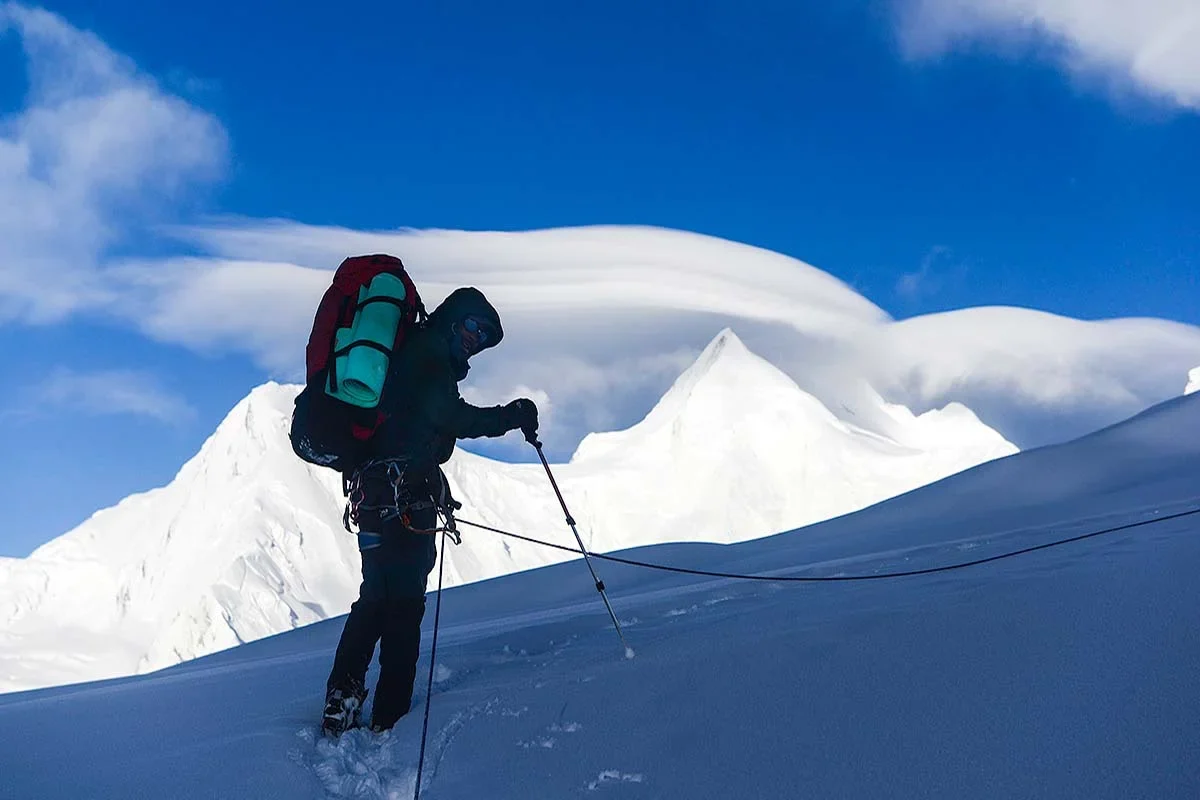
The Spantik peak mission to recover the body of a Pakistani climber has been suspended after heavy snowfall made the terrain too dangerous for rescue teams to continue. The Alpine Club of Pakistan confirmed that the recovery team had already reached Camp 2 on Spantik before being ordered back to base camp. Officials say the operation will resume once weather conditions improve enough to allow a safe approach.
Background
Spantik, widely known as the Golden Peak, rises to 7,027 metres in the Karakoram range of Gilgit-Baltistan. It is often described as one of the more approachable 7,000-metre peaks in Pakistan, which is why it attracts climbers preparing for tougher 8,000-metre expeditions later in their careers. The tragedy began when a Pakistani climber, identified as Dr Asma Mushtaq, successfully summited Spantik as part of a five-member women’s expedition team. She was reportedly in good health at the top of the mountain, but her condition deteriorated sharply during the descent. According to the Alpine Club of Pakistan, Dr Mushtaq suffered a serious case of high-altitude sickness at around 6,400 metres, which ultimately proved fatal. Her body remained stranded on the mountain, prompting authorities to organise a dedicated Spantik peak mission focused on retrieval rather than climbing.
Details
The Spantik peak mission was launched soon after news of the climber’s death spread across the mountaineering community. A specialised recovery team was assembled and dispatched from base camp with the objective of reaching the site where the body was located. Rescue personnel managed to push forward and reach Camp 2, a notable achievement given the difficulty of the terrain at that altitude. However, sudden and heavy snowfall changed conditions rapidly, reducing visibility and increasing the risk of avalanches along the route. Faced with worsening weather, expedition organisers made the difficult call to pull the team back to base camp. This is a standard safety protocol in high-altitude mountaineering, where continuing in poor visibility or unstable snow can turn a recovery mission into another life-threatening situation.
Alongside the ground effort, authorities have also been exploring the possibility of a helicopter mercy mission, seeking approval on humanitarian grounds with support from the Pakistan Army. A helicopter approach, if cleared, could significantly speed up the retrieval process once weather permits flight operations in the region. The Spantik expedition cost for climbers attempting the peak commercially typically ranges from around 3,500 US dollars for base camp only services to well above 6,000 US dollars for full-board packages that include high-altitude porters, guides, and complete logistical support. For Pakistani nationals, domestic packages can start from roughly 350,000 Pakistani rupees, depending on the operator and services included. These figures give context to how significant an undertaking any Spantik expedition, including a recovery mission, truly is in terms of manpower, equipment, and coordination.
Quotes
The Alpine Club of Pakistan issued a statement acknowledging the courage and dedication of the support staff who tried to save Dr Mushtaq’s life during her descent. The club extended its condolences to her family, friends, and loved ones, describing her death as an irreparable loss. Officials involved in coordinating the Spantik peak mission have repeatedly stressed that climber and rescuer safety takes priority over speed. Alpinists familiar with the region have also noted publicly that the mountain guides who stayed with Dr Mushtaq did everything within their ability to assist her before conditions overwhelmed the effort.
Impact
This incident adds to what has already been a difficult mountaineering season in Pakistan’s Karakoram range. Earlier this year, a deadly avalanche on Broad Peak claimed multiple lives, including that of renowned mountaineer Nirmal Purja and several international climbers, further highlighting the risks associated with high-altitude expeditions in the region. For Pakistan’s mountaineering and tourism sector, repeated fatalities and complicated recovery missions raise fresh questions about safety protocols, weather forecasting, and the availability of rescue infrastructure like long-line helicopter capability. Neighbouring Nepal is often cited as having more advanced rescue resources, and incidents like the Spantik peak mission renew calls for Pakistan to strengthen its own capacity.
On a regional level, the story has also drawn attention to the broader risks female climbers face while attempting technical peaks in Gilgit-Baltistan. Dr Mushtaq’s expedition was notable for being an all-women Pakistani team, and her death has been widely discussed within local mountaineering circles as both a personal tragedy and a moment for reflection on safety standards. Internationally, the Spantik expedition K2 base camp cost comparison is often used by climbers researching Pakistan’s mountaineering scene, since Spantik is frequently treated as a stepping stone toward attempting K2 and other 8,000-metre giants nearby. Any high-profile incident on Spantik tends to influence how future climbers and expedition companies plan their own trips into the Karakoram.
Conclusion
Authorities and rescue teams remain on standby, waiting for a suitable weather window to resume the Spantik peak mission. Whether through a ground-based approach once conditions stabilise or through an approved helicopter mercy mission, the priority remains bringing Dr Asma Mushtaq’s body back to her family for a proper farewell. The Alpine Club of Pakistan has indicated that it will continue monitoring weather patterns closely over the coming days, ready to redeploy the recovery team the moment conditions allow safe movement above base camp. Officials have also reiterated that no ground team will be sent back onto the exposed sections of the route until snow stability improves, since a second tragedy on the same mission is a risk nobody involved is willing to take. Mountaineering experts expect that this incident will lead to renewed conversations about rescue readiness in Gilgit-Baltistan, particularly around helicopter access and coordination between the Alpine Club of Pakistan and the Pakistan Army. Many within the local climbing community argue that faster access to long-line helicopter rescue capability could reduce the time bodies and injured climbers spend exposed on the mountain, and this latest delay is likely to strengthen that argument going forward.
The broader Pakistani mountaineering fraternity has also used this moment to call for stronger acclimatisation protocols and closer medical monitoring during descent, since high-altitude sickness remains one of the leading causes of death on peaks like Spantik even when the climb itself goes smoothly. Expedition operators say they expect increased scrutiny on safety briefings and emergency response plans for future Spantik expedition bookings as a direct result of this case. As the recovery effort continues, further updates are expected once weather conditions allow rescue teams to safely return to the mountain, and both the Alpine Club of Pakistan and government authorities have promised to keep the public and Dr Mushtaq’s family informed at every stage. For now, the Spantik peak mission stands paused rather than abandoned, with officials expressing confidence that a resolution will come once the Karakoram’s notoriously unpredictable weather finally cooperates.
Frequently Asked Questions
How long does it take to climb Spantik?
A typical Spantik expedition takes around 28 to 30 days from Islamabad back to Islamabad, factoring in acclimatisation, trekking to base camp, and multiple rotations between higher camps before a summit attempt. The trek to base camp itself usually takes about three to four days from Arandu village, followed by a series of climbing rotations through Camps 1, 2, and 3 before climbers make their final summit push. Weather delays, as seen during the recent Spantik peak mission, can extend this timeline considerably, since safe climbing windows depend heavily on stable snow and visibility conditions in the Karakoram range.
Which Pakistani climbed Mount Everest without oxygen?
Pakistan’s mountaineering community has produced several elite climbers known for tackling the world’s highest peaks without supplemental oxygen, a feat that demands exceptional physical conditioning and years of high-altitude experience. This achievement places Pakistani climbers among a small global group who have summited multiple 8,000-metre peaks, including Everest, without relying on bottled oxygen, a distinction widely celebrated within the country’s growing mountaineering circles. Such climbers are frequently referenced in local media whenever discussions arise around Pakistan’s contribution to world-class high-altitude mountaineering.
How much does it cost to climb Spantik?
The cost of a Spantik expedition varies significantly depending on the tour operator, the level of service selected, and whether a climber opts for a base camp only package or a full-board guided experience. International climbers can expect to pay anywhere from approximately 3,500 US dollars for a base camp service package up to 6,000 US dollars or more for a fully guided expedition that includes high-altitude porters, supplemental oxygen support, and complete logistical assistance from Islamabad through to the summit attempt. Pakistani nationals often have access to more affordable domestic packages, with some operators offering rates starting around 350,000 Pakistani rupees, though prices rise for private or customised group expeditions. Additional costs like royalty fees, high-altitude climber salaries, visa charges, and single accommodation supplements can further affect the final Spantik expedition cost, which is why most operators recommend requesting a detailed quote before booking.