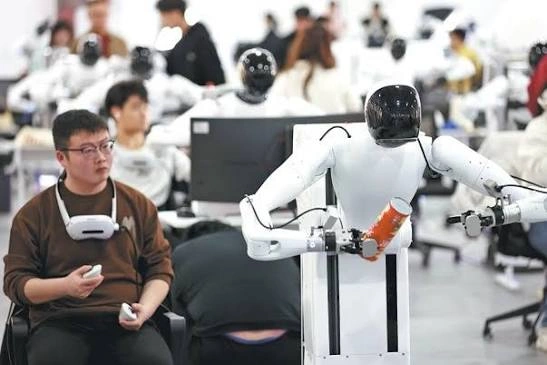
A group of schoolchildren watched with excitement as Wuji, a small humanoid robot guide, welcomed them to a robotics school in eastern China. With animated gestures and a lively presentation, Wuji introduced the students to the institute’s vision of preparing the robotic workforce of the future.
The demonstration highlights China’s growing ambition to become a global leader in humanoid robotics, as advanced machines increasingly emerge as the next major frontier of the artificial intelligence boom.
China Expands Investment in Humanoid Robot
China has rapidly expanded its robotics sector in recent years, with technology companies, manufacturers and investors pouring resources into the development of machines capable of walking, communicating, recognizing objects and performing increasingly complex tasks. Humanoid robots are being designed for potential use in factories, warehouses, healthcare, education and other industries.
The growing momentum has also attracted significant attention from international competitors, particularly the United States, where companies are investing heavily in artificial intelligence and robotics. The race to develop commercially viable humanoid robots is increasingly being viewed as an important part of the broader global technology competition.
Investor enthusiasm has been particularly strong around companies linked to the emerging robotics industry. In one recent market debut, a robotics firm’s shares surged by more than 600% on opening, reflecting enormous expectations surrounding the future of humanoid technology.
Commercial Use Still Faces Major Challenges
However, much of the current excitement remains a bet on future growth rather than established commercial success. Even the most advanced humanoid robots are still at an early stage of development, and their widespread use outside controlled demonstrations remains limited.
Researchers and technology companies continue to face major challenges, including improving battery life, movement, artificial intelligence capabilities, safety and manufacturing costs. Making humanoid robots affordable and reliable enough for mass adoption could take years.
Despite these obstacles, China is positioning robotics as a key component of its future industrial strategy. Training programs, research centers and educational initiatives are being developed to prepare students and workers for an economy in which humans and intelligent machines could increasingly work alongside each other.
The sight of children learning from a humanoid robot such as Wuji offers a glimpse into that possible future. As artificial intelligence advances, humanoid robots could become one of the defining technologies of the next industrial era, potentially transforming workplaces while intensifying competition among the world’s leading technology powers.