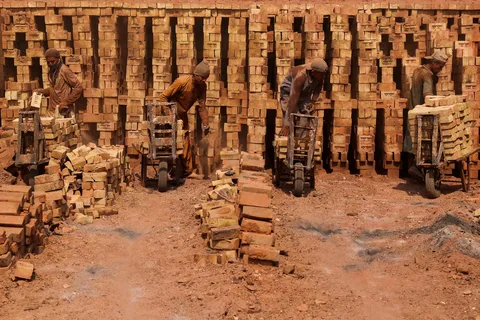
In Sheikhupura, Punjab, brick kiln workers spend their days trapped between two sources of heat: a blazing sun above and a 1,000°C furnace below. Rising temperatures are making an already brutal job harder to survive, and most workers cannot walk away because they owe money to the kiln owners who employ them.
What Is a Brick Kiln?
A brick kiln is a large oven or furnace used to bake clay bricks at extremely high temperatures until they harden. Pakistan relies on this method to supply bricks for its fast-growing construction industry. On the word itself: kiln is pronounced “kil,” with the “n” left silent by most English speakers, though some pronounce it as written, “kiln.”
Background
Brick kilns have operated across Punjab for generations, and the industry remains one of Pakistan’s largest employers of manual labour. Workers mix clay, mould it into bricks, and feed it into furnaces that burn around the clock.
Nationwide, more than 18,000 brick kilns employ over a million people, according to a 2018 estimate from the Climate and Clean Air Coalition. Sheikhupura district, just outside Lahore, sits at the centre of this industry.
Many labourers enter the trade through advance payments from kiln owners. Once a worker accepts that money, repaying it becomes nearly impossible on the low wages the job pays, and the debt can pass from parent to child. This system, known as bonded labour, was formally outlawed in Pakistan in 1992, but it persists in brick kilns, agriculture, and the carpet industry.
Details: A Day at the Kiln
At a kiln in Sheikhupura, workers crush coal through small holes beneath their feet, feeding the fire below while black smoke pours from the chimneys above. The furnace burns above 1,000°C and needs constant monitoring to stay hot enough to bake the bricks.
Abid Hussain, a 35-year-old labourer, described the sensation as being caught between fire below and, increasingly, fire above. He earns roughly 25,000 rupees a month, or about $90, which he said barely covers rent and his children’s basic needs.
“No matter the situation, whether we are ill or there are family matters, we still have to work,” Hussain said. “If I take time off, we’ll be in trouble.”
Summers in Punjab already push past 40°C most years, and workers on the kiln surface absorb heat from both directions for hours without a break. Pakistan is ranked among the countries most vulnerable to climate change globally, and kiln workers are among those with the least protection from it.
Quotes
Syeda Ghulam Fatima, General Secretary of the Bonded Labour Liberation Front Pakistan (BLLF), has spent decades documenting conditions inside the country’s kilns. She described the sites bluntly: “I would describe these brick kilns as places of confinement. Workers endure relentless heat from the blazing sun overhead while the intense heat radiating from the kiln rises beneath them.”
Fatima said the advance-payment system leaves workers with no real choice. Even in dangerous heat, declining to work risks pushing a family deeper into debt they can never repay.
Syeda Ghulam Fatima has led BLLF’s rescue operations since the late 1980s and has personally helped free more than 80,000 bonded labourers across Pakistan, according to the U.S. State Department’s Trafficking in Persons report and the Aurora Humanitarian Initiative, which recognised her work with a Clinton Global Citizen Award in 2015. She has also spoken publicly about raising children to treat animals with kindness, alongside her broader advocacy work, and continues to run BLLF’s Freedom Centers, which offer rescued workers shelter and legal support.
Impact
Two problems are colliding here: bonded labour that was never really stamped out, and heat that keeps getting worse. Sheikhupura isn’t an outlier. Similar conditions show up across kiln clusters in Punjab and Sindh, and labour rights groups say the 1992 bonded labour law is rarely enforced.
The consequences reach beyond the kiln floor. Families tied to debt bondage often cannot send children to school, and the World Bank and ILO have both flagged Pakistan’s continued reliance on informal, unregulated labour as a barrier to economic mobility for its poorest households.
Heat is compounding the risk. Pakistan’s Meteorological Department has repeatedly warned of longer, more intense heatwaves in recent years, and outdoor workers, including kiln labourers, farmers, and construction crews, face the highest exposure with the least access to shade, water breaks, or medical care.
Conclusion
There are signs of possible change. Punjab’s provincial government has floated a push to convert traditional kilns to cleaner, more efficient technology, which could also ease some of the extreme heat exposure workers currently face. Whether that shift reaches workers like Hussain, and whether it comes paired with stronger enforcement against bonded labour, remains to be seen.
For now, activists like Syeda Ghulam Fatima continue pressing the government to treat both problems as connected. As she has said of her decades of work, the fight is not just about freeing individual families from debt, but about forcing a system to change so fewer families end up trapped in the first place.
FAQs
How many brick kilns are there in Pakistan? Pakistan has more than 18,000 brick kilns in operation, based on a 2018 estimate from the Climate and Clean Air Coalition, and together they employ over a million workers nationwide. Punjab, particularly districts like Sheikhupura near Lahore, accounts for a large share of this industry because of its clay-rich soil and proximity to major construction markets. The exact number fluctuates as informal, unregistered kilns open and close outside official record-keeping.
How does a brick kiln work? A brick kiln works by shaping wet clay into brick moulds, drying them, and then baking them inside a furnace that burns at temperatures above 1,000°C. Workers feed coal into the furnace through small openings, often located beneath the surface where other labourers stand or walk, which is part of what makes the job so physically demanding. The bricks need sustained, carefully monitored heat over an extended period before they harden enough for construction use.
What is a kiln worker? A kiln worker is a labourer employed at a brick kiln to mould bricks, feed fuel into the furnace, transport finished bricks, or manage other stages of the brick-making process. Many kiln workers in Pakistan operate under a system of debt bondage, having accepted advance payments from kiln owners that are difficult or impossible to repay through their wages. This arrangement, while formally illegal under Pakistan’s 1992 Bonded Labour System Abolition Act, still shapes daily life for a large share of the country’s kiln workforce.