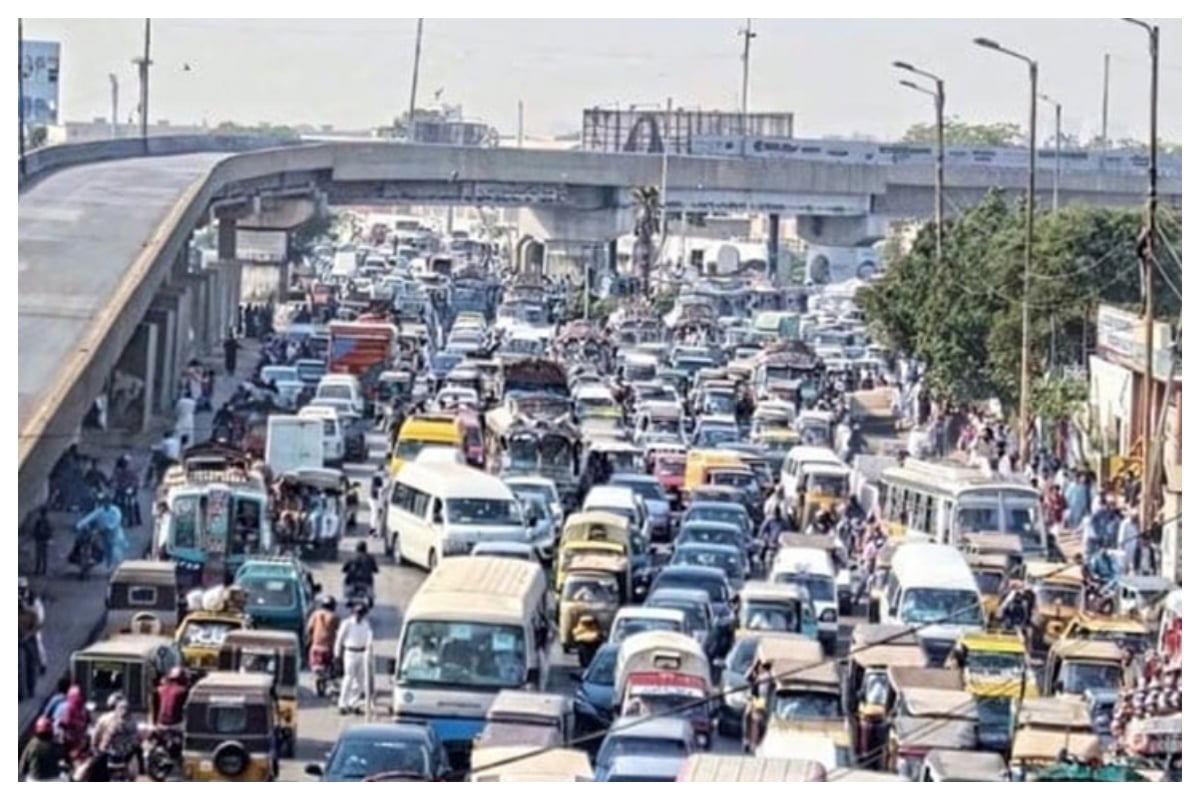
Karachi is witnessing a major traffic jam today as the Jamaat-e-Islami (JI) launches nationwide road blockades from 4:00 pm, with Shahrah-e-Faisal and several other key roads sealed off. Commuters searching for a Karachi traffic jam today live update are being advised to avoid the National Highway, Super Highway, and Shahrah-e-Pakistan until the protest disperses. The Karachi current situation live remains tense as police and traffic wardens scramble to manage diversions across the city.
Background
The Karachi protest today is part of a countrywide JI campaign against the government’s petroleum levy and rising inflation. JI Ameer Hafiz Naeem-ur-Rehman had announced weeks ago that demonstrations would be staged at more than 500 locations across 170 districts of Pakistan on August 7, and Karachi was always expected to be one of the biggest flashpoints given the size of the city and its dependence on arterial roads like Shahrah-e-Faisal.
This is not the first time Shahrah-e-Faisal Karachi today live coverage has trended on social media because of a protest. Just two days earlier, on August 5, PTI workers held a demonstration near Karachi Press Club that triggered severe congestion across Saddar, MA Jinnah Road, and Zainab Market, forcing the Sindh chief minister to personally order emergency traffic clearance. That episode set the tone for a city already on edge, and today’s much larger JI mobilisation has pushed tensions further.
Details
According to Karachi JI chief Monem Zafar Khan, protest caravans began moving at 4 pm from multiple points, including Shahrah-e-Pakistan, Hub Road, National Highway, Super Highway, Orangi, Korangi, Pakistan Chowk, and Sher Shah. All these caravans are converging at Mazar-e-Quaid before marching toward Shahrah-e-Faisal, where a large sit-in is planned. This single decision is behind most of the highway blocked today reports flooding in from commuters across the city.
A Jamaat-e-Islami Sindh spokesperson confirmed that motorways, Mall Road, and roads across ten major districts of Sindh, including national highways and the Super Highway, will remain closed for the duration of the protest. Within Karachi specifically, Shahrah-e-Faisal, Shahrah-e-Pakistan, the Nagan to UP More stretch, Power House, Defence View, Shahrah-e-Orangi, and Sohrab Goth have all been listed as blockade points, making a Karachi traffic jam today live experience almost unavoidable for anyone travelling through the city this afternoon and evening.
Traffic police have not yet released a full alternate-route map, but early advisories suggest that commuters heading toward the airport or eastern parts of the city should avoid Shahrah-e-Faisal entirely and look for longer detours through University Road or interior residential routes. Anyone tracking the Karachi red alert today situation on social media is being urged to plan extra travel time, since even routes not directly blocked are seeing spillover congestion as drivers reroute in large numbers.
The protest comes only two days after another major disruption on the same corridor. On August 5, PTI demonstrators clashed with police near Karachi Press Club, and officers used tear gas and baton charges to clear the area, with more than ten workers reportedly arrested. That protest also caused a documented traffic update Karachi Shahrah-e-Faisal today situation, with vehicles backed up for hours before the Sindh government intervened to restore flow.
Separately, Karachi’s roads have already been under strain this week from a tragic accident. On the night of August 6, a 17-year-old girl was killed after a university bus collided with a motorcycle near Awami Markaz on Shahrah-e-Faisal, and a 40-year-old man died in a separate crash near Buraq Pump on Super Highway. While unrelated to the political protest, these incidents have added to the sense that the city’s arteries are under unusual pressure this week.
Quotes
Addressing the protest campaign, JI chief Hafiz Naeem-ur-Rehman said the petroleum levy amounted to what he called a form of financial injustice against ordinary households, and insisted the movement would continue until the levy is withdrawn. He stressed that the demonstrations would remain peaceful, adding that ambulances would be allowed to pass through all blocked points without hindrance.
Karachi JI chief Monem Zafar Khan told reporters that the caravans from across the city would converge at Mazar-e-Quaid before marching toward Shahrah-e-Faisal, describing today’s mobilisation as a message to the government that citizens can no longer bear the burden of rising fuel costs. A JI spokesperson further warned that if authorities attempted to obstruct the demonstrations, the protest footprint could expand from roughly 500 roads to as many as 1,500 nationwide.
On the earlier PTI protest, Sindh Chief Minister Murad Ali Shah had directed the provincial police chief and Karachi’s additional inspector general to restore traffic flow immediately, instructing that queues on Napier Road, Regal Chowk, and Bolton Market be cleared without delay and that additional traffic personnel be deployed.
Impact
The regional impact of today’s Karachi traffic jam is significant, given that Shahrah-e-Faisal alone carries an estimated 250,000 vehicles daily and connects the city centre to Jinnah International Airport. A shutdown of this scale affects commuters, business deliveries, school pickups, and airport travellers all at once, and the ripple effect is being felt well beyond the immediate protest points.
Economically, the disruption adds further strain to a transport and logistics sector already squeezed by high fuel prices, the very issue driving today’s demonstrations. Small businesses along the blocked corridors, from Sohrab Goth to Defence View, are likely to see reduced footfall for the duration of the sit-in, while fuel wasted in traffic jams ironically compounds the cost pressures protesters are demonstrating against.
On a national level, Karachi’s situation mirrors what is unfolding simultaneously in Lahore, Islamabad, Rawalpindi, Peshawar, Quetta, and Multan, underscoring how widespread public frustration over the petroleum levy has become. Political analysts note that the scale of today’s coordinated blockade, spanning 170 districts, signals a level of organisation rarely seen in recent JI campaigns.
Conclusion
As evening approaches, the Karachi current situation live remains fluid, with traffic police expected to issue updated diversion advisories as the JI sit-in at Shahrah-e-Faisal continues. Whether the roads reopen by nightfall will depend largely on how negotiations, or lack thereof, unfold between JI leadership and provincial authorities in the coming hours.
For now, residents are advised to keep checking official traffic police channels and local news for the latest traffic update Karachi Shahrah-e-Faisal today before heading out. If the petroleum levy issue remains unresolved, JI has already signalled that further protests and highway blockades could follow in the days ahead, meaning today’s disruption may not be a one-off event for the city.
FAQs
What happened in Karachi today?
Karachi experienced a major traffic jam today after Jamaat-e-Islami launched a nationwide protest against the government’s petroleum levy and rising fuel prices. Starting at 4 pm, JI caravans moved from multiple points across the city, including Shahrah-e-Pakistan, Hub Road, National Highway, Super Highway, Orangi, and Korangi, before converging at Mazar-e-Quaid and marching toward Shahrah-e-Faisal for a large sit-in. As a result, several major roads, including Shahrah-e-Faisal, Nagan to UP More, Power House, Defence View, Shahrah-e-Orangi, and Sohrab Goth, were blocked, leading to widespread congestion across the city.
What is the timing of heavy traffic in Karachi?
The heaviest traffic congestion began around 4 pm today, when JI protest caravans started moving simultaneously from several parts of the city toward Mazar-e-Quaid and then onward to Shahrah-e-Faisal. Traffic is expected to remain heavily disrupted through the evening hours until the sit-in concludes and roads are officially reopened by traffic police. Commuters should also note that similar disruptions occurred just two days earlier during the PTI protest near Karachi Press Club, so delays could persist intermittently over the coming days if further demonstrations are called.
Is Karachi safe to visit now?
Karachi remains generally accessible, but visitors and residents should exercise caution around active protest zones, particularly Shahrah-e-Faisal, Mazar-e-Quaid, and surrounding areas where the JI sit-in is taking place. JI leadership has stated the protest will remain peaceful and that ambulances will be allowed through, but previous demonstrations this week, including the PTI protest on August 5, saw police use tear gas and baton charges in isolated clashes. It is advisable to avoid the blocked corridors, follow official traffic advisories, and plan alternate routes until authorities confirm that normal traffic flow has been restored.