

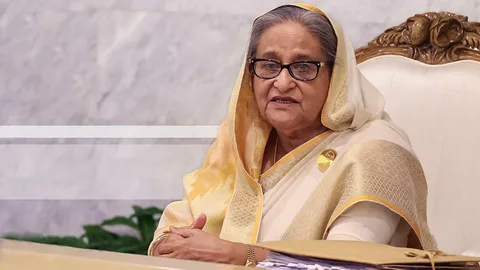

The question of will India hand over Sheikh Hasina has taken a dramatic new turn. In a video address today, August 5, 2026, on the second anniversary of the uprising that removed her from power, Hasina announced she plans to return to Bangladesh voluntarily in December despite facing a death sentence and the near-certainty of immediate arrest.India, where she has been in exile since fleeing by helicopter in August 2024, has still not answered Bangladesh’s extradition requests. It may not need to. Sheikh Hasina today news is no longer just about diplomacy between two neighbours it’s about whether the 78-year-old former prime minister will walk into the country that wants to hang her on her own terms.
Background: How Sheikh Hasina Ended Up in Exile
The Fall of a 15-Year Government
Sheikh Hasina ruled Bangladesh for 15 consecutive years, from 2009 until August 5, 2024. That’s longer than any other head of government in the country’s history, across four election victories though the last three were widely criticised for lack of transparency, boycotts by opposition parties, and allegations of vote manipulation.
Her government became increasingly authoritarian over time. Mass detentions of political opponents, extrajudicial killings, and severe restrictions on the press defined the final years of her administration.The end came fast. Student-led protests that began against a controversial job quota system quickly became something much larger a mass uprising against her government altogether. She fled Bangladesh and took refuge in India following the student protests and unrest in 2024, which eventually led to her resignation as Prime Minister.She left by helicopter on August 5, 2024, and has not set foot in Bangladesh since.
What Happened After She Left
Bangladesh’s International Crimes Tribunal moved quickly.A court in Dhaka sentenced Hasina, as well as former interior minister Asaduzzaman Khan Kamal, to death in absentia after being found guilty of crimes against humanity over a deadly crackdown against the student-led uprising.The United Nations says up to 1,400 people were killed in crackdowns as Hasina tried to cling to power, deaths that were central to her trial.In a separate corruption case, her US-based son Sajeeb Wazed and daughter Saima Wazed, who has served as a top UN official, were sentenced to five years each.</cite> Hasina herself received 21 years on the corruption charges on top of the death sentence.
She denies all wrongdoing.
Sheikh Hasina News Today The December Announcement
“Fear Cannot Decide My Duty”
Former Bangladesh Prime Minister Sheikh Hasina has said she will return to her country after two years in exile in India, despite facing the death penalty. The 78-year-old made the announcement via video link at an event hosted by the Foreign Correspondents’ Club of South Asia, alongside her son Sajeeb Wazed Joy and other Awami League leaders.
I know that they may put me in jail, or they may kill me, or anything may happen, but still I have to go back,” Hasina said. “Fear cannot decide my duty to the people.”She said she plans to return alongside senior members of her banned Awami League party to surrender to authorities. “My party leaders and workers are being subjected to tremendous repression. If death comes, I want it to come on my own soil, where my parents are buried and where their blood was shed.”She said the exact date of return will be announced “when the time comes” but she wants it to be in December.
What This Changes
If Hasina returns voluntarily, India’s decision on extradition becomes largely irrelevant. Extradition law assumes the fugitive wants to stay put. Hasina has flipped that assumption if she boards that plane, the extradition request becomes legally irrelevant overnight.
Bangladesh’s BNP government, which came to power in February 2026 after elections that excluded the Awami League, now faces a very different challenge to the one it was managing before today.
Will India Hand Over Sheikh Hasina The Extradition Question
Three Requests, No Answer
Bangladesh’s government has asked India to extradite Sheikh Hasina, who was sentenced earlier this week to be hanged over a deadly crackdown against a student-led uprising. Hasina has been in hiding in India since her autocratic rule was overthrown in August 2024. As prime minister, she had had New Delhi’s backing.Touhid Hossain, who holds the foreign affairs portfolio in Bangladesh’s interim administration, told reporters that “we sent a letter seeking the extradition of Sheikh Hasina,” which according to Bengali newspaper Prothom Alo was the third official extradition request since Hasina fled.
As of July 17, 2026, India’s Ministry of External Affairs spokesperson Randhir Jaiswal told reporters that Dhaka’s request remains “under examination” given “the legalities that are involved.”
Why India Is Unlikely to Hand Her Over
India has a clear legal argument available to it. The 2013 extradition treaty between India and Bangladesh the same treaty Dhaka says India is obligated to honour contains a standard provision barring extradition where the person faces the death penalty unless the requesting state guarantees no execution will take place. Bangladesh has made no such guarantee.
Observers said India is highly unlikely to agree to hand over Hasina. “India understands this to be political vindictiveness of the ruling political forces in Bangladesh,” said Sanjay Bhardwaj, professor of South Asian Studies at Jawaharlal Nehru University, New Delhi.
India’s past support for Hasina has frayed relations between the two neighbours since her overthrow. But tensions appear to have eased slightly when Bangladesh’s National Security Adviser Khalilur Rahman visited India for a regional security summit.
Who Is Sheikh Hasina?
Sheikh Hasina’s Background and Early Life
Sheikh Hasina was born on September 28, 1947, in Tungipara, East Bengal just weeks after the partition of British India. She is the eldest daughter of Sheikh Mujibur Rahman, the founding father of Bangladesh, who led the country’s independence from Pakistan in 1971.
Sheikh Hasina young: She grew up in a politically active household. Her father was Bangladesh’s first prime minister and later its president. In August 1975, a military coup killed most of her immediate family her father, mother, and three brothers were all murdered. Hasina and her sister Rehana survived only because they were abroad at the time.
That personal trauma shaped her entire political life. She returned from exile in 1981 to lead the Awami League, her father’s party, and dedicated decades to building it back into a governing force.
Sheikh Hasina’s Children
Sheikh Hasina children: She has two children. Her son Sajeeb Wazed Joy is a technology entrepreneur based in the United States who served as an adviser to his mother’s government. He was sentenced to five years in a corruption case by a Bangladeshi court in November 2025. Her daughter Saima Wazed has had a different public profile she has worked as a mental health advocate and served in a senior position at the World Health Organization.Saima Wazed was also sentenced to five years in the same corruption case.
Is Sheikh Hasina Muslim?
Is Sheikh Hasina Muslim? Yes. She is a Sunni Muslim and has been publicly observant throughout her political career, performing Hajj and participating in Islamic observances. Bangladesh is a majority-Muslim country, and religion has been a consistent part of her public identity, even as her government was broadly secular in its constitutional framework.
Sheikh Hasina Net Worth
Sheikh Hasina net worth is difficult to verify precisely because much of the corruption case against her rests on allegations that she and her associates misused state resources rather than accumulating documented personal wealth in traditional ways. Bangladesh’s Anti-Corruption Commission has pursued cases against her involving government land, contracts, and procurement decisions. Independent verified figures for her personal net worth are not publicly available.
Sheikh Hasina’s Political Career How Long Did She Rule Bangladesh?
Sheikh Hasina first became prime minister in 1996. She served until 2001, then lost to Khaleda Zia’s BNP. She returned to power in January 2009 after a decisive election win, and remained in office continuously until August 5, 2024 meaning her second, unbroken stint lasted just over 15 years. Combined with her first term, she served approximately 20 years as Bangladesh’s prime minister.
She was the Bangladesh Prime Minister for longer than any other person, and the longest-serving female head of government in the world at the time of her removal.
Impact What Happens If She Returns?
For Bangladesh
Hasina’s voluntary return would be the most destabilising political event Bangladesh has experienced since her removal. Her party, the Awami League, was banned and excluded from February’s elections. She has called for that ban to be lifted and for political prisoners to be released.
A return would confront the BNP government with a choice it has no easy answer to: arresting her risks making her a martyr; failing to arrest her undermines the legal proceedings that formed the government’s entire case against her administration.
For India-Bangladesh Relations
India-Bangladesh relations have been under strain since 2024. New Delhi backed Hasina’s government for years, and Dhaka’s post-Hasina government has not forgotten that. If Hasina returns voluntarily, it removes the extradition dispute from the bilateral relationship but it doesn’t remove the underlying tensions over India’s role in the region.
For the Region
Bangladesh’s political instability has knock-on effects across South Asia. Myanmar’s ongoing crisis has already created refugee pressure on Bangladesh’s borders. A destabilised Dhaka which a contested return could produce adds another layer of regional complexity that India, China, and the international community will be watching closely.
Conclusion What Comes Next
The Sheikh Hasina story has not ended. It has entered its most unpredictable chapter.India may never need to answer Bangladesh’s extradition requests if Hasina boards a plane to Dhaka in December. What happens when she arrives whether she is arrested, protected, or something in between will define Bangladesh’s political future for years.Her statement today, “Fear cannot decide my duty to the people,” has already changed the terms of the entire debate. Whether it is political theatre, genuine courage, or both, the Sheikh Hasina news today has given Bangladesh a deadline it wasn’t expecting.
Frequently Asked Questions
Where Is Bangladesh’s Sheikh Hasina Now?
Sheikh Hasina is currently in exile in India, where she has been since fleeing Bangladesh on August 5, 2024.She has remained in exile there ever since following the student-led uprising that forced her from power. Her exact location within India has not been publicly confirmed by Indian authorities. As of today, August 5, 2026, she has announced via video link that she intends to return to Bangladesh voluntarily around December 2026 the exact date to be announced when “the time comes.” Bangladesh has filed at least three extradition requests with India; all remain unanswered, with India saying the matter is “under examination.” India has not confirmed whether it would facilitate or block her departure.
Who Returned to Bangladesh After 17 Years?
This question likely refers to Sheikh Hasina herself, who returned to Bangladesh in 1981 after six years in exile following the assassination of her father and most of her family in 1975. She had been living abroad in India and later in Europe. Her return to lead the Awami League in 1981, following the death of its then-president Abdur Razzak, was a defining moment in Bangladesh’s post-independence political history. It is also possible the question refers to other political figures who have returned after extended exile Bangladesh has a recurring pattern of leaders spending years abroad before returning, given the country’s volatile political cycles. No specific figure “after 17 years” has been confirmed in recent major news.
How Long Did Sheikh Hasina Rule Bangladesh?
Sheikh Hasina served as Bangladesh Prime Minister for approximately 20 years across two separate stints. Her first term ran from 1996 to 2001. She was then in opposition for nearly eight years before winning the December 2008 election and returning to power in January 2009. She then served continuously for 15 years and 7 months until August 5, 2024, making her both the longest-serving prime minister in Bangladesh’s history and, at the time of her removal, the world’s longest-serving female head of government. Her second unbroken tenure was marked by significant economic growth but also serious democratic backsliding, with opposition parties boycotting elections and international observers raising concerns about vote manipulation and restrictions on civil liberties.