U.S. State Department Begins Crackdown on Parents Who Fail to Pay Child Support
By Asim Siddiqui | Washington, D.C.
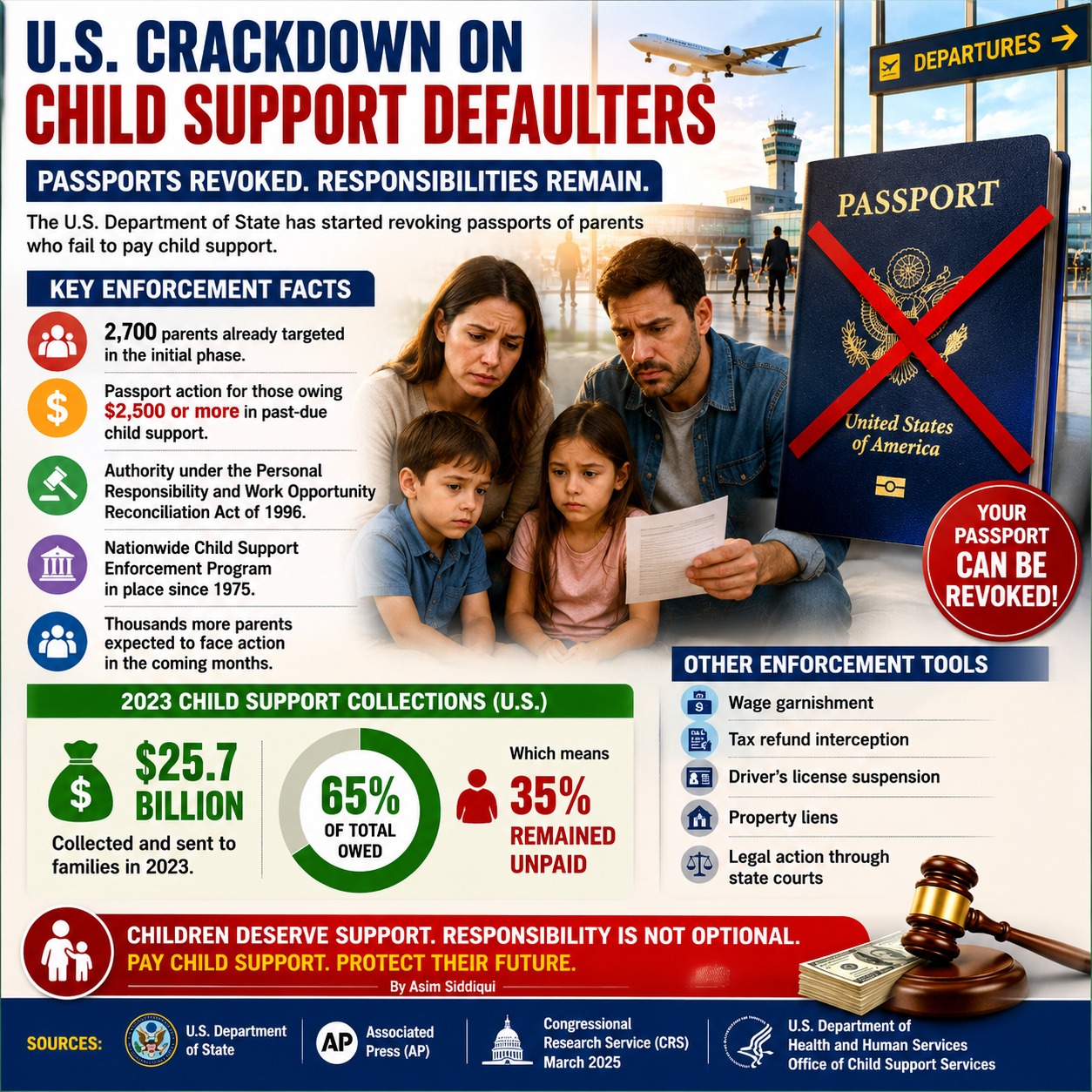
The U.S. government has launched a renewed enforcement effort against parents who fail to meet their child support obligations, with the U.S. Department of State taking steps to deny or revoke passports for individuals who owe substantial amounts in unpaid child support.
According to reports, enforcement actions have initially targeted approximately 2,700 parents with significant child support arrears. Under current federal law, individuals who owe $2,500 or more in past-due child support can be denied the issuance or renewal of a U.S. passport. Federal agencies have indicated that additional enforcement actions are expected against thousands of other delinquent parents who meet the legal threshold.
The passport enforcement program is based on the Personal Responsibility and Work Opportunity Reconciliation Act of 1996, which authorizes the U.S. Department of State to deny passport services to individuals certified by state child support agencies as seriously delinquent in their child support obligations.
Child support enforcement has been a nationwide program since 1975, when Congress established the federal Child Support Enforcement Program to ensure that noncustodial parents contribute financially to the upbringing of their children while reducing public assistance costs.
According to the Congressional Research Service (CRS) report published in March 2025, state child support enforcement agencies collected approximately $25.7 billion in child support during 2023 and distributed those funds to families. This represented approximately 65% of the total child support owed, meaning that roughly 35% of child support obligations remained unpaid.
Officials say passport denial has become one of several enforcement tools designed to encourage compliance. Other enforcement measures may include wage garnishment, interception of tax refunds, suspension of driver’s licenses, property liens, and legal action through state courts.
The renewed enforcement effort highlights the federal government’s continued emphasis on ensuring that children receive the financial support to which they are legally entitled.
Sources
U.S. Department of State
Associated Press (AP)
Congressional Research Service (CRS), Child Support Enforcement Program Report, March 2025
U.S. Department of Health and Human Services, Office of Child Support Services