
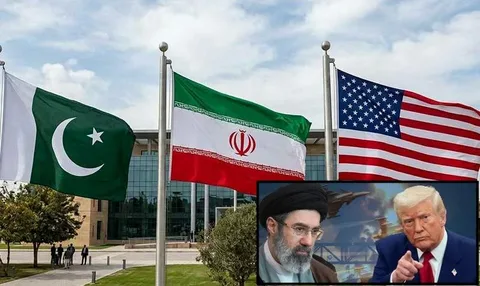

Pakistan has intensified its diplomatic push at the United Nations Security Council, arguing that sustained dialogue remains the only viable path to ending the standoff between Iran and the United States. The renewed effort comes as instability around the Strait of Hormuz continues to threaten global energy markets and regional stability.
Background
Pakistan’s role as a mediator between Washington and Tehran traces back to earlier this year, when hostilities between the two countries escalated sharply following the breakdown of nuclear negotiations. Islamabad, drawing on its long border with Iran and its working relationship with the United States, positioned itself early as a facilitator rather than a party to the conflict.
In March, Pakistan’s Deputy Prime Minister and Foreign Minister Ishaq Dar hosted a quadrilateral meeting in Islamabad with counterparts from Saudi Arabia, Turkiye, and Egypt to explore pathways toward de-escalation. That effort, combined with a five-point China-Pakistan initiative for regional peace, helped set the stage for a temporary US-Iran ceasefire announced in early April.
Since then, Pakistan has repeatedly returned to the UN Security Council to press its case. Pakistan’s ambassador told the council that Islamabad, working alongside China, Saudi Arabia, Turkiye, and Egypt, has led constructive diplomatic efforts aimed at de-escalation and broader stability between Washington and Tehran.
Details
The latest push follows renewed hostilities that began again in early July, undoing much of the progress made during the earlier ceasefire window. Pakistan’s Foreign Office said the country expressed deep concern over the escalation on July 8 and has since called on all parties to exercise maximum restraint.
Much of the current tension centers on the Strait of Hormuz, the narrow waterway through which roughly a fifth of the world’s oil supply passes. Analysts describing Iran’s escalation dominance in the strait argue that Tehran retains significant leverage there, since its forces can disrupt shipping lanes far more easily than outside powers can guarantee uninterrupted passage.
A Security Council Report briefing on the crisis noted that a Bahrain-led draft resolution on maritime security in the Strait of Hormuz has faced repeated delays, reflecting a lack of consensus among council members on how forcefully to respond to the instability. The vote, originally scheduled for earlier this month, has now been pushed back amid continued disagreement.
Pakistan’s Chief of Defence Forces, Field Marshal Asim Munir, has remained directly engaged in back-channel talks, speaking with US officials including Vice President JD Vance and special envoy Steve Witkoff, as well as Iranian Foreign Minister Abbas Araghchi. Officials in multiple capitals have credited this sustained contact with helping keep communication channels open even as fighting continued on the ground.
The mediation effort has not been without controversy. Comments made by India’s External Affairs Minister S. Jaishankar on Pakistan’s mediation role drew sharp criticism from Islamabad after he reportedly described Pakistan as a “dalaal,” or broker, during an all-party meeting on the crisis. Pakistani officials rejected the remarks as dismissive of a genuine diplomatic effort.
Quotes
Pakistan’s Deputy Prime Minister Ishaq Dar told the Security Council that another prolonged conflict would serve no one’s interest, warning it would endanger regional peace, disrupt global energy flows, deepen humanitarian suffering, and strain an already fragile international order.
Dar added that Pakistan, as a friendly neighbor of Iran and a country with longstanding ties to the United States, has consistently stood for restraint, de-escalation, and a return to diplomacy, thanking partner countries including China, Saudi Arabia, Egypt, Turkiye, and Qatar for their support.
An Iranian official, speaking about Pakistan’s efforts, said Pakistani leaders were undoubtedly doing their best to help bring about a cessation of hostilities, while also noting serious security concerns after individuals previously involved in de-escalation efforts on Iran’s side had been targeted.
Impact
The regional and global stakes of the current standoff remain significant. Continued instability around the Strait of Hormuz has already rattled energy markets, given the corridor’s role in global oil and gas transit, and further disruption could push prices sharply higher worldwide.
For Gulf states, the uncertainty has forced a delicate balancing act. Countries like Bahrain and Qatar have pushed for stronger Security Council action while also praising Pakistan’s mediation, illustrating how deeply intertwined regional diplomacy has become with the broader Iran-US confrontation.
Pakistan’s own position carries risk too. Its 2025 defence pact with Saudi Arabia has come under scrutiny following renewed Houthi attacks on Saudi territory, raising questions about whether Islamabad can keep positioning itself as a neutral mediator while also holding formal defense commitments to one of the parties affected by the wider regional conflict.
Conclusion
With the Security Council still divided over how to respond to instability in the Strait of Hormuz, Pakistan’s diplomatic role is likely to remain central to any near-term de-escalation effort. Officials in Islamabad have signaled they will continue pressing both Washington and Tehran toward renewed technical-level talks, building on the framework established through the earlier Islamabad memorandum of understanding.
Whether this latest push succeeds may hinge on things outside Pakistan’s direct control, including how Gulf states respond to Houthi attacks on Saudi Arabia and whether the Security Council can finally reach consensus on the long-delayed maritime security resolution.
Frequently Asked Questions
Can the war de-escalate?
De-escalation remains possible, though it depends heavily on sustained diplomatic engagement from mediating countries like Pakistan, China, and Gulf states, combined with a willingness from both Washington and Tehran to return to negotiations. Earlier in the year, a similar diplomatic push led to a temporary ceasefire, showing that de-escalation is achievable even amid active hostilities, though that truce eventually broke down when talks stalled. Analysts generally agree that a lasting de-escalation will require addressing the underlying disputes over Iran’s nuclear program and regional security guarantees, rather than a temporary pause in fighting alone.
What is a de-escalation fee?
A de-escalation fee is not a term used in international diplomacy or conflict resolution; it typically refers to an unrelated concept used in business or customer service contexts, such as charges associated with resolving billing disputes or account issues. In the context of international conflicts like the Iran-US standoff, the relevant concept is de-escalation as a diplomatic strategy, referring to deliberate steps taken by involved parties, often facilitated by third-party mediators, to reduce military tension and avoid further conflict.
What are the 4 steps of de-escalation?
While specific frameworks vary by context, diplomatic de-escalation efforts, including those seen in the current Iran-US crisis, generally follow a recognizable pattern: first, an immediate halt to active hostilities or a ceasefire; second, establishing direct or indirect communication channels between the conflicting parties, often through a trusted mediator; third, building confidence through smaller agreements or goodwill gestures that demonstrate genuine intent to negotiate; and fourth, moving toward a broader, more durable settlement that addresses the root causes of the conflict. Pakistan’s mediation efforts have largely followed this structure, starting with ceasefire proposals tied to reopening the Strait of Hormuz before working toward a wider settlement window.