France and Morocco have one of the most layered relationships in the Mediterranean world, built on decades of colonization, migration, football, and quiet diplomacy that occasionally turns loud. This week, that relationship is back in the headlines as French Prime Minister Sébastien Lecornu makes his first foreign trip since taking office and he chose Rabat over any other capital.
That choice says something. It’s not just a courtesy visit. It’s the latest sign that France Morocco relations, after a rocky stretch between 2021 and 2023, have entered a period of genuine repair.
Background: How France and Morocco Got Here
Morocco was never fully colonized by France the way Algeria was. It became a French protectorate in 1912, under the Treaty of Fez, and stayed under French control until independence in 1956. That’s 44 years of French administration shorter than many people assume, but long enough to leave a deep imprint on Morocco’s legal system, education, elite bilingualism, and infrastructure.
Spain also controlled parts of northern Morocco during this period, which is why the colonization story isn’t quite as clean-cut as it is for Algeria, where France ruled for 132 years and treated the territory as an extension of the French mainland rather than a protectorate.
That difference still shapes how each country talks about its past with Paris. France Algeria relations remain touchier, weighed down by the Algerian War of Independence and unresolved questions about memory and reparations. Morocco France history, by contrast, has generally been framed by both governments, at least as a partnership rather than a wound, even though colonization is colonization no matter how it’s packaged.
Geographically, the two countries are closer than people expect. The straight-line France Morocco distance between Paris and Rabat is roughly 1,850 kilometers, and the gap narrows to under 15 kilometers at the closest point, across the Strait of Gibraltar between Spanish territory and northern Morocco. Anyone who pulls up a Morocco France map can see why the two nations have stayed entangled economically, culturally, and through one of Europe’s largest diaspora communities, with more than a million people of Moroccan origin living in France today.
The 2022 World Cup Night Nobody in Morocco Has Forgotten
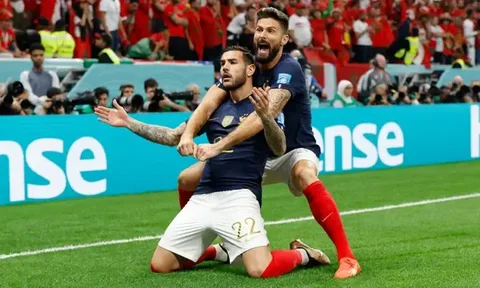
No recent event captures the emotional charge of this relationship better than the France Morocco World Cup 2022 semifinal in Qatar. Morocco had stunned the tournament by knocking out Spain and Portugal, becoming the first African and Arab nation to reach a World Cup semifinal. Then they ran into France.
The France Morocco score that night was 2-0, with Theo Hernandez scoring inside five minutes and Randal Kolo Muani sealing it late. France went on to the final. Morocco went home with fourth place and something arguably bigger: a run that changed how the football world saw North African teams, and a reminder of just how tangled French and Moroccan identity had become on the pitch, with several French players tracing their own roots back to Morocco and Algeria.
That match wasn’t just sport. For a lot of Moroccan and Franco-Moroccan fans, it played out like a proxy for the older story a former colonial power edging out its former protectorate at the last hurdle.
Details: What’s Happening Now
Lecornu landed in Rabat on the evening of July 15 and was received by Moroccan Head of Government Aziz Akhannouch. He brought a delegation of around a dozen ministers, including Foreign Affairs Minister Jean-Noël Barrot and Interior Minister Laurent Nuñez, which tells you the agenda isn’t ceremonial. Officials on both sides describe the trip as an effort to lock in the sharp improvement in ties the two countries have seen over the past two years.
The two governments held their 15th high-level bilateral meeting on July 16, the first gathering of that kind since 2019. Talks covered defense cooperation, security coordination, migration management, and investment in infrastructure, renewable energy, and advanced technology. There’s also been talk of a Rafale fighter jet deal, and both sides are reportedly laying groundwork for a future visit by King Mohammed VI to Paris.
The turning point behind all of this was France’s decision, in July 2024, to formally recognize Moroccan sovereignty over Western Sahara — a disputed territory Morocco has controlled since Spain withdrew in 1975, and which the Polisario Front still claims as an independent state. That recognition ended years of ambiguity from Paris and effectively reset the relationship after a genuinely difficult stretch marked by visa restrictions, disputes over judicial cooperation, and friction over intelligence sharing.
Quotes: What Officials and Analysts Are Saying
King Mohammed VI marked France’s National Day this week by describing the strengthened partnership as “a key factor for prosperity and a driver of a promising future,” language that reflects how far the relationship has come since 2023.
Analysts see the visit as more symbolic than transactional. According to reporting from Al Jazeera, one North Africa researcher argued that opening defense files linked to Western Sahara gives France’s policy shift institutional weight, turning what could have looked like a personal decision by President Macron into a lasting strategic position. Another regional expert framed Lecornu’s trip as significant less for what it produces on paper and more for what it signals about where the relationship is heading.
Impact: Why This Matters Beyond Paris and Rabat
France Morocco relations don’t exist in a vacuum. Morocco has spent the last decade turning itself into a logistics and manufacturing hub for companies trying to reach both Europe and Africa the expanded Tanger Med port complex is now one of the busiest shipping hubs in the Mediterranean. For France, closer ties with Rabat are partly about clawing back commercial ground it has lost elsewhere on the continent as China, Turkey, the Gulf states, and the U.S. compete for influence in Africa.
There’s a regional angle too. France Algeria relations remain strained, and Algeria has historically bristled at French support for Morocco’s position on Western Sahara. A warmer Paris-Rabat axis doesn’t make that triangle any simpler if anything, it raises the stakes for how Algeria positions itself next.
For ordinary people, the practical impact shows up in smaller ways: easier visa processing, more direct flights, expanded student exchange programs, and if defense talks go the way both sides want deeper security cooperation on counterterrorism and migration across the western Mediterranean.
Conclusion: What Comes Next
Lecornu’s Rabat trip wraps up with a wreath-laying at the Mausoleum of Mohammed V and an official lunch, but the real test will be whether the agreements discussed this week translate into signed deals over the coming months. Watch for movement on the Rafale jet negotiations, a formal date for King Mohammed VI’s visit to Paris, and whether investment pledges in renewable energy and AI actually show up in Morocco’s economy.
For now, France Morocco relations are on their best footing in years. Whether that holds depends less on this one visit and more on what both governments do with the goodwill it’s supposed to represent.
FAQs
Does France support Algeria or Morocco?
France has historically tried to balance ties with both countries, but its position shifted clearly toward Morocco in July 2024, when President Macron formally recognized Moroccan sovereignty over Western Sahara. That decision angered Algeria, which backs the Polisario Front’s claim to the territory and has periodically downgraded diplomatic contact with Paris in response. France still maintains formal relations with Algeria, but the balance of warmth has tilted toward Rabat in recent years, and Algeria has made clear it sees that tilt as a problem.
Why was France interested in Morocco?
Historically, France wanted Morocco for strategic and economic reasons tied to controlling North African trade routes and countering rival colonial powers, which led to the 1912 protectorate agreement. Today the motivations are different but still strategic: Morocco offers France a stable partner for trade, security cooperation, and access to African markets at a time when other global powers are expanding their own influence across the continent. Morocco’s growing logistics infrastructure, including the Tanger Med port, makes it an attractive gateway for French and European businesses.
How long was Morocco colonized by France?
Morocco was a French protectorate for 44 years, from 1912 until it gained independence in 1956. That’s notably shorter than Algeria, which was under direct French rule for 132 years. Spain also administered parts of northern Morocco during the same period, which is part of why Morocco’s colonial history is often described differently than Algeria’s in French and Moroccan political discourse.