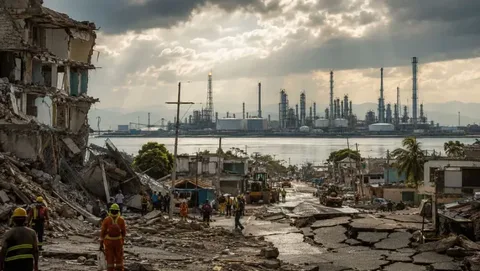
Venezuela’s economy stands as one of the most dramatic collapses in modern history, and people around the world keep asking what destroyed Venezuela economy after decades of oil wealth. In short, a mix of falling oil prices, government mismanagement, corruption, and crushing international sanctions pushed the once-wealthy nation into a prolonged financial disaster. Today, in 2026, the country is still trying to recover even after major political changes.
When Did Venezuela Economic Crisis Start
The Venezuela economic crisis did not happen overnight. Most economists trace its roots back to 2013, right after the death of former president Hugo Chavez, when Nicolas Maduro took over the presidency. As global oil prices crashed a year later, Venezuela’s heavily oil-dependent economy could not withstand the shock, and the downward spiral began almost immediately.
Within a few years, the situation worsened rapidly. By 2018, annual inflation had exceeded 130,000 percent, one of the worst hyperinflation episodes the world has seen in the 21st century. Basic goods disappeared from shelves, the local currency lost almost all its value, and millions of citizens found themselves unable to afford food or medicine.
Why Is Venezuela Poor With So Much Oil
This is one of the most searched questions online, and the answer lies in a painful irony. Venezuela sits on roughly 303 billion barrels of crude oil, which represents about a fifth of the entire world’s known reserves. Despite this enormous natural wealth, the country became one of the poorest nations in Latin America.
Years of underinvestment in oil infrastructure, corruption within state oil company PDVSA, and heavy US sanctions crippled production capacity. <cite index=”3-1″>Oil production fell to just over 1 million barrels per day, less than a third of what it produced at the end of the last century</cite>. Without steady oil revenue, the government could not fund social programs, public wages, or basic services, and the poverty rate climbed to nearly 90 percent of the population.
Background: How the Political Crisis Deepened the Economic Collapse
Political turmoil made the economic disaster far worse. <cite index=”12-1″>The July 28, 2024 presidential election became one of the most consequential tests of Maduro’s grip on power, with the opposition led by Maria Corina Machado and her proxy candidate Edmundo Gonzalez Urrutia obtaining voting records from over 30,000 polling stations suggesting Gonzalez won with roughly 67 percent of the vote</cite>. The National Electoral Council still declared Maduro the winner, sparking global outrage and further isolating Venezuela diplomatically.
The situation took an unprecedented turn on January 3, 2026. <cite index=”2-1″>US special forces captured Nicolas Maduro, ending his presidency, and Delcy Rodriguez, his former vice president, became acting president</cite>. This single event reshaped both the political and economic future of the country almost overnight.
What Happened to Venezuela President
Nicolas Maduro’s dramatic removal from power shocked the region. He was captured in a military operation and is currently held in US custody facing narco-trafficking charges. His removal ended more than a decade of authoritarian rule that many economists blame for accelerating Venezuela’s downfall.
Following his capture, Delcy Rodriguez took charge as interim president. <cite index=”5-1″>While Maduro remains in US custody, the acting administration under Rodriguez has moved swiftly to implement a plan for stabilization, recovery, and transition</cite>. Her government has focused heavily on reviving oil exports and negotiating with Washington to ease sanctions.
Venezuela Crisis 2024: The Turning Point
The year 2024 is widely seen as the turning point that set the stage for everything that followed. Inflation had briefly cooled to around 48 percent that year, offering a rare moment of relative stability. However, the disputed election results reignited unrest and set off a chain of events that eventually led to Maduro’s ouster in early 2026.
International observers, including the United Nations and regional governments, condemned the election process throughout 2024 and into 2025. This period of instability discouraged foreign investment further and deepened the humanitarian emergency that was already unfolding across the country.
Economic Crisis in Venezuela: The Numbers Behind the Collapse
The scale of Venezuela’s economic devastation is staggering when measured against historical figures. <cite index=”2-1″>Venezuela’s GDP collapsed roughly 80 percent between 2013 and 2025, falling from approximately 350 billion dollars to around 83 billion dollars</cite>. Very few economies in peacetime history have experienced a contraction of this magnitude.
Inflation remains one of the biggest daily struggles for ordinary citizens. <cite index=”2-1″>Full-year 2025 inflation surged to 475 percent, the world’s highest, with accumulated inflation of nearly 52 percent recorded in just January and February of 2026</cite>. Average monthly wages for many public workers still sit below 200 dollars, far short of what families need for basic survival.
Latest News on Venezuela Crisis
Recent developments suggest a cautious and uneven recovery is underway. <cite index=”8-1″>After 19 consecutive quarters of moderate growth, Venezuela’s economy is showing signs of a remarkable breakthrough, with an expansion of some 12 percent now possible this year</cite>, driven mainly by rising oil output and easing sanctions.
However, ordinary Venezuelans are not yet feeling the benefits of this growth. <cite index=”10-1″>Venezuela’s minimum wage remains at 130 bolivares, less than one dollar, frozen since March 2022</cite>, even as headline economic figures improve. This gap between macroeconomic growth and everyday living standards continues to fuel public frustration and protests in Caracas.
Meanwhile, foreign oil companies are cautiously returning. <cite index=”12-1″>Venezuela’s new hydrocarbons law, passed in January 2026, caps royalties at 30 percent and allows private companies to assume full operational management, a structural break from the mandatory joint-venture model in place since 2007</cite>. Firms including Chevron, Repsol, and Eni have expanded their operations under new licensing arrangements.
Impact: Regional and Global Consequences
Venezuela’s crisis has reshaped migration patterns across the entire Western Hemisphere. <cite index=”5-1″>Since 2014, roughly a quarter of Venezuela’s population, about 8 million people, has left the country, creating one of the largest displacement crises in recent history</cite>. Neighboring countries like Colombia, Peru, and Brazil have absorbed the largest share of these refugees, straining their own public services.
Globally, energy markets have also felt the ripple effects. As Venezuelan oil returns to international markets, analysts are watching closely to see how this affects global crude prices and supply chains, particularly given ongoing volatility in other oil-producing regions.
Conclusion: What Lies Ahead for Venezuela
Venezuela’s path forward remains uncertain, balanced between genuine signs of recovery and deep structural problems that will take years to fix. Experts caution that current growth is largely driven by oil and temporary external factors rather than lasting institutional reform. Without stronger rule of law, transparent governance, and sustained foreign investment, the current rebound could fade just as quickly as it arrived.
For now, the world continues to watch closely as Delcy Rodriguez’s interim government navigates relations with Washington, manages oil production increases, and attempts to rebuild public trust after more than a decade of economic devastation. Whether this marks a genuine new chapter or another temporary recovery will likely become clearer over the coming months.
Frequently Asked Questions
Why did Venezuela’s economy collapse?
Venezuela’s economy collapsed due to a combination of factors that built up over more than a decade. Heavy dependence on oil revenue left the country extremely vulnerable when global oil prices crashed in 2014. This was made worse by widespread corruption within the state oil company, poor government policy decisions, price controls that discouraged production, and years of crippling international sanctions that limited the country’s ability to sell its oil on global markets. Political instability under President Maduro further discouraged foreign investment, accelerating the downward spiral into hyperinflation and mass poverty.
What is the situation in Venezuela right now?
As of 2026, Venezuela is going through a period of major transition following the capture of former president Nicolas Maduro by US forces in January. Acting President Delcy Rodriguez is now leading efforts to stabilize the economy, ease tensions with the United States, and attract foreign investment back into the oil sector. While GDP growth projections look promising on paper, with some estimates suggesting up to 12 percent expansion this year, ordinary citizens are still struggling with extremely low wages, high inflation, and limited access to basic services like clean water and healthcare.
How serious is the Venezuela crisis?
The crisis remains extremely serious despite recent signs of economic improvement. Nearly 90 percent of the population still lives in poverty, and millions of people have already fled the country in search of better opportunities elsewhere. Public sector wages remain frozen at extremely low levels, water and electricity infrastructure continues to deteriorate, and the country’s public debt still sits at a very high percentage of GDP. Analysts widely agree that true recovery will require years of sustained reform, not just a temporary boost from rising oil exports.