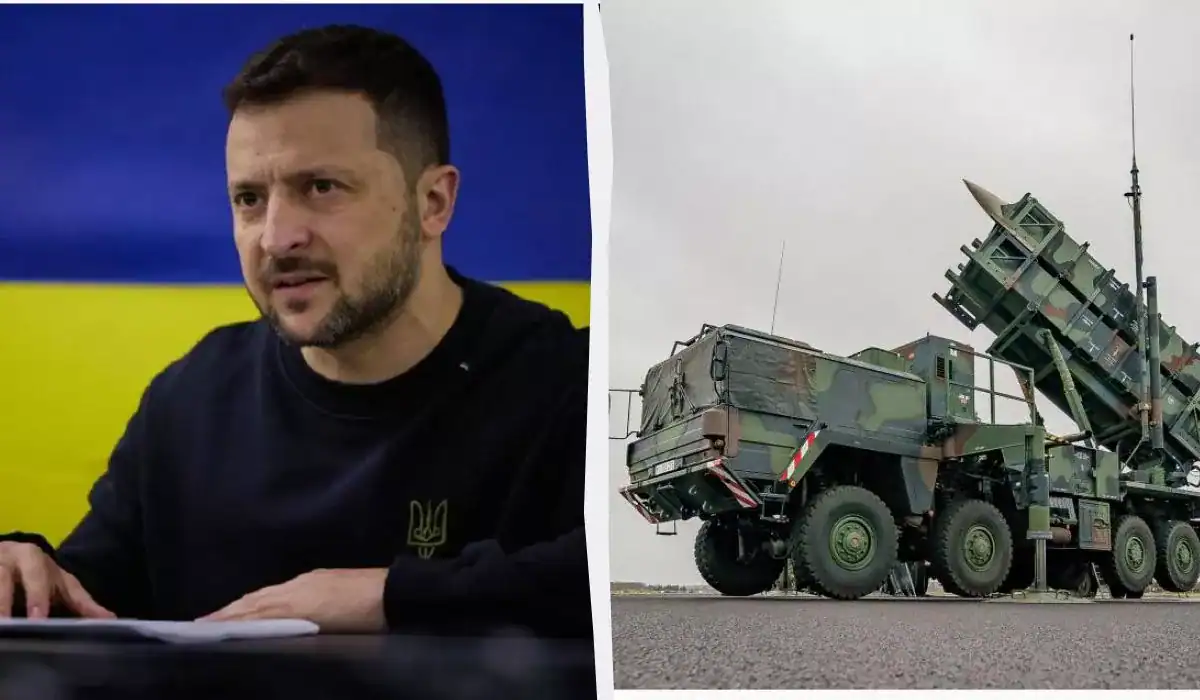
Ukrainian President Volodymyr Zelenskyy has renewed his call for urgent efforts to begin domestic production of the Patriot missile system. He wants Washington to grant Ukraine a licence to manufacture Patriot batteries and interceptors on Ukrainian soil. The appeal comes as Russian ballistic missile attacks continue to overwhelm Kyiv’s limited stock of interceptors.
Background
The Patriot air defense system, officially known as the MIM-104 Patriot, has been the backbone of Ukraine’s protection against Russian ballistic missiles since 2022. It remains one of the only Western systems capable of intercepting fast-moving ballistic threats.
However, global demand for the Patriot missile system has surged sharply in recent years. Conflicts in the Middle East, alongside the ongoing Russia-Ukraine war, have depleted almost a third of the global stockpile of Patriot interceptors, with Gulf states collectively firing more than 1,100 of them in recent months.
This shortage has left Ukraine struggling to keep pace with Russian strikes. Zelenskyy has said Ukrainian forces intercepted 31 of 33 cruise and ballistic missiles fired overnight in one recent incident, but shortages of Patriot interceptors specifically for ballistic threats remain a critical vulnerability.
Details
Speaking at the NATO summit in Ankara this week, Zelenskyy made his case directly to allies and to US President Donald Trump. He told the summit that current Patriot production is not enough to meet the growing demand for protection against ballistic missiles, and asked allies to support Ukraine’s efforts to secure a production licence.
The scale of the shortfall is significant. According to Zelenskyy, Lockheed Martin produces roughly 600 interceptors a year, or about 60 to 65 per month, a rate far below what current global conflicts demand.
Trump responded positively during a bilateral meeting on the sidelines of the summit. He told Zelenskyy that the United States would give Ukraine a licence to make Patriots, calling it “pretty cool”. This marked a major shift after years of Ukraine pushing for the same arrangement.
Despite the announcement, the process is not finalized. Zelenskyy later clarified that technical aspects still need to be agreed between Ukrainian and American teams before Patriot production can actually begin in Ukraine.
It also remains unclear exactly where manufacturing would take place. Trump indicated that a company would eventually be brought to Ukraine to work directly with Ukrainian industry, though he did not confirm whether missiles would be built in Ukraine or in another partner country.
Zelenskyy has separately been pushing European nations to accelerate their own Patriot missile system capabilities. He wants Europe to reduce its dependence on the United States for ballistic missile defense given the strain on global supply.
Understanding the Patriot Missile Battery
To understand why this shortage matters, it helps to look at how a Patriot battery is structured. A standard Patriot missile battery includes a radar unit, an engagement control station, a power generator, and multiple mobile launchers.
According to the Patriot air defense system Wikipedia entry, a Patriot battalion typically consists of a headquarters battery along with between four and six line batteries, which are the actual launching units. Each of these individual firing batteries is what most people refer to simply as a “battery.”
The number of launchers in a Patriot missile battery has grown over time. Recent European battery configurations typically include four launchers, though larger configurations of six to eight launchers per battery are also in service depending on the buyer’s requirements.
Each launcher can be loaded with either PAC-2 GEM-T missiles, which carry a blast-fragmentation warhead effective against aircraft and cruise missiles, or PAC-3 MSE interceptors, which are designed specifically to hit incoming ballistic missiles. A standard launcher can hold four GEM-T missiles or twelve of the smaller PAC-3 MSE interceptors.
The Patriot missile range varies significantly depending on which interceptor is used. The PAC-2 GEM-T variant can engage aircraft and cruise missiles at ranges up to roughly 70 kilometers, while the PAC-3 MSE variant offers improved range against faster, harder-to-hit ballistic targets.
Who Manufactures the Patriot Missile System
The Patriot missile manufacturer is a joint American industrial effort. Raytheon builds the radar and overall system architecture, while Lockheed Martin manufactures the PAC-3 interceptor missiles themselves.
Outside the United States, licensed production has historically been limited. Only Japan’s Mitsubishi Heavy Industries currently builds Patriot missiles under licence from US companies, a factor that has placed enormous strain on the US Army’s own production lines.
This is precisely why Ukraine’s request is significant. If granted, Ukraine would become one of the few countries in the world with the ability to build Patriot components domestically, alongside long-standing US allies.
Patriot Missile System Price
The Patriot air defense system carries an enormous price tag, which further explains why production has struggled to scale. A complete Patriot battery, including a radar unit, engagement control station, four to eight launchers, and a missile load of 24 PAC-3 MSE plus 8 GEM-T interceptors, carries an acquisition cost ranging from roughly $560 million for hardware and missiles alone to over $1 billion for a fully supported configuration.
Individual interceptor costs are steep as well. PAC-3 MSE interceptors cost approximately $4.2 million per unit based on recent US Army budget figures, while PAC-2 GEM-T interceptors cost around $4 million each.
Larger national procurement packages run into the billions. Poland’s Phase I contract, for example, covered four radars, sixteen launchers, and 219 PAC-3 MSE missiles for a total of $4.75 billion.
These figures highlight why even wealthy NATO members have struggled to expand their Patriot missile system holdings quickly, and why global supply cannot easily keep pace with simultaneous demand from Ukraine, the Middle East, and other US partners.
Quotes
Zelenskyy has been direct about the scale of the problem facing Ukraine’s air defenses. “We all value the Patriot system, but today’s wars have shown that current Patriot production is not enough to meet the growing demand for protection against ballistic missiles,” he told the NATO Summit in Ankara.
He also stressed the diplomatic groundwork already underway. “We have already discussed with our American partners the issue of licenses for Patriot production, and I ask you to support our efforts to make this a reality,” Zelenskyy said.
Trump, for his part, struck an optimistic tone about Ukraine’s manufacturing capacity. He said Ukraine has “a great ability to produce weapons, pretty complex weapons,” while also acknowledging current US stockpiles remain limited, saying “we have Patriots, but we don’t have that many. We need them for ourselves, too”.
Analysts have also weighed in on the significance of the shift. David Blagden, an associate professor of international security and strategy at the University of Exeter, described the outcome as a clear win for Ukraine, noting that building some of the best air defenses under licence could be a huge advantage in blunting Russian ballistic missile attacks.
Impact
The impact of this decision, if finalized, would extend well beyond Ukraine. A domestic Patriot missile system production line in Ukraine could eventually help supply other European nations facing their own air defense shortages.
Zelenskyy has framed this as part of a broader European push for self-sufficiency. He has repeatedly urged EU nations to invest in their own missile defense manufacturing rather than relying solely on the United States for future Patriot air defense system deliveries.
For Russia, the announcement is a significant setback. Moscow has increasingly relied on ballistic missile barrages specifically because Ukraine’s stock of Patriot interceptors capable of stopping them has been thin, resulting in high civilian casualties in cities like Kyiv and Kharkiv.
Regionally, the move could also reshape defense industry dynamics across Eastern Europe, with Ukraine potentially emerging as a new manufacturing hub for Western-designed air defense systems once large-scale production begins.
Conclusion
While Trump’s public commitment marks a major diplomatic breakthrough for Kyiv, the path to actual Patriot missile system production inside Ukraine remains unfinished. Technical negotiations between US and Ukrainian teams are still ongoing, and no firm timeline has been announced.
In the meantime, Ukraine continues to rely on allied deliveries through the PURL program to sustain its existing Patriot batteries. How quickly licensed production can be established will likely determine how effectively Ukraine can defend its cities against continued Russian ballistic missile attacks in the months ahead.
Frequently Asked Questions
Is Patriot better than S-400?
Direct comparisons between the Patriot missile system and Russia’s S-400 are difficult because the two systems are designed with different priorities. The Patriot air defense system, particularly its PAC-3 MSE variant, is specifically optimized for hit-to-kill interception of ballistic missiles at shorter to medium ranges, while the S-400 is built around longer-range engagement of aircraft and some ballistic threats using a layered missile family. Western defense analysts generally regard the Patriot as more combat-proven against modern ballistic missile threats, given its extensive real-world use in Ukraine, Saudi Arabia, and the UAE, whereas the S-400’s combat record against advanced Western-supplied threats is far more limited. Ultimately, effectiveness depends heavily on interceptor availability, radar coverage, and the specific threat being countered, rather than either system being universally superior.
Can Shaheen 3 be intercepted by S-400?
The Shaheen-III is a Pakistani medium-range ballistic missile with an extended range profile, and whether it could be intercepted by an S-400 system depends on multiple classified variables including flight trajectory, speed at intercept point, and which S-400 missile variant is deployed. Publicly available information on this specific scenario is limited, since neither Pakistan nor any S-400 operator has published data on such an engagement. In general terms, modern S-400 batteries are designed to engage a range of ballistic missile threats, but real-world interception success depends on radar detection range, missile speed, and the maneuvering characteristics of the incoming warhead, none of which can be confirmed without official testing data.
Who helped China get nuclear weapons?
China developed its nuclear weapons program independently, achieving its first successful nuclear test in 1964 during the Mao Zedong era. While China received early scientific and technical exchanges with the Soviet Union in the 1950s, that cooperation ended before China completed its own weapons program, meaning Beijing largely developed its nuclear capability through domestic research and its own scientists and engineers rather than direct foreign transfer of a completed weapon design.