The Gaza humanitarian crisis took another tragic turn this week after an Israeli air strike killed a prominent Palestinian aid worker just before a public World Cup screening he had organised. The strike, which also killed three other people, has renewed global attention on the humanitarian crisis in Gaza and the fragile ceasefire that has held since October last year. Rights groups say the incident reflects the scale of suffering that continues to define the humanitarian crisis in Palestine.
Background
The humanitarian crisis in Gaza has unfolded over more than two years of conflict, displacement and blockade. Even after a ceasefire agreement took hold in October, humanitarian conditions across the territory have remained dire. Homes, hospitals and schools lie in ruins in many areas, and reconstruction has barely begun.
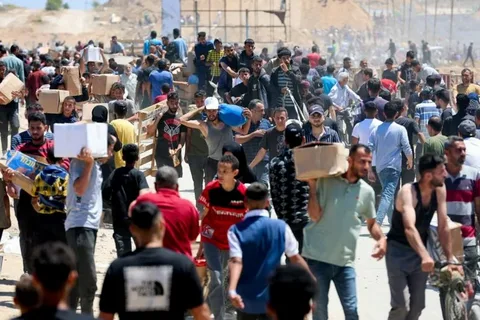
Ordinary life in Gaza has continued under extraordinary strain. Families live in tents or damaged buildings, humanitarian aid deliveries remain inconsistent, and access to clean water, electricity and medical care is limited. For many residents, even a small distraction like a football match offers rare relief from daily hardship.
Understanding what is happening in Gaza today requires looking at both the political ceasefire framework and the human reality on the ground, where basic needs remain unmet despite the formal end of large-scale hostilities.
Details
On Tuesday evening, an Israeli strike hit a vehicle in Gaza City’s Sabra neighbourhood, killing Mohammed al-Wahidi, a senior official with the Egyptian Committee in Gaza. He had spent weeks helping organise public World Cup screenings that gave displaced residents a brief escape from the humanitarian crisis surrounding them.
Three other people died in the same strike, including two young brothers and the driver of the vehicle. The attack occurred shortly before hundreds of Palestinians gathered among damaged buildings to watch Egypt play Argentina in the tournament’s knockout stage.
The Israeli military said the strike targeted a member of Hamas’s military wing travelling in the vehicle, and stated that al-Wahidi was not the intended target. It said the incident is under review and that it regrets harm to people not involved in hostilities.
Health authorities in Gaza report that more than 1,000 Palestinians, including children, have been killed by Israeli military action since the ceasefire took effect in October. This figure highlights how the humanitarian crisis in Gaza has continued despite the truce, with sporadic strikes still causing civilian casualties on a near-daily basis.
Large sections of Gaza also remain under Israeli military control, complicating aid distribution and reconstruction. Humanitarian organisations have repeatedly warned that access restrictions and security concerns continue to slow the delivery of food, medicine and shelter materials to affected families.
Quotes
Speaking about the strike, a Gaza resident who had watched matches organised by al-Wahidi described the loss as devastating, noting that such moments of joy are rare and precious in the enclave.
Egypt’s national team coach, Hossam Hassan, addressed the humanitarian crisis in Palestine directly during a pre-match briefing, urging global sports figures to speak up for Palestinians and calling for the world to let them live freely.
An Israeli military spokesperson confirmed the strike had taken place and said the incident is under review, adding that the military takes measures to limit harm to people not involved in the conflict.
Impact
The killing of a well-known humanitarian figure moments before a World Cup screening has drawn international attention back to the humanitarian crisis in Gaza at a moment when global media focus had shifted toward the tournament itself. Journalists and human rights observers say the timing of the strike has amplified public reaction across the Middle East and beyond.
Regionally, the incident risks straining the ceasefire further, with Egypt and other Arab states closely watching how Israel responds to mounting international criticism. Egypt has positioned itself as a key humanitarian actor in Gaza through committees like the one al-Wahidi worked for, and his death adds pressure on Cairo to press for stronger protections for aid workers.
Globally, the episode feeds into wider debate about the humanitarian crisis in Palestine and whether the current ceasefire framework adequately protects civilians and humanitarian personnel. Analysts note that continued casualties, even after a formal truce, undermine confidence in longer-term peace efforts and complicate reconstruction planning for Gaza.
Aid agencies argue that incidents like this illustrate why Gaza humanitarian aid delivery remains inconsistent, since safety concerns for both civilians and relief workers persist despite the ceasefire’s formal terms.
Conclusion
The death of Mohammed al-Wahidi is likely to remain a focal point in discussions about accountability and civilian protection as the humanitarian crisis in Gaza continues into its third year. Egyptian officials and international rights groups are expected to press for a full investigation into the strike and renewed guarantees for the safety of aid workers operating in the territory.
Going forward, observers will be watching whether the ceasefire holds, whether humanitarian aid access expands, and whether reconstruction efforts in Gaza can finally gain momentum. For now, the humanitarian crisis in Palestine remains a defining regional and global concern, with civilian casualties continuing even as diplomatic efforts to stabilise the situation proceed.
Frequently Asked Questions
What caused the humanitarian crisis in Gaza?
The humanitarian crisis in Gaza stems from years of armed conflict, large-scale displacement of residents, extensive destruction of homes and infrastructure, and restrictions on the movement of goods and people into and out of the territory. Repeated rounds of fighting have damaged hospitals, water systems and schools, leaving hundreds of thousands of people dependent on humanitarian aid for basic survival. Even after the ceasefire reached in October, reconstruction has been slow, and continued military activity has kept the humanitarian situation fragile rather than resolved.
Why is there no humanitarian aid in Gaza?
It is not accurate to say there is no humanitarian aid in Gaza at all, but aid flows have been inconsistent and often insufficient relative to the scale of need. Access restrictions, security incidents, damaged infrastructure and bureaucratic delays at border crossings have all slowed the delivery of food, medicine, fuel and shelter materials. Humanitarian organisations have repeatedly said that the volume of aid entering Gaza falls short of what is required to meet the needs of the population, particularly in areas still affected by military operations.
What is the meaning of humanitarian crisis?
A humanitarian crisis refers to a situation in which the wellbeing, safety and basic needs of a large group of people are severely threatened, typically due to conflict, natural disaster or displacement, and where external assistance is needed to address urgent needs like food, water, shelter, healthcare and protection. In the context of Gaza, the term describes the combined effect of conflict-related casualties, mass displacement, infrastructure damage and restricted access to essential services that has persisted for an extended period.