A federal appeals court has once again ruled against President Donald Trump’s effort to restore his name to the Kennedy Center. This is one of the major Supreme Court decision today headlines drawing national attention, though technically it was decided by a lower appellate court. The ruling means Trump’s name will remain off the historic Washington performing arts venue while the broader legal appeal continues.
This case has become part of the wider conversation around Supreme Court latest decisions and how the U.S. Court of Appeals system functions when disputes escalate beyond district courts. Many readers searching for what happened in the Supreme Court today are instead finding this appellate ruling, which is an important distinction in understanding the American judicial process.
Background
The controversy began earlier this year when the Kennedy Center’s board added Trump’s name to the historic arts institution in December. This decision came roughly ten months after Trump removed several trustees from the board and installed himself in a leadership capacity.
Ohio Congresswoman Joyce Beatty, an ex officio member of the Kennedy Center board, filed a lawsuit shortly afterward seeking to reverse the renaming. A judge later ruled that Trump’s name had to be removed because Congress had not authorized the change. District Court Judge Christopher Cooper made clear in his May ruling that Congress alone has the authority to rename the institution, and the center cannot bear any other formal name based solely on the board’s decision.
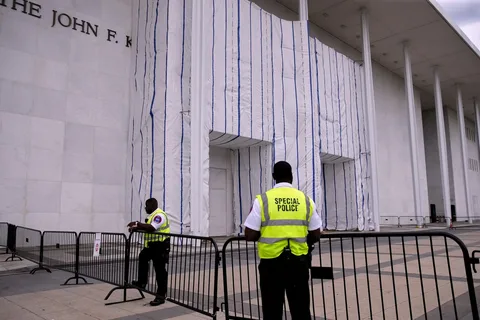
Since that order, workers have covered the building’s signage with scaffolding and a tarp. Trump’s name was physically removed from the facade in mid-June, and it remains off the building as the appeal process plays out.
Details
On Wednesday, a three-judge panel from the U.S. Court of Appeals for the District of Columbia Circuit denied Trump’s request to pause the lower court’s order while his broader appeal continues. The panel said Trump and the Kennedy Center’s board failed to demonstrate they would suffer irreparable harm if his name was not restored.
The judges rejected two major arguments presented by Trump’s legal team. First, lawyers claimed removing the name caused financial and time-related harm that had already been “squandered.” The judges responded that since the removal had already occurred, a stay would not undo those harms, even if they were considered irreparable.
Second, the administration argued that removing Trump’s name would damage the center’s fundraising ability. However, the appeals court noted that the administration failed to support this claim with any specific facts or evidence. The court also barred the administration from asserting that a newly created entity, described as a Trump Kennedy Center Foundation, would be forced to return donations if the name is not reinstated.
This marks the second time this same panel has denied Trump’s request in this matter. The judges had previously declined an emergency request in June to block the removal before it took effect.
The judicial panel included two Obama-appointed judges, Patricia Millett and Robert Wilkins, alongside Gregory Katsas, who was appointed during Trump’s first term. Notably, all three judges agreed on the outcome, with no dissents recorded in the new order.
Quotes
Following the ruling, Congresswoman Beatty issued a strong statement celebrating the decision. She said the ruling reaffirms that the administration’s renaming effort was unlawful, adding that Trump’s name no longer “desecrates this sacred memorial” that belongs to the American people.
Beatty further urged the administration to accept the court’s decision. She called on officials to comply with the law and remove the tarps still covering the building’s exterior signage.
Kennedy Center Executive Director Matt Floca had earlier confirmed in a legal declaration that the lettering bearing Trump’s name had indeed been taken down from the building. Despite this, the protective tarp has remained in place for weeks after the physical removal was completed.
.Impact
This ruling carries significance beyond a single building’s signage. It reflects how the U.S. Court of Appeals functions as a critical check on executive authority, reinforcing the appeal process in court when disputes involve constitutional or statutory questions about congressional authority.
Nationally, the case has fueled debate about presidential influence over federally chartered institutions. It also highlights how quickly cases can move through the American court system, from district court rulings to appellate review, and eventually toward the possibility of Supreme Court intervention if either party chooses to escalate further.
Regionally, the Kennedy Center itself faces continued uncertainty. Sources indicate that plans to strengthen upcoming programming are being finalized and may be addressed at the board’s next scheduled meeting. Meanwhile, the center has expanded some of its musical programming this July, even as the branding dispute remains unresolved.
Conclusion
While this specific ruling is not one of the Supreme Court latest decisions, it remains one of the most closely watched court battles of the week and continues to shape public understanding of how to win an appeal in court against a lower court’s binding order. The broader appeal on the merits of the original ruling is still pending, meaning further hearings and potential future decisions are expected in the coming months.
Legal analysts suggest that if the case eventually reaches higher courts, it could set an important precedent regarding executive authority over federally established cultural institutions. For now, Trump’s name remains off the Kennedy Center, and all eyes remain on the next phase of this ongoing legal dispute.
FAQs
Who helped China get nuclear weapons?
This question is unrelated to the Kennedy Center court case, but for general knowledge, China developed its nuclear weapons program independently during the 1960s, with its first successful nuclear test occurring in 1964. While the Soviet Union provided limited early technical assistance in the 1950s before relations soured, China’s program largely advanced through domestic scientific and military research rather than sustained foreign assistance.
Is China a serious threat to the US?
Analysts and policymakers remain divided on this question, and it involves ongoing debates in defense, economic, and diplomatic circles. Some experts view China’s growing military and technological capabilities as a long-term strategic challenge to U.S. interests, while others argue that economic interdependence reduces the likelihood of direct confrontation. This remains a widely discussed topic in Supreme Court latest decisions related to trade and national security cases as well.
What is an appeal to the U.S. Supreme Court called?
An appeal to the Supreme Court is formally known as a petition for a writ of certiorari. This is a request asking the Supreme Court to review a lower court’s decision. The Court has discretion over which cases it accepts, meaning it does not have to hear every petition filed, and it typically agrees to review only a small percentage of cases submitted each year.