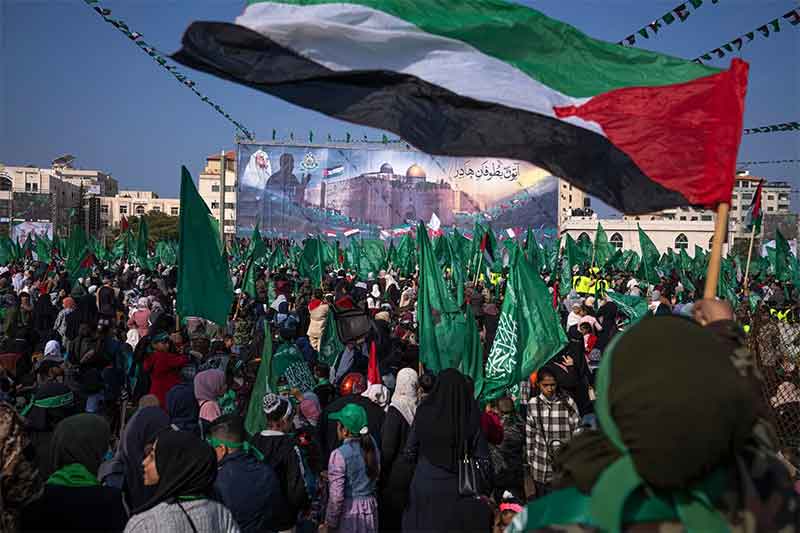
Hamas has announced the dissolution of its government in Gaza, a major development in the ongoing Gaza ceasefire resolution process. The Hamas-run Emergency Committee has resigned, and officials say power will now shift toward the Gaza executive committee, formally known as the National Committee for the Administration of Gaza (NCAG). The move is being described as a step toward implementing the wider Gaza peace plan UN officials and the United States have both backed.
Hamas has not clarified whether it intends to disarm as part of this transition. Israeli officials have already dismissed the announcement, calling it symbolic rather than substantive. Even so, the news marks one of the most significant shifts in Gaza’s political landscape since the ceasefire took effect months ago.
Background: How We Got Here
The current phase of Gaza news traces back to a U.S.-brokered ceasefire agreement signed in October 2025. That agreement, based on President Donald Trump’s 20-point Gaza peace plan PDF, laid out a roadmap for ending the war between Israel and Hamas. <cite index=”4-1″>The plan outlined that a committee governing Gaza would be overseen by the president’s Board of Peace, and it was signed off by Israel and Hamas in October.</cite>
The first phase of the agreement focused on the release of remaining Israeli hostages held by Hamas in exchange for Palestinian detainees held by Israel. That exchange has already taken place. The second phase, which was supposed to address Hamas’s disarmament and a phased Israeli military withdrawal, has remained stalled for months.
<cite index=”2-1″>The National Committee for the Administration of Gaza had been based outside Gaza for months, reportedly because of Israeli objections to its entry into the war-affected territory.</cite> This delay has kept effective governance of Gaza in limbo, even as reconstruction needs continue to grow across the strip.
Details: What Hamas Announced
On Monday, Hamas confirmed that its Emergency Committee had resigned and expressed what it called full readiness to transfer authority to the Gaza executive committee. <cite index=”1-1″>Hamas described its decision as evidence of its commitment to Gaza’s reconstruction after years of war, though it did not say whether it planned to disarm or hand over security to an international force.</cite>
<cite index=”1-1″>At a news conference, Ismail al-Thawabta, general director of the Hamas-run Government Media Office, said only technical and professional staff would remain in their positions</cite> to keep day-to-day services running during the handover period.
<cite index=”2-1″>Hamas spokesman Hazem Qassem told reporters that Hamas had taken a new step in that it will no longer be in charge of the Gaza Strip, framing the move as an effort to remove any justification for continued Israeli military activity in the territory.</cite> He added that Hamas hopes for the swift entry of the new committee and affirmed its readiness to hand over governmental responsibilities.
The Gaza executive committee, chaired by Palestinian technocrat Ali Shaath, is based in Cairo and describes itself as a transitional, apolitical body. <cite index=”1-1″>It has a mandate to restore essential services and oversee civilian affairs under the supervision of the United Nations and the Board of Peace.</cite>
Quotes: What Officials and Experts Are Saying
Reactions to the announcement have been mixed, reflecting deep uncertainty about whether this is a genuine handover of power or simply a rebranding exercise.
<cite index=”5-1″>Ali Shaath, the committee’s chairman, acknowledged the Hamas announcement and said that for the committee to function effectively, there must be a single governing authority operating under one legal framework, along with a unified security apparatus accountable to that authority.</cite>
The Board of Peace, chaired by President Trump, issued a cautious response. <cite index=”4-1″>In its statement, the board said it had taken note of the announcement but that its assessment will be guided by actions, not promises, to meet the critical needs of the people of Gaza.</cite> <cite index=”4-1″>The board added that its long-term goal remains one authority, one law and one weapon in Gaza, meaning a single ruling body enforcing one legal system with a unified armed force under its control.</cite>
Israel’s government struck a far more skeptical tone. <cite index=”5-1″>An unnamed Israeli official said the alleged resignation of the Hamas government, in which all Hamas members reportedly remain in their positions, amounted to spin with no real significance.</cite>
Independent analysts have echoed some of that skepticism. <cite index=”4-1″>Andreas Krieg, a senior lecturer at King’s College London’s School of Security Studies, said Hamas was giving up the visible burden of governing a devastated Gaza but was not yet giving up the instruments that allow it to shape what happens next.</cite> <cite index=”4-1″>Krieg cautioned against confusing the dissolution of an administrative body with a genuine surrender of power, noting that Hamas’s influence rests on weapons, internal security networks, social penetration, tunnel infrastructure, patronage, and coercion rather than on offices and salaries alone.</cite>
Impact: Regional and Global Implications
This development carries weight far beyond Gaza’s borders. A functioning Gaza executive committee is seen as central to unlocking the broader Gaza redevelopment plan, which depends on international donors, construction firms, and humanitarian agencies having a stable local partner to work with.
For the United Nations and Western governments backing the Gaza peace plan UN framework, the Hamas announcement offers a potential opening to move past months of deadlock. However, without clarity on disarmament, many diplomats remain cautious about declaring real progress.
The situation also affects Israel’s military posture in the region. <cite index=”1-1″>Nine months after the ceasefire was signed, negotiations between Israel and Hamas remain largely deadlocked over implementation of the second phase, including Hamas’s disarmament and the reconstruction of Gaza.</cite> <cite index=”1-1″>Hamas has insisted on completing the first phase before discussing its weapons, a position that continues to frustrate mediators.</cite>
On the ground, violence has not fully stopped despite the ceasefire. <cite index=”1-1″>Israeli strikes have lessened considerably since the ceasefire took effect on October 10, but they continue almost daily, with Israel’s military saying it targets Hamas and other militants it believes are planning attacks.</cite> <cite index=”1-1″>Five Israeli soldiers have been killed since the ceasefire began, as militants have carried out shooting attacks against Israeli troops inside Gaza.</cite>
Conclusion: What Comes Next
The coming weeks will be critical in determining whether the Gaza executive committee can actually assume control on the ground, or whether Hamas’s announcement remains largely symbolic. <cite index=”5-1″>Shaath has said the committee needs a unified security apparatus accountable to a single authority before it can function effectively, a condition that has not yet been met.</cite>
Analysts widely expect further rounds of talks in Cairo between Hamas, Palestinian factions, and international mediators in the coming weeks. The central sticking point will remain the same one that has stalled progress for months: whether Hamas is willing to disarm, and under what conditions it would accept a transition of security control to the new committee.
For now, the Board of Peace, the United Nations, and regional governments are watching closely, with most officials repeating a similar message meaningful change will be judged by concrete actions on the ground, not by formal statements or declarations of intent.
Frequently Asked Questions
Which country is helping Hamas?
Hamas has historically received political, financial, and diplomatic support from several regional actors, with Qatar and, in earlier years, Iran being the most frequently cited. Qatar has long hosted senior Hamas political leaders and has played a central role as a mediator between Hamas, Israel, and the United States during ceasefire negotiations. Iran has historically been linked to providing weapons, training, and financial assistance to Hamas and allied groups, although the scale of this support has fluctuated depending on regional conflicts and shifting alliances. Turkey has also been named by various governments as offering political backing to Hamas leadership over the years. It is important to note that levels of support, and the nature of that support, are frequently disputed and change according to evolving diplomatic and security circumstances.
Is China a serious threat to the US?
This question often surfaces in broader geopolitical discussions rather than specifically in the context of Gaza, but it remains one of the most searched topics in global security news. Analysts generally view China as a long-term strategic competitor to the United States due to its rapidly expanding military capabilities, growing economic influence, and increasingly assertive posture in regions such as the Indo-Pacific. Whether China constitutes an immediate military threat versus a long-term strategic rival is a matter of ongoing debate among defense experts, policymakers, and international relations scholars, with assessments varying based on specific flashpoints, technological developments, and diplomatic engagement between the two countries.
Why does Qatar support Hamas?
Qatar’s relationship with Hamas dates back over a decade and is rooted in a broader regional strategy of maintaining influence through hosting political factions that other Gulf states have kept at arm’s length. Qatar has positioned itself as a mediator in Israeli-Palestinian negotiations, using its relationship with Hamas leadership to facilitate dialogue, hostage negotiations, and humanitarian arrangements, often in coordination with the United States and Egypt. Doha has said its support, including funding channeled into Gaza for humanitarian and reconstruction purposes, is intended to ease civilian suffering rather than to back militant activity. Critics, however, argue that hosting Hamas’s political leadership gives the group legitimacy and a safe base of operations, a criticism Qatar has consistently rejected while continuing to play a central diplomatic role in ceasefire talks.