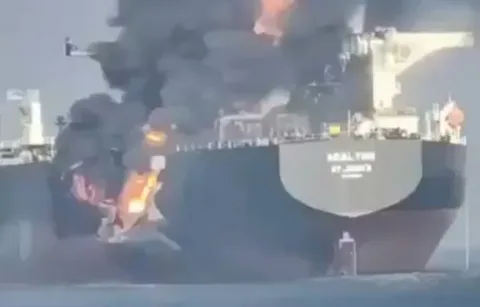
A tanker travelling through the Strait of Hormuz was struck by an unknown projectile early Tuesday morning, causing a fire on board near the coast of Oman. The British military’s maritime agency confirmed the strike but said no casualties or environmental damage had been reported so far. The incident adds fresh uncertainty to an already fragile situation in one of the world’s most important oil transit routes.
Background
The Strait of Hormuz has been at the center of regional tension since the United States and Israel launched joint strikes against Iran earlier this year. Since then, the narrow waterway between Iran and Oman has witnessed repeated attacks on commercial vessels, forcing many shipping companies to suspend or reroute their operations. This latest strike follows months of warnings from Iranian forces demanding that all tankers use routes it has approved, rather than international shipping lanes.
Understanding the Strait of Hormuz map helps explain why this waterway matters so much. It is a narrow passage separating Iran from the Arabian Peninsula, linking the Persian Gulf to the Gulf of Oman and, beyond that, to the open waters of the Arabian Sea. A large share of the world’s oil and gas shipments pass through this single chokepoint every single day, which is exactly why any disruption here sends immediate ripples through global energy markets.
Details of the Incident
According to the United Kingdom Maritime Trade Operations agency, the vessel was hit on its port side while travelling south out of the strait toward the Gulf of Oman. The strike occurred close to Limah, on the northern coast of Oman, and set off a fire on board. Authorities confirmed the crew was safe and that investigations into the exact source of the projectile were underway.
Iranian state television later suggested that a liquefied natural gas tanker had come under attack after allegedly ignoring official warnings. Reports citing anonymous sources claimed the vessel, reportedly named Al Rekayyat, was carrying gas from Qatar at the time it was struck. However, no formal claim of responsibility has been issued by Iranian authorities as of now.
This is not an isolated case. Earlier this year, the sanctioned tanker known as the Skylight oil tanker was struck by a projectile north of Khasab Port in Oman’s Musandam Governorate. That attack left several crew members injured and forced a full evacuation, drawing international attention to the growing dangers facing seafarers in the region.
Quotes and Official Statements
Iran’s joint military command had already issued a stern warning days before this latest strike, stating that any tanker failing to comply with its designated routes through the strait would face what it called an immediate and forceful response from its armed forces. The statement also cautioned that any interference by United States forces in the strait would be met with what it described as a rapid and decisive reaction.
Maritime security analysts have described the situation as one shaped less by a formal blockade and more by fear and psychological pressure on shipping companies. Industry data shows that transits through the strait have already dropped sharply, with many major shipowners choosing to suspend operations entirely rather than risk their vessels and crews.
Impact on Global Shipping and Oil Markets
The situation in Hormuz Strait carries consequences far beyond the region itself. Roughly one-fifth of the world’s oil supply and a significant share of global liquefied natural gas shipments pass through this narrow corridor. Any prolonged disruption threatens to push oil prices sharply higher, a concern that has already prompted several shipping giants to pause transits altogether.
Marine insurers have also become increasingly cautious, with many halting coverage for vessels attempting to pass through the strait. This has left shipping operators facing a difficult choice between paying steep risk premiums or avoiding the route entirely, adding further strain to an already stretched global supply chain.
Questions about who controls the Strait of Hormuz have resurfaced repeatedly during this crisis. While the strait itself lies within international waters under UN maritime law, Iran has repeatedly attempted to assert control over shipping routes passing through it, a claim that the United States and several Gulf states have firmly rejected.
Conclusion
As tensions continue to simmer, the international community remains on edge over further Strait of Hormuz news. With ongoing negotiations between the United States and Iran yet to yield a lasting resolution, maritime authorities have urged extreme caution for vessels operating in the area. Whether this latest tanker on fire in Strait of Hormuz marks another isolated incident or the beginning of a fresh escalation remains to be seen, and further developments are expected in the coming days.
Frequently Asked Questions
Whose oil tankers were attacked?
Several tankers of different nationalities and flag registrations have been targeted in the Strait of Hormuz since tensions escalated earlier this year. These have included vessels flagged under Palau, the Marshall Islands, and other international registries, carrying crude oil and liquefied natural gas from various Gulf nations including Qatar. The most recent incident involved a tanker reportedly carrying natural gas, while earlier attacks affected sanctioned vessels such as the Skylight, which had crew members from both India and Iran on board. Ownership and management of these ships often trace back to international shipping companies rather than any single government, making each incident a matter of serious concern for multiple countries at once.
Is the Strait of Hormuz owned by Iran?
No, the Strait of Hormuz is not owned by Iran. It is recognized under international maritime law as an international waterway open to navigation by vessels of all nations, since it connects the Persian Gulf to the Gulf of Oman and the wider Arabian Sea. While Iran controls the northern coastline of the strait and Oman controls parts of the southern side, neither nation holds sovereign ownership over the waterway itself. Iran has, however, repeatedly attempted to impose its own navigation rules and approved routes on vessels passing through, a move that the United States and several Gulf Arab states have strongly opposed, insisting that freedom of navigation must be preserved for international shipping.
Can girls wear jeans in Iran?
This question falls outside the scope of maritime and shipping news, but generally speaking, dress codes in Iran are governed by strict Islamic guidelines that apply publicly to all women, including foreign visitors. While jeans themselves are not explicitly banned, they must typically be worn alongside a long, loose-fitting top or manteau that covers the body appropriately, along with a headscarf covering the hair. Authorities have periodically relaxed or tightened enforcement of these rules depending on the political climate, so it is advisable for anyone travelling to or living in Iran to check the most current guidance from official or trusted travel advisory sources before making assumptions about acceptable clothing.