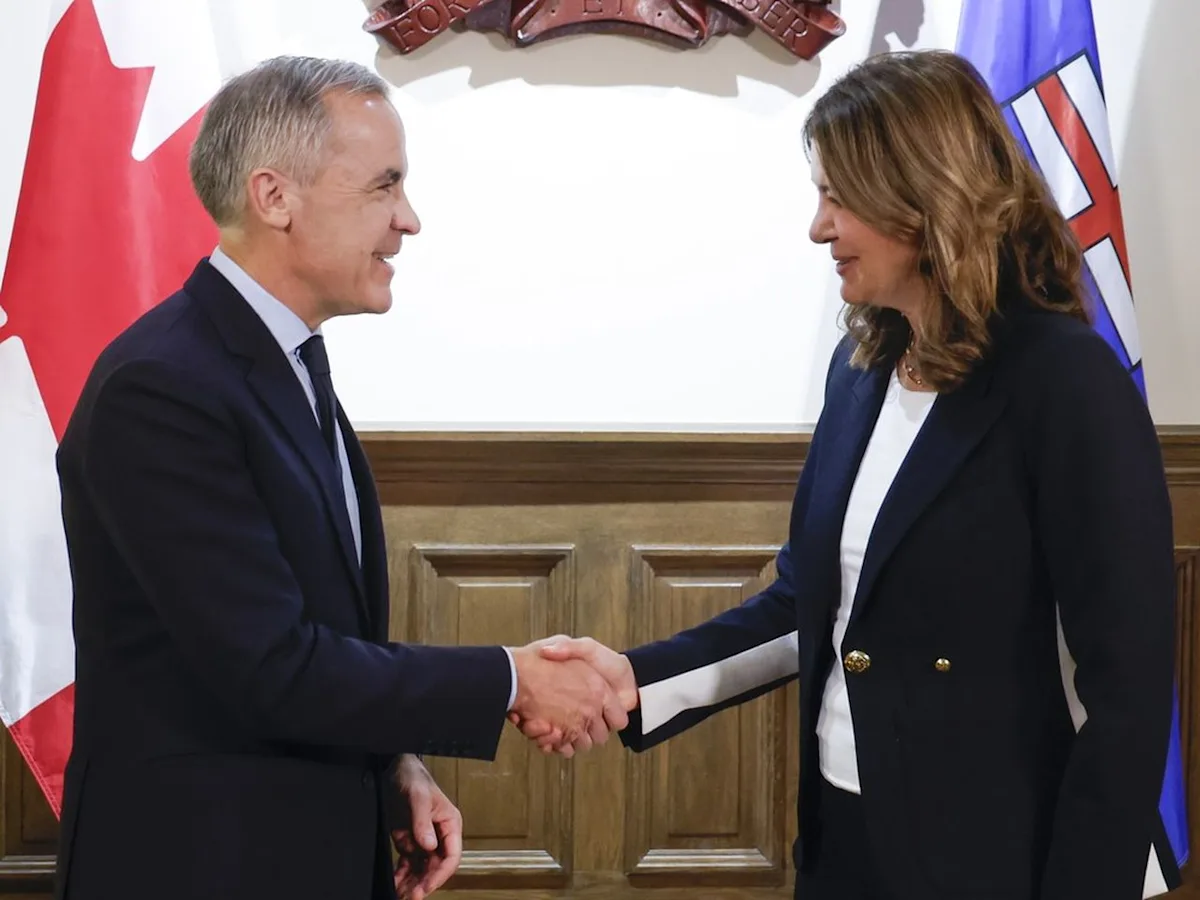
Canadian Prime Minister Mark Carney has moved forward with a long-awaited B.C. pipeline plan meant to carry more than one million barrels of oil per day from Alberta to Asian markets. The Eby pipeline route, running through southern British Columbia, is designed to ease Canada’s growing energy crisis and reduce the country’s dependence on a single export buyer.
Background
For decades, Canada has shipped the overwhelming majority of its crude oil to just one customer, the United States. That single-buyer arrangement left Alberta’s oil producers accepting steep price discounts, since they had almost nowhere else to sell.
The Trans Mountain pipeline expansion, completed in 2024, offered some relief. It carries Alberta crude to the B.C. coast, from where roughly two-thirds of shipments now head to Asia. Even so, the U.S. still absorbs the bulk of Canadian energy exports.
Trade tensions with Washington under President Donald Trump added new urgency. Tariff threats and shifting U.S. trade policy exposed how vulnerable Canada’s economy was to decisions made south of the border. That vulnerability is now widely described in Canadian policy circles as part of a broader Canada energy crisis.
Against this backdrop, Carney and Alberta Premier Danielle Smith began working on a fresh Carney B.C. pipeline proposal, one that could finally give Alberta’s oil patch a real alternative to the U.S. market.
Details
The proposed pipeline would begin in Bruderheim, northeast of Edmonton, and travel south through a corridor already used by the Trans Mountain pipeline. It would end on the southern coast of British Columbia, where tankers would carry the oil onward to Asian buyers.
Carney and Smith unveiled the route at a joint press event in Calgary. Officials say the completed project could move more than one million barrels of oil daily once operational.
The B.C. pipeline plan keeps a long-standing tanker ban in place along the northern coast of British Columbia. That ban has been a sensitive issue for years, and Premier David Eby made clear he secured firm assurances that it will not be lifted.
The Eby pipeline commitment matters politically. Eby has faced pressure from coastal communities and First Nations groups who strongly oppose any new tanker traffic near the ecologically sensitive Great Bear Rainforest. By preserving the northern ban while allowing a southern route, Carney’s government is attempting to balance economic ambition with environmental and Indigenous concerns.
Alberta’s government is also partnering with the federally owned Trans Mountain Corporation and Calgary-based Pembina Pipeline on what officials are calling the West Coast oil pipeline. The exact private-sector ownership split has not yet been finalized.
The line would follow closely along a route already used by the Trans Mountain pipeline, running from Bruderheim northeast of Edmonton to the southern British Columbia coast. This overlap with existing infrastructure is meant to speed up regulatory approval and reduce construction costs compared with building an entirely new corridor.
Alberta holds enormous untapped potential. The northern Alberta region contains one of the largest proven oil reserves in the world, estimated at roughly 164 billion barrels. Smith has said she wants the province to eventually double its output to eight million barrels per day over the next decade or more.
Broader Energy Context: Comparing Global Pipeline Strategies
Canada’s push mirrors a pattern seen elsewhere in the world, where nations with heavy reliance on a single export corridor look for alternate routes to protect themselves from disruption.
The UAE west-east pipeline, for example, was built specifically to give the Gulf state a way to move crude to export terminals without passing through the narrow and often tense Strait of Hormuz. That pipeline is widely cited as a Strait of Hormuz alternative pipeline model, allowing oil to reach international tankers even if shipping lanes through the strait were ever blocked.
Canada’s situation is different in geography but similar in logic. Just as the UAE sought insurance against a single chokepoint, Canada is seeking insurance against a single customer. Analysts say the Carney B.C. pipeline serves the same strategic purpose domestically that the Strait of Hormuz alternative pipeline serves for Gulf producers, reducing exposure to one point of failure.
Diversification efforts are not limited to oil. Canadian graphite mine development has also picked up pace in recent years, as the country looks to expand its role in critical minerals used for batteries and clean-energy technology. Government officials frequently pair pipeline announcements with references to this wider push, arguing that a stronger and more diverse energy mix Canada relies on will make the country more resilient against future shocks.
Officials involved in the pipeline talks have said the project is being paired with a proposed carbon capture initiative, with both expected to move forward together rather than as separate, competing priorities.
Quotes
Carney was direct about why the shift matters now. He said that Canada’s deep trade ties with the United States, once considered a strength, have become a liability given how quickly American trade policy can change.
“It’s time to move to action,” Carney told reporters in Calgary, standing alongside Premier Smith. He described the southern route through the Trans Mountain corridor as the most viable path to reach what he called the world’s fastest-growing markets.
Smith framed the deal in terms of economic independence for her province. She said the agreement would help ensure Alberta and Canada as a whole are no longer dependent on a single customer for their most valuable natural resource.
Not everyone welcomed the announcement. Coastal First Nations President Marilyn Slett said her community has no interest in economic benefits tied to a project it believes threatens the coastal way of life. Premier Eby, for his part, stressed repeatedly that the pipeline still lacks a confirmed private-sector proponent, a finalized route in some sections, and full permitting.
Impact
For Alberta’s energy sector, a completed B.C. pipeline route would mean access to buyers across Asia, potentially narrowing the price gap that Canadian crude has long suffered compared with global benchmarks. Producers have argued for years that limited pipeline capacity forces them to accept lower prices simply because they have nowhere else to sell.
For Canada as a whole, the project ties directly into efforts to address the wider Canada energy crisis narrative that has dominated economic policy discussions since renewed U.S. tariff threats began. Carney has noted that over 95 percent of Canada’s energy exports currently go to the United States, calling that level of dependence a serious vulnerability rather than a strength.
Globally, the pipeline could reshape trade flows in the Pacific. Asian economies looking to diversify their own energy suppliers away from Middle Eastern producers, including those reliant on routes near the Strait of Hormuz, may find a stable, democratic alternative in Canadian crude delivered through the new B.C. pipeline.
There are also political ripples inside Canada. Alberta is preparing for a public vote in the fall on whether to hold a referendum on separating from Canada altogether, a sentiment fueled partly by past federal reluctance to support new pipeline infrastructure. Supporters of the Eby pipeline and the broader Carney B.C. pipeline framework argue that visible federal action on energy exports could help ease those separatist pressures.
Environmental groups and some coastal First Nations remain firmly opposed, warning that any increase in tanker traffic along the southern coast raises the risk of a spill in ecologically important waters, even with the northern ban intact.
Conclusion
The Carney B.C. pipeline plan is still in its early stages. It currently lacks a confirmed private investor, a fully mapped route in every segment, and final regulatory approval. Carney himself has acknowledged that without a private-sector partner willing to build it, the project will not move forward at all.
Even so, the announcement signals a meaningful shift in Ottawa’s posture toward energy infrastructure after years of hesitancy. Combined with growing attention to Canadian graphite mine development and a broader rethink of the country’s energy mix, the pipeline reflects an effort to build a more diversified and resilient Canadian economy.
The coming months will likely bring further negotiations with British Columbia, ongoing consultation with coastal First Nations, and continued search for private backers. How those talks unfold will determine whether the Eby pipeline commitment to protect the northern coast can coexist with Alberta’s ambitions for expanded oil exports.
Frequently Asked Questions
What happened to the oil pipeline from Canada?
Canada’s federal government, under Prime Minister Mark Carney, has advanced a new proposal for a Pacific Coast oil pipeline running from Alberta to southern British Columbia. The route would closely follow the existing Trans Mountain pipeline corridor and is intended to carry more than one million barrels of oil per day to export terminals, where tankers would carry it onward to Asian markets. The project builds on a memorandum of understanding signed earlier between Ottawa and Alberta, and it now includes firmer commitments from British Columbia regarding environmental protections along the northern coast. The pipeline still needs a private-sector proponent, full permitting, and a completely finalized route before construction can begin, meaning it remains a proposal rather than a confirmed, funded project at this stage.
What does the USA buy from Canada?
The United States has traditionally been Canada’s largest energy customer, purchasing the vast majority of its crude oil exports along with significant volumes of natural gas and electricity. Beyond energy, the U.S. also imports large quantities of Canadian automobiles and auto parts, lumber and forestry products, agricultural goods, and various raw materials such as aluminum and potash. This deep trade relationship has historically been mutually beneficial, but recent tariff disputes and shifting U.S. trade policy have pushed Canadian officials to actively reduce their reliance on this single market, particularly for oil, by developing new pipeline infrastructure aimed at reaching Asian buyers instead.
Who owns 90 percent of Canada?
This is a common misconception rooted in the fact that a very large share of Canada’s land area, often cited as roughly 89 percent, is classified as Crown land, meaning it is owned by the federal or provincial governments on behalf of the public rather than by private individuals or corporations. It does not mean any single entity, company, or person owns the country. Provincial governments manage most of this Crown land, and decisions about resource development, including oil and gas projects like the proposed B.C. pipeline, must go through public and often Indigenous consultation processes precisely because so much of the underlying land remains under public ownership rather than private title.