
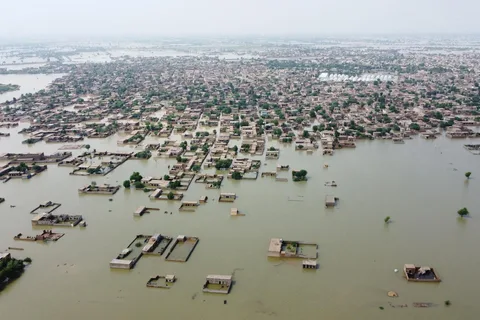
Flood loss in Pakistan 2025 has made it into the Economic Survey of Pakistan 2025 as a significant drag on economic performance which should not surprise anyone who has been watching Pakistan’s climate situation, but matters because it is now officially part of the national economic record.
Flood affected areas in Pakistan 2025 saw damage to agriculture, infrastructure, housing, and public services. The numbers being discussed in policy circles are large enough that climate resilience has stopped being a side conversation and become a central one in how policymakers think about economic planning.
Background
Pakistan is one of the countries least responsible for climate change and most exposed to its consequences. That gap between contribution and impact has been a consistent feature of international climate negotiations, and it shows up in real terms every monsoon season.
The 2022 floods set a reference point that has not been forgotten. That disaster which submerged a third of the country at its peak reshaped how disaster preparedness is discussed at every level of government and how international climate financing conversations are framed. It also raised a difficult question: if 2022 was the baseline for what extreme flooding looks like, what does the next decade hold?
Floods in Pakistan 2025 articles and NDMA assessments suggest the answer is: more of the same, at minimum. Preparedness has improved in some areas. The underlying vulnerability has not.
Economic Survey of Pakistan 2025 and Flood Impact
The Economic Survey of Pakistan 2025 was direct about climate-related vulnerabilities as a structural threat to economic stability. Weather-related disasters are no longer categorized as exceptional events that disrupt an otherwise stable trajectory. They are a recurring cost that the economy absorbs or fails to absorb every year.
Agriculture takes the most immediate hit. Pakistan’s rural economy depends heavily on crop production, and floodwaters do not discriminate between standing crops and fallow land. When fields go under water in the middle of a growing season, the losses are not recoverable that year. Farmers who lose harvests lose income, savings, and in many cases the ability to plant the following season without financial support they may not be able to access.
The reconstruction burden is the slower economic cost. Roads, bridges, irrigation infrastructure, schools, and health facilities all require repair or replacement after significant flooding. That spending comes directly out of development budgets, which means projects that were planned to build something new end up rebuilding what existed before.
NDMA Report on Flood 2025
The NDMA report on flood 2025 covered preparedness coordination, emergency response, and damage assessment across the affected regions. The National Disaster Management Authority ran alongside provincial agencies through the monsoon season, monitoring conditions and pushing early warnings where rainfall accumulation suggested elevated risk.
Early warning systems are one area where genuine improvement has been made since 2022. The coverage is broader, the lead time before alerts is longer in some areas, and coordination with provincial agencies has been better than it was. That matters communities with advance warning have time to move livestock, protect stored crops, and get people out of the most exposed locations.
The limitation is that early warnings help people survive flooding more safely, but they do not stop the flooding. Infrastructure that cannot handle the water volume fails regardless of how much notice the population received. That is the gap that early warning systems cannot close on their own.
Flood Affected Areas in Pakistan 2025
The flood affected areas in Pakistan 2025 spread across Punjab, Sindh, Khyber Pakhtunkhwa, and Balochistan, with severity varying significantly by district depending on rainfall intensity, river proximity, and local drainage capacity.
Rural communities near rivers and in low-lying areas bore the heaviest impact, as they typically do. These are also the communities with the least financial resilience — subsistence farmers and daily wage workers whose ability to recover from a bad season is limited to what they can borrow from family or local moneylenders.
Temporary displacement pushed thousands of families into relief camps or into relatives’ homes in higher ground areas. The displacement itself creates secondary effects: interrupted schooling, disrupted healthcare access, and the psychological toll of losing a home even temporarily.
Flood in Punjab Pakistan 2025
The flood in Punjab Pakistan 2025 drew particular attention because of Punjab’s weight in national agricultural production. Heavy rainfall in vulnerable districts created waterlogging conditions that damaged standing crops and disrupted transport links between farming areas and markets.
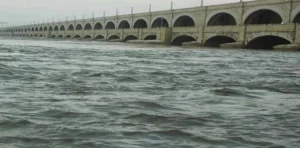
River monitoring was active throughout the season, and emergency measures were deployed in areas where water levels approached danger thresholds. Some interventions worked. Others came too late or were insufficient for the volume of water.
Agricultural experts tracking the Punjab situation flagged the same concern that comes up after every flood season: the infrastructure built to protect farmland embankments, drainage channels, irrigation systems has not been maintained or upgraded at the pace that changing rainfall patterns require. The gap between what the infrastructure was designed to handle and what it is now being asked to handle keeps widening.
Human and Economic Costs
Flood loss in Pakistan 2025 is a figure that captures property and infrastructure damage. It does not fully capture the human cost, which runs longer and cuts deeper than the damage assessments suggest.
Income loss for farming families does not end when the water recedes. Debt taken on to survive the flood season compounds through the following year. Children pulled out of school during displacement often do not return when flooding ends. Health risks from contaminated water sources persist for weeks after water levels drop. Small businesses that lose inventory or equipment face closure timelines measured in months, not days.
Economists studying Pakistan’s climate vulnerability have made the point consistently: repeated disasters slow development by pulling resources toward recovery and away from investment. Every rupee spent fixing flood damage is a rupee not spent building something new. Over decades, that reallocation compounds into a meaningful constraint on the growth trajectory.
Expert Views on Climate Resilience
The expert consensus on what Pakistan needs is clear and has been clear for some time. Improved drainage systems in flood-prone areas. Upgraded embankments along major rivers. Modern weather forecasting infrastructure at district level. Climate-resilient design standards for new construction. Urban planning that accounts for drainage capacity rather than ignoring it.
The gap is not in knowing what to do. It is in the sustained political and financial commitment to do it before the next monsoon, rather than after.
Urban planning is one area that gets less attention than rural flooding but has growing importance. Population growth in cities has pushed development into areas with poor drainage. When heavy rainfall hits those areas, flooding that would have run off into agricultural land now sits in residential neighborhoods. The problem is created by development decisions, not just by rainfall.
International partnerships matter here. Pakistan has made the case in global climate forums that vulnerable countries need adaptation financing, not just mitigation commitments. That case is legitimate, and some financing has come through. Whether it comes at the scale and speed the situation requires is a different question.
Regional and Global Impact
The floods in Pakistan do not stay within Pakistan’s borders in their consequences. Agricultural supply disruptions from major flooding events affect commodity prices regionally. Labor migration from flood-affected areas puts pressure on receiving cities and provinces. Food insecurity in affected regions has ripple effects on nutrition and health that take years to resolve.
International organizations that track climate vulnerability consistently cite Pakistan as a case study for what climate change does to developing economies not in the future, but now. That framing matters for climate financing negotiations, where the connection between emissions elsewhere and damage in Pakistan is well-documented but difficult to translate into binding commitments.
Looking Ahead
The Economic Survey of Pakistan 2025 signals that climate adaptation will remain a policy priority through the coming years. That signal is necessary. Whether it translates into consistent budget allocation, sustained infrastructure investment, and genuine inter-agency coordination will determine whether Pakistan’s flood vulnerability actually decreases or whether the same conversation keeps happening after every monsoon.
Changing rainfall patterns mean the window for getting this right is not open indefinitely. Weather systems that once produced predictable seasonal flooding are producing more extreme, less predictable events. Infrastructure planning that worked for last century’s rainfall does not work for this century’s.
Progress has been made in early warning and emergency response. The structural work drainage, embankments, floodplain management, climate-resilient construction — is where the gap remains largest.
Conclusion
Flood loss in Pakistan 2025 is a line item in an economic survey, a statistic in an NDMA report, and a lived reality for the communities that absorbed the damage. The Economic Survey of Pakistan 2025 puts it in national economic terms. The flood affected areas in Pakistan 2025 put it in human terms.
Both framings matter. Climate resilience is an economic necessity, not a luxury policy debate. Pakistan has limited fiscal space and growing climate exposure. Managing that combination requires serious, sustained investment not emergency responses followed by policy drift until the next monsoon arrives.
FAQs
What is the current GDP of Pakistan in 2026?
Pakistan’s GDP in 2026 is estimated to have grown compared to the previous fiscal year, supported by IMF program stabilization, improved external account conditions, and modest recovery in key sectors. Exact figures depend on the methodology and source — the State Bank of Pakistan, IMF Article IV consultations, and the Economic Survey provide the most reliable estimates. Growth has been positive but modest, with inflation, fiscal consolidation, and external debt obligations all continuing to constrain expansion. Real GDP growth projections from major institutions range between 2.5 and 3.5 percent for the current fiscal year.
What is the IMF report on water crisis in Pakistan?
The IMF has flagged water management as an economic risk in Pakistan across multiple assessments. The concerns center on water scarcity in agriculture-dependent regions, inefficient irrigation systems that waste significant volumes, groundwater depletion from over-extraction, and the compounding effects of extreme weather events on water availability. IMF recommendations have included investment in water storage infrastructure, reform of agricultural water subsidies that encourage inefficient use, and stronger climate adaptation spending. Pakistan’s water stress is projected to worsen as population grows and glacial melt patterns change.
What is the biggest flood in Pakistan history?
The 2022 monsoon floods are the most destructive in Pakistan’s recorded history. At their peak, floodwaters covered roughly one-third of the country’s territory. The disaster killed over 1,700 people, displaced more than 30 million, and caused economic losses estimated at over 30 billion US dollars. Entire districts in Balochistan and Sindh were submerged for weeks. The event reshaped international conversations about climate financing for vulnerable countries and remains the reference point against which all subsequent Pakistani flooding is measured.