
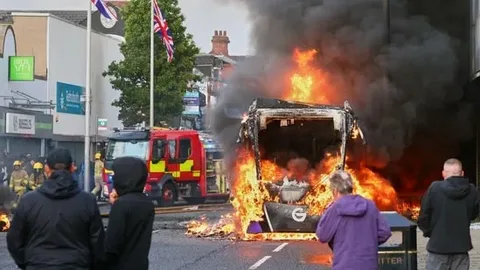
Belfast is not a city that forgets its history of conflict easily and in 2026, that history feels uncomfortably close to the surface again. Anti-immigration protests have turned into violent street clashes across several parts of the city, drawing urgent national attention and putting authorities under serious pressure to restore order.
Property has been damaged. Police have intervened. And across social media, a storm of unverified claims is making an already tense situation significantly harder to manage. The Belfast riots 2026 are not just a policing problem they are a symptom of something that has been building for a long time.
Background of Belfast Immigration Unrest
To understand what is happening now, it helps to understand what has been simmering beneath the surface. The Belfast riots 2026 did not emerge from nowhere. Immigration debates have been intensifying across the United Kingdom for years, and Belfast with its own distinct political identity and history of community division has not been shielded from those pressures.
Housing shortages, economic anxiety, and disagreements over integration policy have all contributed to a steadily rising tension in parts of Northern Ireland. The phrase “Belfast anti immigrant unrest today” trending online reflects a public that is anxious, confused, and hungry for answers that official channels have been slow to provide.
Community fault lines that were quieter a few years ago have reopened. And when those fault lines open in Belfast, the consequences tend to be felt quickly and sharply.
What Triggered the Belfast Riots?
The immediate trigger for the Belfast riots 2026 appears to have been a combination of local incidents that collided with an already overheated online environment. Reports of a violent confrontation specifically a Belfast stabbing incident spread rapidly across social media platforms before any official account was available, and the gap between what people were reading online and what authorities were confirming became its own accelerant.
Searches for “Belfast stabbing what happened” and “Belfast knife attack motive” spiked sharply, reflecting genuine public confusion about what had actually occurred. In that information vacuum, speculation filled the space that facts should have occupied and some of that speculation was deliberately inflammatory.
Certain groups moved quickly to connect the incident to immigration, and that framing spread faster than any correction could follow it. By the time authorities were urging caution, the narrative had already taken hold in significant parts of the online conversation.
Knife Attack and Stabbing Incident Details
Police have confirmed that a serious stabbing case is under active investigation and that it is connected to the broader context of the current unrest. What they have not confirmed is the Belfast knife attack motive and that distinction matters enormously, even if it has not slowed the spread of claims online.
The term “Belfast migrant attack” has been circulating widely across social platforms, but law enforcement has been explicit: drawing conclusions before official evidence is released is not just premature, it is actively dangerous. Misinformation in situations like this does not just mislead it inflames.
“Belfast knife attack x” trended across multiple platforms, a real-time demonstration of how quickly unverified content can become part of the dominant public narrative during a sensitive incident. That speed is one of the core challenges facing both authorities and responsible media in situations like this one.
Police Response and Crowd Control
Northern Ireland’s police service moved quickly to get additional resources onto the streets as gatherings turned aggressive. Riot control measures were deployed in several areas where crowds became too large and too hostile to manage through ordinary policing.
The operational priorities have been clear from the start: disperse dangerous gatherings, protect property and people, and prevent the disorder from spreading to parts of the city that have so far remained calm. Whether those priorities can all be achieved simultaneously in a fast-moving situation is the challenge that every officer on the ground is navigating in real time.
Police have also made a point of appealing directly to the public not just for physical calm on the streets, but for restraint online. Every piece of unverified content shared during an active disorder situation has the potential to pull more people into it.
Why Belfast Riots Are Happening
The “Belfast riots reason” question does not have a single clean answer, and anyone offering one should probably be treated with suspicion. What is happening in Belfast in 2026 is the product of multiple pressures that have been building simultaneously and have now found a point of release.
Economic pressure is real. Housing in Northern Ireland, as across much of the UK, has become significantly less affordable, and competition for limited resources creates resentment that looks for somewhere to land. Immigration has become the focal point for some of that resentment, whether or not the connection is accurate or fair.
Political debate around immigration has also become sharper and less nuanced in the UK’s broader national conversation, and those national arguments filter down into local communities where people are already feeling stretched. Add social media’s ability to transform a local incident into a nationally trending story within minutes, and the conditions for rapid escalation are in place before anything has even happened.The stabbing incident did not create these conditions. It activated them.
Impact of Belfast Anti-Immigrant Unrest
The Belfast anti immigrant unrest today is being felt well beyond the streets where the clashes are actually happening. Businesses in affected areas have shut early or taken damage they had no reason to expect. Residents who have nothing to do with the protests are frightened and disrupted. Communities that were quietly getting on with the difficult work of integration are watching that work be undermined by a wave of hostility that does not represent them.
Politically, the pressure is intensifying from multiple directions. Leaders are being asked to condemn the violence most are doing so. They are also being asked to address the underlying concerns that the protests claim to represent and that is where the responses become more careful and more contested.
International observers are watching closely, partly because Belfast carries symbolic weight, and partly because the patterns visible here online mobilization, rapid escalation from incident to riot, immigration as the focal point are appearing in cities across Europe. Belfast is not uniquely susceptible to this. It is simply the latest city where these forces have found a flashpoint.
Community and Official Reactions
Local leaders and community representatives have been consistent in their message: violence is not a legitimate response to grievance, and dialogue is the only path that actually leads anywhere. Those calls for calm carry real weight in a city where community leadership has historically played a significant role in whether tensions escalate or de-escalate.
Officials have been equally clear that the violence will be met with consequences arrests are being made, CCTV footage is being reviewed, and charges are expected. But they have also been careful to acknowledge that policing alone cannot resolve the underlying pressures. That requires a different kind of response, over a longer timeframe, from institutions with broader reach than the police service.
Security analysts watching the situation have flagged the risk of a cycle taking hold where each incident generates online content that generates more anger that generates more incidents. Breaking that cycle requires getting ahead of the misinformation as much as it requires getting ahead of the crowds.
Global and Regional Impact
The images coming out of Belfast have reached audiences well beyond the United Kingdom, and the reaction from European observers in particular has been notable. Countries that are managing their own versions of immigration-driven political tension are watching Northern Ireland as a case study in what happens when those tensions are left to build without adequate political response.
For the UK government, the Belfast riots 2026 are an uncomfortable reminder that immigration is not an abstract policy debate it is a lived experience in communities, and the gap between policy conversation and street-level reality has consequences. How that gap gets addressed, if it gets addressed, will have implications beyond Northern Ireland.
The role of digital platforms in amplifying local conflict into national and international stories is also drawing renewed attention. The speed at which this situation spread online is not unique to Belfast but Belfast’s specific political sensitivity makes the stakes of that speed higher than they would be almost anywhere else.
Conclusion
The Belfast riots 2026 are a serious moment for a city that has worked hard, over decades, to move beyond its association with street-level conflict. What is happening now does not erase that work but it does demonstrate how quickly the conditions for unrest can reassemble when economic pressure, political polarization, and online misinformation all arrive at the same moment.
Restoring order on the streets is the immediate task, and authorities are working at it. But the harder task addressing the underlying issues that made those streets vulnerable to this kind of disorder requires a sustained commitment from political leaders, community organizations, and institutions that goes well beyond the current crisis.The coming days will show whether the immediate situation can be stabilized. Whether the deeper problems get addressed is a question with a much longer timeline.
FAQs
What was the stabbing in Belfast about?
Police are actively investigating the stabbing incident connected to the current unrest, and the investigation remains open. Officials have confirmed that a serious attack took place, but the full circumstances, including motive, have not been officially established. Authorities have specifically warned against accepting online claims about the nature of the attack or those involved, noting that misinformation about this incident has already contributed to escalating tensions on the ground. The investigation will determine the facts and those facts matter.
Which is safer, Belfast or Dublin?
Both cities are generally safe for residents and visitors by European standards, and both have improved significantly in terms of public safety over the past two decades. Like any major urban area, safety varies by neighborhood and time of day, and conditions can shift during periods of civil unrest. Visitors to either city are advised to stay aware of local conditions, avoid areas experiencing active disorder, and check current guidance from local authorities. The current unrest in Belfast is concentrated in specific areas rather than being city-wide.
Is Belfast still segregated?
In some respects, yes. Belfast still carries visible signs of its historical divisions peace walls in certain neighborhoods, areas that remain predominantly unionist or predominantly nationalist, and community identities that remain strongly tied to that political history. But the picture is not static. Significant integration has occurred across many parts of the city since the Good Friday Agreement, and younger generations in particular are navigating a Belfast that looks quite different from the one their parents grew up in. The challenges are real, but so is the progress that has been made.