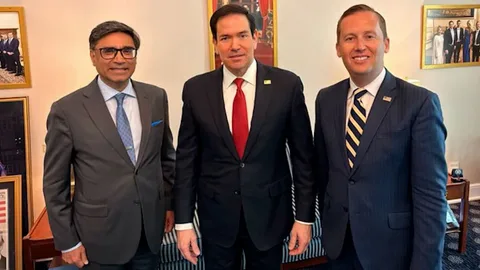
US Secretary of State Marco Rubio arrived in India on May 23, 2026, for a landmark four-day diplomatic visit even as a ferocious India heatwave 2026 ravaged the country, killing at least 16 people in the southern state of Telangana. Rubio met Prime Minister Narendra Modi, invited him to the White House, and participated in the Quad ministerial meeting in New Delhi. The twin crises of diplomatic friction and extreme climate conditions have placed India at the center of global attention this week.
Background
Rubio’s visit to India came at a critical moment in US-India relations. The Trump administration had previously doubled tariffs on India to 50 percent over New Delhi’s continued purchases of Russian oil a policy that had strained bilateral ties for months. Washington has also been dealing with the geopolitical fallout of the US-Israeli conflict with Iran and the closure of the Strait of Hormuz, which struck India particularly hard given its heavy reliance on Gulf energy imports.
The India heatwave 2026 date that officials now mark as the season’s most dangerous period began in mid-May, with temperatures consistently climbing above 45 degrees Celsius across large parts of the country. India’s 1.4 billion people were simultaneously navigating a high-stakes diplomatic moment and a dangerous public health emergency.
Rubio in India: Key Diplomatic Developments
Rubio in India kicked off with stops in Kolkata, New Delhi, and Jaipur. In Kolkata, he visited the tomb of Mother Teresa and the headquarters of her charitable organization a gesture widely seen as a signal of goodwill toward the Indian public. In New Delhi, he oversaw a ribbon-cutting ceremony for a new wing of the US Embassy, symbolizing a long-term American commitment to the bilateral relationship.
The centerpiece of the visit was a meeting between Rubio and Prime Minister Modi. The US State Department confirmed that both leaders agreed to deepen trade and defense cooperation and to accelerate collaboration on critical and emerging technologies. Rubio formally invited Modi to the White House a move observers described as a significant diplomatic olive branch following months of tension.
“This important relationship between our two countries is at the cornerstone of our approach to the Indo-Pacific,” Rubio said during his visit.
The four-day trip concluded with the ministerial meeting of the Quadrilateral Security Dialogue, known as the Quad, on May 26 in New Delhi. The Quad groups the United States, Japan, Australia, and India, and has been described informally as the Asian counterpart to NATO. The meeting was seen as Washington’s reaffirmation of its commitment to the Indo-Pacific region, particularly after US President Donald Trump visited Beijing and met Chinese President Xi Jinping in early May.
India Heatwave 2026: Deaths, Temperatures, and Warnings
While Rubio was conducting high-level diplomacy, millions of Indians were struggling under the weight of the India heatwave 2026. At least 16 people died of heatstroke in the southern state of Telangana, making it one of the deadliest heat events of the season so far.
The India heatwave 2026 date of peak severity has been recorded throughout May, with temperatures in several cities hovering well above 45 degrees Celsius. In the capital, New Delhi, and surrounding areas, mercury stayed above 40°C for the entire week, sending electricity consumption soaring to record levels. Overnight temperatures also remained dangerously high, giving residents little time to recover from the blazing daytime heat.
Telangana’s revenue minister Ponguleti Srinivasa Reddy called for “statewide vigilance” to protect public health. His office stated that the intensity of the heat had reached unprecedented levels, and urged officials to issue advance warnings across the state. The local government advised the elderly, children, and pregnant women to stay indoors during daylight hours unless absolutely necessary.
The India Meteorological Department (IMD) issued warnings earlier in the week, predicting above-normal temperatures and intense heatwave conditions across multiple regions. Power grids were under enormous stress as millions of households and businesses ran air conditioners and cooling equipment around the clock.
Health experts have explained that extreme heat leads to dehydration that thickens the blood and, in particularly severe cases, causes organs to fail. The India heatwave 2026 has made this danger very real for vulnerable populations across the country.
Quotes from Officials
Telangana Revenue Minister Ponguleti Srinivasa Reddy: “The intensity of the heat has reached unprecedented levels. Officials should issue advance warnings about precautions to be taken during heatwaves.”
US Secretary of State Marco Rubio (on US-India ties): “This important relationship between our two countries is at the cornerstone of our approach to the Indo-Pacific.”
US State Department (on Modi-Rubio talks): Rubio and Modi “agreed to deepen trade and defence cooperation and accelerate collaboration on critical and emerging technologies.”
Climate Context: Why the India Heatwave 2026 Is So Severe
India is no stranger to brutal summers, but scientists have repeatedly found that climate change is making heatwaves longer, more frequent, and more deadly. The India heatwave 2026 fits this pattern precisely. India’s highest officially recorded temperature remains 51°C, measured at Phalodi in Rajasthan in 2016 but experts warn that record could be broken in coming years.
India is the world’s most populous nation and its third-largest emitter of greenhouse gases. The country relies heavily on coal for power generation. While India has committed to reaching a net-zero emissions economy by 2070, that deadline is two decades behind the targets set by most industrialized Western nations. Scientists and climate advocates continue to warn that such timelines are insufficient given the accelerating pace of global warming.
The India heatwave 2026 is not only a domestic health emergency it is a signal to the world that climate adaptation and mitigation must be central to international diplomacy.
Regional and Global Impact
The India heatwave 2026 has disrupted daily life for hundreds of millions of people. Schools in affected states have modified schedules, outdoor workers have faced severe health risks, and hospitals have reported a surge in heat-related admissions. Power demand has hit record highs, straining the national grid at a time when the country also needs stable electricity for economic growth.
On the diplomatic front, Rubio in India has broader implications for the Indo-Pacific region. The Quad summit sends a clear message about the alignment of democratic nations against Chinese assertiveness in the region. Meanwhile, the energy security discussions that took place during the visit including the extension of a US sanctions waiver on Russian oil at sea reflect the practical pressures India faces as it balances strategic alliances with economic realities.
The India-US relationship is deeply intertwined with global climate, energy, and security questions. As Rubio in India navigated those complexities, the deadly heatwave served as a stark reminder that climate is no longer a secondary issue in international relations.
Conclusion
Rubio in India marked a turning point in a relationship strained by tariffs, Russian oil purchases, and geopolitical friction. The Quad meeting, the Modi invitation to the White House, and the deepening of defense and technology cooperation all suggest Washington is determined to keep India in its strategic camp. At the same time, the India heatwave 2026 with its 16 confirmed deaths in Telangana, temperatures above 45°C, and record power demand underscores that climate risk is now an unavoidable backdrop to every diplomatic engagement. As the monsoon season approaches, India and the world will be watching both the diplomatic outcomes of this visit and the trajectory of one of the world’s most climate-vulnerable nations.
FAQs
What is the monsoon prediction for 2026 in India?
The India Meteorological Department has predicted above-normal temperatures and prolonged heatwave conditions for several parts of the country in May 2026. The monsoon season is expected to begin arriving in Kerala around its typical early June window, but climate scientists note that erratic pre-monsoon heat spells like the current India heatwave 2026 can sometimes affect the timing and distribution of monsoon rainfall. Official IMD forecasts for the full 2026 monsoon season are expected to provide more detailed predictions as June approaches.
Will 2026 be hotter than 2025?
Based on current data, 2026 is tracking toward being one of the hottest years on record globally. The India heatwave 2026 has already produced deadly temperatures well above 45°C in multiple regions, and scientists note that the underlying trend of global warming continues to push annual temperature baselines higher. While year-to-year variation exists, the long-term trajectory is unmistakably upward. Climate researchers have noted that extreme heat events are becoming more frequent and intense, meaning 2026 could indeed surpass or match 2025 in terms of peak temperatures across South Asia.
Why is 2030 the point of no return?
Many climate scientists and international bodies, including those linked to the IPCC, have identified the late 2020s to early 2030s as a critical window for decisive climate action. If global greenhouse gas emissions are not significantly reduced by around 2030, the world is likely to breach the 1.5°C warming threshold set by the Paris Agreement, making it virtually impossible to avoid the most catastrophic consequences of climate change — including more severe heatwaves like the India heatwave 2026, rising sea levels, extreme weather events, and ecosystem collapse. India, as the world’s third-largest emitter, plays a central role in whether or not 2030 becomes a genuine turning point.