The United Kingdom has a powerful tradition of turning political anger into art. From screen-printed protest posters to feminist photography and anti-fascist paintings, arts protest exhibitions UK venues have delivered some of the most thought-provoking shows in recent memory. This is a look at the exhibitions that defined the art of protest in Britain and why they matter more than ever.
Why Protest Art Matters in Britain Today
Art and activism have always walked hand in hand in the UK. While protest is at the heart of modern art’s rejection of traditional forms, political activism has shaped twentieth-century art in much more significant ways. Picasso’s Guernica remains a powerful anti-war statement reflecting the horrors of the Spanish Civil War.
That tradition is very much alive. Many UK galleries are now acting as platforms for resistance, with spaces hosting bold, politically charged work that reflects a desire to speak out and drive change. The best arts protest exhibitions in the UK have moved beyond the gallery walls and into public consciousness. They ask uncomfortable questions, and they demand answers.
The Right to Protest Exhibition Museum of Unrest
No discussion of arts protest exhibitions UK is complete without the Museum of Unrest’s landmark show. The Right to Protest exhibition is hosted by the Museum of UnRest, displaying its archive of iconic screen-printed posters that mark the struggle against climate breakdown, the cost of living crisis, housing shortages, and more.
The Museum of UnRest began during its first iteration as Paddington Printshop in the 70s and 80s, designing posters with activists, community groups, and local bands including the likes of the Sex Pistols and The Clash’s Joe Strummer. It later became London Print Studio before transforming into the Museum of UnRest.
The Right to Protest exhibition brings this radical history into the present day. Across its walls, bright and bold screen-prints read ‘Read, rebel, revolt!’, ‘No War with Iran’, and ‘You are charged with conspiring to work for peace.’ It is a vivid, urgent reminder of why visual art remains one of the most powerful tools of dissent.
One standout piece is from See Red Women’s Workshop, a feminist-run printing studio producing screen prints to fight back against culturally sexist perceptions of women. The preservation of these works is, as curators note, the preservation of the voices behind them.
Arts Protest Exhibition UK 2022 Atkinson Art Gallery, Southport
The Atkinson Art Gallery in Southport has long been a home for creative and community-driven art. In October 2022, it hosted a particularly meaningful project. The ‘Protest of Identity’ exhibition at The Atkinson saw a group of young people use photography and fashion as a tool for championing social and environmental rights.
The project, running from 1 to 29 October 2022, was a collaboration with Open Eye Gallery and two artists in residence, Ocean Farini and Sally Gilford. Young people from the New Beginnings youth group, based in and around Bootle, came together to produce their own series of fashion items that culminated in the public exhibition.
The Atkinson is Southport’s home for music, theatre, art, literature and history, holding over 3,500 artworks and over 25,000 pieces of social history, displayed on rotation across its museum and galleries. As a venue, the Atkinson Art Gallery has consistently provided a platform for voices that might otherwise go unheard.
The Art of Protest Exhibition Steve McQueen’s ‘Resistance’
One of the most anticipated arts protest exhibitions UK audiences experienced recently was curated by Oscar-winning director Steve McQueen. His show ‘Resistance’ assembled rarely-seen black and white photographs articulating the history of protest in Britain, offering an alternative vision of political campaigning. It illuminated stories from the suffragettes to the anti-fascist protests of the 1930s and the civil rights marches of the 1970s, alongside many other decisive political rallies over the past century.
McQueen paid homage to the radical contributions of photography, a medium which in his own words “has really acted as a kind of catalyst for change.” For anyone passionate about the art of protest exhibition culture in Britain, this was a landmark show a reminder of how much has been fought for and how much remains at stake.
Feminist Exhibition London Acts of Resistance at South London Gallery
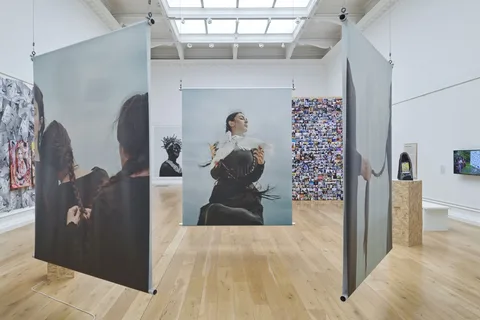
The feminist exhibition London scene has produced some of the most powerful protest art in recent years. Acts of Resistance: Photography, Feminisms and the Art of Protest was a collaborative exhibition between the South London Gallery and the Victoria and Albert Museum, organised as part of the V&A Parasol Foundation Women in Photography Project.
Photography has long been associated with acts of resistance. It is used to document action, share ideas, inspire change, tell stories, gather evidence, and fight against injustice. This group exhibition brought together works by international artists and collectives using the camera to challenge and move beyond traditional protest photography.
Artist Hoda Afshar created a new limited edition artwork for the South London Gallery in response to the feminist uprising that began in Iran in September 2022, following the death of 22-year-old Jina Amini, who had been arrested by Iran’s morality police for not wearing the hijab in an approved way.
This outpouring of activist-propelled art including the vast scale of Re/Sisters at the Barbican and Tate’s Women in Revolt!, alongside Acts of Resistance is indicative of the fact that such shows are long overdue, with so much still to be said. The feminist exhibition London landscape has never been more urgently needed.
Political Art Exhibitions London 2026 and Beyond
Political art exhibitions London venues are staging continue to grow in ambition and importance. Comrades in Art: Artists Against Fascism at The Towner in Eastbourne tells the story of British artists who created political art to fight the rising tide of fascism, including paintings, sculpture, drawings and posters from artists who united behind democracy and cultural freedom at a major turning point in global history.
Catherine Opie’s To Be Seen at the National Portrait Gallery, running until 31 May 2026, questions representations of home, intimacy, family, and power structures. Over 30 years, Opie has explored the portrait in ways that make visible queer communities, mentors, children, political crowds, and self-portraiture.
These political art exhibitions in London show that the city’s cultural institutions are not shying away from difficult conversations. They are leaning into them and their audiences are responding.
When Art Itself Becomes the Target Censorship in the UK
The relationship between protest art and censorship is increasingly fraught. In December 2025, an arts exhibition called Window Wonderland 2025 at The Bomb Factory Art Foundation in London was vandalised and forced to close. The show explored themes of migration, identity, and cultural fusion, and was shut down as a direct result of intimidation targeting the artists.
Article 19, the human rights organisation, condemned the vandalism as a freedom of expression violation, stating that violent or threatening acts that suppress expression create a chilling effect far beyond their immediate targets and that they can discourage artists and institutions from presenting work on important societal issues.
The silencing of protest art is never just about art. It is about who is allowed to speak and who decides.
The Curator’s Voice Why These Exhibitions Are a Call to Arms
The curatorial intent behind the best arts protest exhibitions UK has hosted is worth examining. As Clive Russell, curator of The Right to Protest exhibition, put it: “The exhibition is a call to arms to all artists, designers, and citizens. It’s time to give a shit about what’s happening in the world. It’s time to use whatever tools you possess in defence of care and freedom.”
That sentiment cuts to the heart of what protest art does. It refuses silence. It refuses comfort. It makes the viewer uncomfortable in ways that matter and then it asks what they plan to do about it.
Global and Regional Impact of UK Protest Art
The UK’s arts protest exhibition culture does not exist in a bubble. The UK has a long history of protest, and art has been used to document protest and as a focus of protest particularly so since 2020, which saw major global movements reflected in exhibition programming across British galleries.
As the UK prepares to navigate a changing political landscape, the importance of venues like the Museum of Unrest, the South London Gallery, and the Atkinson Art Gallery cannot be overstated. They are not just exhibition spaces they are archives of resistance.
Conclusion The Future of Protest Art in the UK
The best arts protest exhibitions UK galleries have staged represent far more than a trend. They are a response to a world in crisis. From the Right to Protest exhibition to the feminist exhibition London venues have championed, and from political art exhibitions London’s major institutions are hosting to the community-rooted work of the Atkinson Art Gallery, protest art is alive, urgent, and necessary.
Many UK galleries are now acting as platforms for resistance, with exhibitions reflecting a desire to speak out and drive change. That desire is not going away. If anything, it is growing louder and the art that carries it is becoming more powerful by the year.
FAQs
Is censorship illegal in the UK?
There is no single law that makes all forms of censorship illegal in the UK. The country has no written constitution with an absolute free speech guarantee. However, freedom of expression is protected under Article 10 of the European Convention on Human Rights, as incorporated by the Human Rights Act 1998. The government and public bodies are required to justify any restrictions on expression. Certain forms of censorship such as banning a legal publication purely to suppress a political viewpoint — could be challenged in court. However, restrictions on obscenity, hate speech, defamation, and national security grounds are all legally permitted in the UK, creating a complex legal landscape around what censorship actually means in practice.
Is censoring art illegal?
Censoring art is not automatically illegal in the UK, but it depends entirely on the circumstances. A government or state institution that suppresses lawful artistic expression without justification could face legal challenge under human rights legislation. Private entities, including galleries and platforms, can generally make their own decisions about what they display. However, violent acts used to force the closure of an art exhibition such as the vandalism of Window Wonderland 2025 are condemned by human rights organisations as violations of freedom of expression, with calls for prosecution under criminal law. When censorship involves intimidation or physical damage, it crosses clearly into criminal territory.
What is the new digital censorship law in the UK?
The UK’s Online Safety Act 2023 is the primary piece of legislation governing online content. The Act requires user-to-user services to address illegal content such as child sexual abuse material, terrorist propaganda, and fraud categories that mirror existing offline laws. Section 22 of the Act introduces a statutory protection for freedom of expression in UK domestic law, the first time Parliament has legislated an explicit duty for online services to protect users’ lawful speech. However, the law remains controversial. Critics argue that its immediate consequences including restricted footage, threatened access to certain platforms, and censored protest videos are previews of a digital order built on control rather than genuine safety. Supporters say those concerns misrepresent a law designed to target only genuinely illegal material while protecting lawful expression.