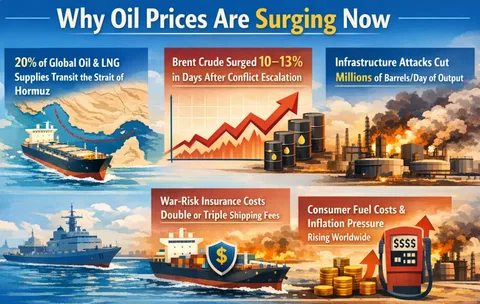
The Iran war has crossed from a regional military conflict into a full-scale global economic emergency. Brent crude oil prices have surged past $107 a barrel, the Strait of Hormuz remains a flashpoint, and ordinary people from Tokyo to Karachi are already paying more for fuel, food, and even printer ink. This is not just a war between nations. This is a war on the global economy.
Background: How the US-Iran War Began
The US-Iran war formally escalated on February 28, 2026, when a US and Israel-led military campaign targeted Iranian nuclear facilities and military infrastructure. Iran retaliated swiftly, launching ballistic missiles and drones across the region.
Within days, the Strait of Hormuz the world’s most critical oil chokepoint was effectively closed. That single event triggered what the International Energy Agency has since described as the “largest supply disruption in the history of the global oil market.”
Iran news today continues to reflect a conflict showing no clear signs of resolution. Ceasefire talks have remained fragile, and violence has kept flaring up at sea.
The Strait of Hormuz: The Bottleneck the World Cannot Afford to Lose
The Strait of Hormuz is a narrow waterway, just 33 kilometers wide at its narrowest point, connecting the Persian Gulf to the open ocean. Roughly 20 percent of the world’s daily oil supply approximately 20 million barrels passes through this chokepoint every single day.
When Iran effectively closed the strait in early March 2026, the consequences were immediate and brutal. Oil prices from Kuwait, Iraq, Saudi Arabia, and the UAE dropped by at least 10 million barrels per day. Shipping companies refused to enter the waterway. The UK Navy confirmed that vessels were experiencing disrupted navigation signals throughout the Persian Gulf.
The Iran war Hormuz crisis is not just about barrels of oil. It is about the entire architecture of global trade that was quietly built on the assumption this route would always remain open.
Brent Crude Oil Price What the Numbers Tell Us
Before the US-Iran war began, Brent crude was trading in a comfortable range. Since the conflict started, both WTI and Brent crude oil prices have risen by more than 45 percent.
Brent crude oil price surged to $114.44 a barrel on a single Monday in early May 2026 a near 6 percent single-day jump. By Tuesday of the same week, Brent had eased only slightly to $107.77, still representing an extraordinary premium driven entirely by war risk.
Analysts at Sparta in Singapore explained that markets are pricing in “more oil infrastructure damage and the likelihood that the Strait of Hormuz will be shut beyond the timeline the Trump administration has laid out.” Saudi Aramco CEO Amin Nasser warned bluntly that even if the Strait of Hormuz opens today, the oil market will not normalize until 2027.
If the blockade continues, Arab economists and Qatar’s Energy Minister have warned that oil prices could reach $150 per barrel a figure that would devastate energy-importing economies worldwide.
Inflation, Groceries, and the Everyday Cost of the Iran War
The US-Iran war is not staying contained to military theaters. It is arriving in kitchens, gas stations, and grocery stores.
In the United States, April 2026 inflation reached 3.8 percent the sharpest spike in nearly three years driven primarily by surging gasoline prices. The Iran war is rippling through the entire American economy, from road trip fuel costs to restaurant prices.
Inside Iran itself, the situation is far more severe. Iranians are facing spiraling prices for food, medicine, and basic goods, alongside mass job losses and business closures. Iran’s months-long internet shutdown has further cut off self-employed citizens, many of them women, from their livelihoods.
The Gulf Cooperation Council states have faced what analysts are calling a “grocery supply emergency.” These countries rely on the Strait of Hormuz for over 80 percent of their caloric intake. By mid-March, 70 percent of the region’s food imports were disrupted, with retailers airlifting basic staples as consumer prices spiked between 40 and 120 percent.
Even in Japan, the Iran war is changing the color of snack packaging. Japanese snack brand Calbee announced it would temporarily shift 14 of its products to black-and-white packaging because the conflict has disrupted supplies of colored printing ink a telling sign of how deep these supply chain effects now reach.
Expert Voices on the Iran War and Oil Markets
June Goh, Senior Oil Market Analyst, Sparta (Singapore): Markets are pricing in more infrastructure damage and a real risk that the Strait of Hormuz will remain shut longer than the Trump administration’s stated timeline suggests.
Amin Nasser, CEO of Saudi Aramco: “If the Strait of Hormuz opens today, it will still take months for the market to rebalance, and if its opening is delayed by a few more weeks, then normalization will last into 2027.”
Chatham House, Global Economy Programme: Higher oil and gas prices raise the import bill for households and firms, squeezing real incomes and eroding purchasing power. If the surge proves fleeting, most advanced economies may absorb the shock but that outcome remains uncertain.
Hadi Kahalzadeh, Iranian Economist, Brandeis University: “The economic cost of the war and the US naval blockade has been very substantial and unprecedented for Iran.” Yet Iran, with decades of experience surviving sanctions, has not had its adaptive capacity fully dismantled.
Global Impact Who Pays the Highest Price?
The Iran war’s economic fallout is being distributed unevenly across the world, and that distribution largely follows the lines of energy dependency.
India faces severe pressure. The country relies on the Persian Gulf for nearly 60 percent of its petroleum imports and over $125 billion in annual remittances. Disruptions to LNG exports from Qatar have already forced India to reduce production at three urea plants, with knock-on effects on food production globally.
Brazil imports nearly half of its fertilizer supply through the Strait of Hormuz. As a country that accounts for roughly 60 percent of global soybean exports, any fertilizer shortage carries serious implications for world food security.
Europe and Asia face an estimated 0.5 percentage point rise in inflation above pre-conflict forecasts if the situation stabilizes soon manageable but not painless.
Gulf States, by contrast, face an existential humanitarian challenge. Iranian strikes on desalination plants which supply 99 percent of drinking water in Kuwait and Qatar have pushed the crisis beyond economics into questions of survival.
The breaking news on Iran war is that this conflict is no longer just about missiles and military operations. It is about water. It is about food. It is about fuel that billions of people depend on.
Opinion The World Cannot Stay Neutral on This
There is a temptation among global commentators to frame the US-Iran war as a distant regional affair a conflict between specific actors over specific grievances. That framing is no longer defensible.
When Brent crude oil price climbs past $107 and threatens $150, that is a tax on every citizen of every energy-importing nation on earth. When the Strait of Hormuz is closed, it does not just strand Iranian oil it strands the food, fuel, and fertilizer that feed and power billions of people.
The Iran war today is forcing a reckoning with just how fragile the architecture of global trade always was. Decades of globalization were quietly built on the assumption of stable sea lanes. One narrow strait, closed by one conflict, has exposed that assumption for what it was: a gamble.
The world did not choose this war. But the world is already paying for it. The longer it continues, the larger that bill becomes and the more unevenly it falls on those least able to afford it.
Conclusion What Comes Next
Iran war latest news suggests the path forward remains deeply uncertain. The US military has attempted to escort commercial vessels through the strait under “Project Freedom,” but shipping companies remain hesitant. Geopolitical analysts note that US President Trump may seek Chinese intervention to pressure Iran toward a deal.
Admiral James Stavridis has warned that reopening Hormuz by force would require significant naval resources, ground troops, and cost approximately one billion dollars per week. That is an extraordinary price, even for the world’s largest military.
The question before the world is not whether the Iran war has global consequences. It clearly does. The question is how long the global economy can absorb them and what kind of world emerges when the guns eventually fall silent.
For now, Iran news today tells a story of a conflict that began as a military campaign and has become an economic emergency affecting every corner of the globe. Oil prices, food prices, inflation, supply chains all are paying the price of a war that shows no clear end in sight.
FAQs
Will the Iran war affect car prices?
Yes, indirectly but significantly. The Iran war has driven up oil and energy prices sharply. Higher oil prices raise manufacturing and transportation costs across industries, including automotive production. Steel, aluminum, and shipping costs all rise when energy prices surge. If the conflict prolongs and Brent crude remains above $100 per barrel, expect vehicle prices especially for new cars to face additional upward pressure in the months ahead.
What happens to crude oil prices during war?
Wars in oil-rich regions historically drive crude oil prices higher due to supply uncertainty. The US-Iran war is a stark current example: Brent crude has risen more than 45 percent since the conflict began in late February 2026. Markets price in the risk of supply disruption, infrastructure damage, and the potential closure of key transit routes like the Strait of Hormuz. The longer a war lasts and the more it threatens physical oil infrastructure or sea lanes, the higher crude prices tend to go.
Are oil companies profiting from the Iran war?
The short answer is: yes, in the near term, some are. Higher Brent crude oil prices mean higher revenues for oil producers whose production costs are fixed. However, the picture is complex. Shipping disruptions, insurance cost spikes, and operational risks in the region are cutting into margins for some producers. Saudi Aramco, for instance, is facing output constraints because of Hormuz disruptions even as prices rise. Long-term investment decisions are also being delayed due to geopolitical uncertainty, which could constrain future supply and keep prices elevated well beyond the conflict itself.