

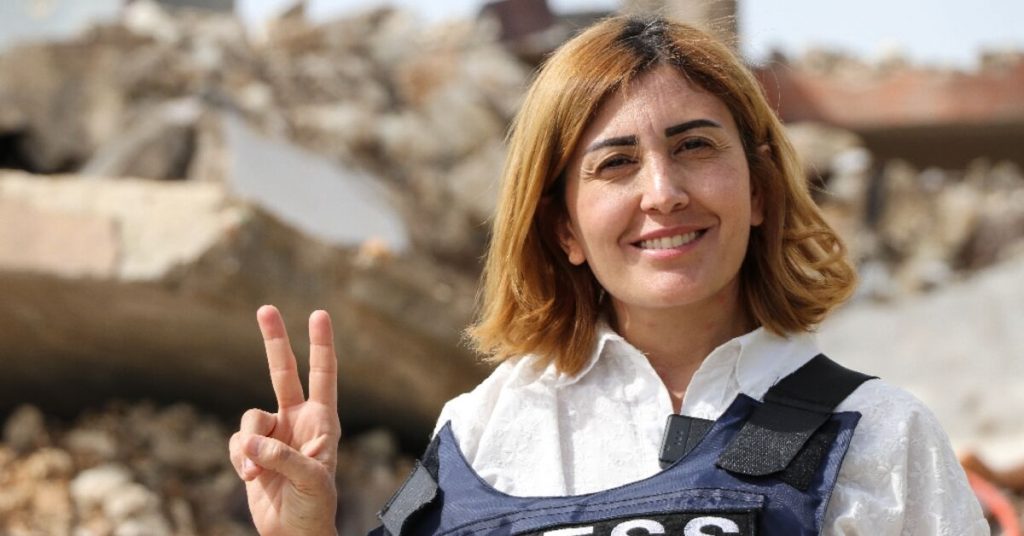

Amal Khalil, 43, a journalist with the Lebanese newspaper Al-Akhbar, bled to death in the ruins of a building hit in an Israeli drone strike, after Israeli forces’ gunfire prevented ambulance crews from reaching her for nearly four hours.The killing shook the world of journalism and sparked outrage from governments and rights organizations alike. She is the fourth media worker killed by Israel in Lebanon since March and the attack happened during an active ceasefire.
Background: Who Was Amal Khalil?
Amal Khalil was not just a reporter. She was a symbol of defiance, dedication, and truth in a region where telling the truth can cost you your life. Khalil, born in 1984, hailed from the southern town of Baysariyyeh in the Sidon district. She worked with the local Al-Akhbar news outlet since 2006.
The 43-year-old was a renowned journalist at the prominent newspaper Al-Akhbar and had covered the conflict with Israel since 2006. Dozens of journalists paid tribute to her on Thursday, describing her as “unshakeable” and “devoted. She was not a stranger to danger. In 2024, Khalil told Al Jadeed that she received a threatening phone call from an Israeli phone number warning her to leave the south and threatening to destroy her home and decapitate her.
Despite these threats, she never left. She kept reporting, kept telling the stories of the people of southern Lebanon until Israel silenced her forever.
Details: What Happened on April 22, 2026?
Khalil and Faraj were reporting on an earlier Israeli attack on a vehicle on Wednesday when they were targeted while fleeing towards a building to take shelter. Paramedics rescued Faraj and recovered Khalil’s body from the rubble hours later.
When the Lebanese Red Cross arrived to transport the injured, Israeli forces prevented the completion of the humanitarian mission, firing a stun grenade at the ambulance and targeting it with gunfire, making it impossible to extract Khalil.This is not just a killing it is a pattern, a deliberate campaign to silence journalism.
Rescue workers initially tried to reach the veteran Al-Akhbar journalist but came under Israeli fire and were forced to withdraw. A second strike then hit the house where the two journalists had sought refuge. Khalil’s body was recovered shortly before midnight, more than seven hours after the attack.
Amal Khalil’s age at the time of her death was 43. She had spent most of her adult life covering the suffering of Lebanese civilians under Israeli bombardment. Her Al Jazeera coverage and media reports from Al-Akhbar gave international audiences a firsthand look at life in southern Lebanon during one of its most brutal chapters.
The Ceasefire That Wasn’t: Iran News and Regional Context
The killing of Amal Khalil did not happen in isolation. It took place during a supposed ceasefire a pause in fighting that was already under severe strain. Lebanon will request a one-month extension of the ceasefire at peace talks with Israel. Israeli strikes on southern Lebanon on Wednesday killed at least five people, including Khalil.
The wider regional backdrop is equally alarming. The conflict between Israel and Lebanon is deeply tied to Iran news and the ongoing regional tensions. Khalil had been covering a renewed escalation of hostilities between Israel and the Lebanese group Hezbollah, which resumed in early March amid wider regional tensions linked to the US-Israel war on Iran.The killing of a journalist during ceasefire negotiations sends a devastating message that Israel does not feel bound by the rules of war, diplomacy, or international law.
President Trump said Thursday that Israel and Lebanon have agreed to extend their ceasefire for three weeks after the two sides met at the White House for high-level negotiations, posting: “The Ceasefire between Israel and Lebanon will be extended by THREE WEEKS.” But a ceasefire means little when journalists are being buried under rubble during its active days.
Quotes: Condemnation From All Corners
Lebanese leaders did not mince words. President Joseph Aoun stated: “Israel deliberately targets journalists in order to conceal the truth about its crimes against Lebanon,” denouncing what he called “war crimes.”
Lebanese Prime Minister Nawaf Salam accused Israel of war crimes, saying: “Targeting of media workers in the south while they carry out their professional duties is no longer isolated incidents, but an established approach that we condemn and reject.”
International rights groups added their voices. Jonathan Dagher, head of the Middle East desk at Reporters Without Borders, said the sequence of strikes “would indicate targeting and obstruction of aid constituting war crimes.”
Ramzi Kaiss, Lebanon researcher for Human Rights Watch, called for a credible investigation “with a view towards justice and accountability,” adding: “Intentionally targeting civilians is a war crime.”
At a protest in downtown Beirut, fellow journalists took to the streets. Journalist Inas Sherri told AFP: “Accountability is the most important thing. If we were holding people accountable, Israel would not have continued killing journalists one after another.”
Opinion: Silence Is Complicity
This is where journalism intersects with conscience. The killing of Amal Khalil is not simply breaking Iran news or another headline to scroll past. It is a moment that demands moral clarity.
Al Jazeera, international media organizations, and press freedom groups have repeatedly documented how Israel has targeted journalists in Lebanon and Gaza. Khalil was the ninth journalist killed in Lebanon in 2026 alone.That number is not a statistic it is an indictment.
The world must ask itself: what does press freedom mean when reporters are bombed while sheltering from other bombs? What does a ceasefire mean when it is violated with drone strikes and ambulances are fired upon? The killing of Amal Khalil, at age 43, after nearly two decades of reporting from a war zone, is a devastating loss for Lebanese journalism and for the global press.
If governments and international bodies continue to offer ceasefire extensions while ignoring the systematic targeting of journalists, they are sending a message of their own that some lives, and some truths, do not matter.
Also in the News: Hinglaj Mata Temple
In a separate development making headlines in the region, the Hinglaj Mata Temple has been in the news for positive reasons. The Balochistan government decided to declare the historic Hinglaj Mata Temple, located in Lasbela district, as a world tourism site. The decision was taken during a meeting between Chief Minister Sarfraz Bugti and Senator Danesh Kumar, where they discussed initiatives to promote minority religious tourism in the province.
The Hinglaj Mata Temple is a Hindu temple in Hinglaj, a town on the Makran coast in the Lasbela district of Balochistan. It lies in the middle of Hingol National Park and is one of the 51 Shakti Peethas in Hinduism.The move is widely seen as a step toward religious inclusivity and heritage preservation in Pakistan.
Impact: A Global Crisis for Press Freedom
The killing of Amal Khalil has consequences far beyond Lebanon. It sends a chilling signal to every journalist working in a conflict zone anywhere in the world. It says: your press vest is not protection. Your camera is not a shield. Your notebook will not save you.
Al Jazeera and other networks have faced repeated targeting by Israeli forces. Amal Khalil was killed while carrying out her journalistic work the fourth media worker killed by Israel in Lebanon since March alone.Each death chips away at the public’s right to know what is happening in conflict zones.
The international community’s response will define whether press freedom remains a genuine value or merely a slogan used when politically convenient.
Conclusion: Justice Cannot Wait
The ceasefire has been extended. The talks in Washington will continue. But Amal Khalil will not be there to report on what happens next. She was buried on April 23, 2026, draped in the Lebanese flag, a blue press vest resting on her casket a final testament to what she gave her life for.
Khalil once said: “The pressure to break me was relentless, but I didn’t yield.” Through her work, she tried to be in solidarity with the people of the land.Now it is the world’s turn to stand in solidarity with her memory by demanding accountability, justice, and an end to the deliberate targeting of journalists in war zones.
FAQs
When did Israel attack Lebanon?
Israel has been conducting strikes on Lebanon in connection with its conflict with Hezbollah, which intensified from October 2023 onward. Hostilities resumed in early March 2026 amid wider regional tensions linked to the US-Israel war on Iran. A ceasefire was signed on April 16, 2026, though Israeli strikes have continued during the truce period.
Who is Israel’s best friend?
The United States has historically been Israel’s closest strategic ally, providing military aid, diplomatic support, and a strong defense partnership. President Trump announced the three-week ceasefire extension after Israeli and Lebanese sides met at the White House for high-level negotiations.The US continues to play a central role in mediating between Israel and Lebanon.
Who won the Lebanon vs. Israel war?
The conflict between Israel and Lebanon particularly involving Hezbollah has not produced a clear military victor. Both sides have suffered casualties, and Lebanon has sought a one-month extension of the ceasefire while Israeli strikes have continued to kill civilians and journalists during the truce.Diplomatically, the outcome remains unresolved, with ongoing talks in Washington and a fragile ceasefire in place as of April 2026.