

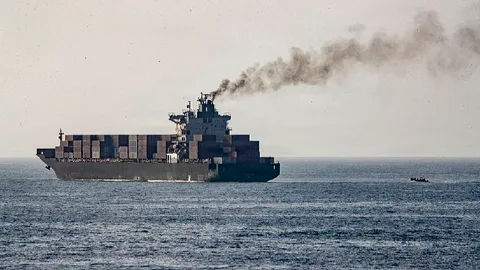

The US-Iran conflict has reached a dramatic new flashpoint at sea. The US Navy Guided Missile Destroyer USS Spruance intercepted the Iranian cargo ship Touska in the Gulf of Oman, firing on the vessel after the Iranian crew refused repeated warnings to stop. Iran has responded with fury, seizing commercial ships of its own and vowing full retaliation pushing the world’s most important oil waterway into its deepest crisis in decades.
Background: How Did We Get Here?
The current Iran US oil tanker standoff did not happen overnight. It is the product of a rapidly escalating war between the United States, Israel, and Iran that began in early 2026. As the conflict intensified, both sides began targeting the Strait of Hormuz the narrow channel through which a massive share of the world’s energy supply flows.
Before the United States and Israel launched their 2026 war against Iran, the Strait of Hormuz was open and about 25% of the world’s seaborne oil trade and 20% of the world’s liquefied natural gas passed through it. Iran’s decision to weaponize that chokepoint triggered a chain of events that led directly to the current Iran US bombing and naval standoff.
On April 13, the US military began enforcing a naval blockade, barring ships entering and leaving Iranian ports from passing through. The blockade also covered clearance of mines from the waterway. Iran responded by closing the Strait of Hormuz to most commercial traffic a move that sent oil prices soaring and alarmed governments worldwide.
Details: The US Fires on an Iranian Cargo Ship
The most explosive single incident in this crisis was the attack on the Iranian cargo vessel Touska. On Monday, the US military fired on and then seized the Iranian-flagged container ship Touska close to the Strait of Hormuz in the northern Arabian Sea as it was en route to the Iranian port of Bandar Abbas.
The US Central Command and President Donald Trump claimed the Touska was hit after it refused to follow US orders to withdraw from its planned passage through the Strait of Hormuz. The Touska is the first non-military Iranian ship the US is known to have hit during the war.
Trump said on Truth Social that the US Navy “gave them fair warning to stop. The Iranian crew refused to listen, so our Navy ship stopped them right in their tracks by blowing a hole in the engine room.” He said US Marines took custody of the vessel, noting it was “under US Treasury Sanctions because of their prior history of illegal activity.”
The operation saw Marines from a US destroyer rappelling down from a helicopter onto the deck of the Touska tanker a dramatic scene that came after a six-hour standoff with the Iranian vessel.
Iran Shoots Back: Ships Attacked in the Strait
Iran did not wait long to respond to the Iran US bombing escalation at sea. The Islamic Revolutionary Guard Corps Navy moved swiftly against commercial vessels in the Strait of Hormuz.
Iran’s Revolutionary Guard gunboats fired on a tanker in the Strait of Hormuz, and a container ship was hit by an unknown projectile, according to the United Kingdom Maritime Trade Operations Centre.Crews reported harrowing experiences, including gunfire and distress calls captured in audio by maritime monitoring groups.
On April 22, an Iranian gunboat attacked the Greek-owned cargo ship Epaminondas off the coast of Oman, despite earlier giving it permission to cross the strait. The attack, using gunfire and rocket-propelled grenades, caused significant damage to the bridge. Another ship, MSC Francesca, was targeted off the coast of Iran and instructed to drop anchor, with damage to its hull. A third ship, the Euphoria, was also targeted.
Iran’s Revolutionary Guard Navy stated it had seized the ships for what it claimed were maritime violations and transferred them to Iranian shores. The Iran cargo ship seizures and attacks marked the first time Tehran had taken such direct action against non-Iranian vessels since the war began.
Iran Oil Field Explosion and Bombing History
The maritime crisis is inseparable from a broader Iran US bombing campaign that has targeted energy infrastructure across the country. Iran oil field and energy site attacks have been central to both sides’ strategies throughout this conflict.
Kharg Island, situated in the Persian Gulf about 20 miles off the Iranian mainland, is a strategic port and oil export hub handling up to 90 percent of Iran’s oil exports. The island hosts major energy infrastructure including the Falat Iran Oil Company, which produces 500,000 barrels of crude oil per day.
On March 13, 2026, US President Donald Trump announced that the US military “totally obliterated” military forces on Kharg Island, calling it “one of the most powerful bombing raids in the History of the Middle East” which “totally obliterated every military target in Iran’s crown jewel.” Trump did not order strikes on its oil infrastructure “for reasons of decency” but threatened to “immediately reconsider.”
After one ceasefire announcement, Iran’s Lavan Island oil refinery and Sirri Island crude export facilities were struck by what was described as an “enemy attack,” further escalating the Iran oil field explosion and bombing picture.
Separately, QatarEnergy has said Iranian strikes on a large gas field will take three to five years to repair a sign that energy infrastructure damage is running in both directions across the region.
Have US Navy Ships Been Hit by Iran?
A key question being asked globally is: have any US Navy ships been hit by Iran directly during this conflict? So far, hundreds of commercial tankers have been stranded on both sides of the Strait of Hormuz, and the primary victims of direct fire have been commercial vessels rather than US warships. The US military has maintained air and naval dominance, with Iran focusing its retaliation on commercial shipping and cargo ships.
However, two fuel tankers the Maltese-flagged Zefyros and the Marshall Islands-flagged Safesea Vishnu were attacked in Iraqi waters and caught fire, with Iraqi oil terminals suspending operations.The targeting of allied shipping assets around US-controlled areas illustrates how broadly the conflict has spread across regional waters.
Quotes: Officials and Experts React
The Iranian foreign ministry condemned the US seizure of the Iranian-flagged cargo ship, describing it as “piracy” and an “act of aggression” against Iran, demanding the crew be immediately released.
An Iranian official warned: “Trump’s ceasefire extension is certainly a ploy to buy time for a surprise strike. The time for Iran to take the initiative has come.”
Warren Patterson, head of commodities strategy at ING, commented: “Oil prices are being whipsawed by developments in the Middle East once again, with what appears to be de-escalation quickly turning to re-escalation.”
China’s Foreign Ministry also expressed concern over the US interception of the Iranian ship, with Chinese President Xi noting that normal passage through the Strait of Hormuz serves the common interests of regional countries and the international community. China is the main buyer of Iranian crude oil.
Impact: Oil Prices Surge, Global Markets Reel
The Iran news from the Strait of Hormuz has had immediate, severe consequences for global energy markets.
West Texas Intermediate futures rose nearly 7% to close at $89.61 per barrel. International benchmark Brent crude futures advanced more than 5% to settle at $95.48 per barrel as markets digested the Iran US oil tanker confrontation and renewed fears about supply disruption.
US gas prices reached a national average of $4.05 a gallon, and may not return to under $3 a gallon until “next year,” according to Energy Secretary Chris Wright.
The 32 members of the International Energy Agency, including the UK, released 400 million barrels of oil in an attempt to lower prices.Several Middle Eastern states also cut or suspended production due to the attacks, compounding the supply shock felt across the globe.
Roughly one-fifth of the world’s oil supply passes through the Strait of Hormuz, making it a critical chokepoint for global energy markets, according to the US Energy Information Administration.Any extended closure threatens not just fuel prices but food supply chains and manufacturing economies that depend on affordable energy.
Conclusion: What Comes Next?
The path forward remains deeply uncertain. Peace talks were expected, with Vice President JD Vance set to travel to Pakistan for a new round of negotiations. However, Iranian state news outlet Tasnim reported that negotiators from Tehran would not attend further talks.
Iran has seized two vessels in the Strait of Hormuz, and the struggle for control of the waterway is intensifying even as a formal ceasefire technically remains in place.The Iran US bombing campaign, the Iran cargo ship seizures, and the naval blockade are all running simultaneously making a diplomatic breakthrough increasingly difficult to achieve.
On April 23, Trump ordered the US Navy to destroy any Iranian boats laying mines in the Hormuz a new escalation order that signals the military posture is hardening rather than softening. The coming days will determine whether diplomacy or further Iran US bombing defines the next chapter of this crisis.
FAQs
Why is the Strait of Hormuz closed again?
Iran said it closed the Strait of Hormuz again in response to the US refusing to lift its naval blockade.Iran had briefly agreed to re-open the waterway during ceasefire negotiations, but reversed course after accusing the United States of breaching the truce. No tankers passed through the Strait of Hormuz on several recent days, according to ship tracking data.
Why did the US board the oil tanker?
The US claims the Iranian ship Touska was trying to evade its naval blockade. Under its blockade, the US military is barring any ships belonging to Iran, or travelling to or from Iranian ports, from passing through the strait.US Central Command said the Iranian ship refused to comply with US warnings over the course of six hours before the US fired on the ship and boarded it.
Who is controlling the Strait of Hormuz?
Currently, neither side has complete control. The Strait of Hormuz is considered an international waterway under international law, through which ships have the right of transit passage, according to the United Nations Convention on the Law of the Sea.In practice, the US is enforcing a blockade on Iranian-linked vessels from the Arabian Sea side, while Iran is blocking and seizing commercial ships attempting to use the strait from its own territorial waters. Both are operating simultaneously in a dangerous power struggle over the world’s most critical oil shipping lane.