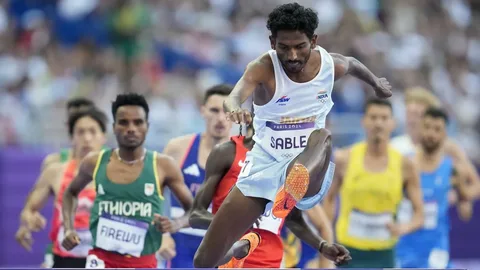
The Athletics Integrity Unit (AIU) has placed the Athletics Federation of India (AFI) in Category A the highest-risk doping bracket joining nations like Russia, Belarus, Ethiopia, Kenya, Nigeria, and Ukraine.This means Indian athletes must now undergo far stricter anti-doping tests than before. The decision follows years of mounting doping violations and growing international pressure on India’s sports governance.
Background
India’s doping crisis did not emerge overnight. In 2022, India recorded 124 total anti-doping violations across all sports, with 48 of those coming in athletics alone ranking it first globally that year.The numbers only grew worse in the years that followed. India recorded 48 cases in 2022 and 63 in 2023, before topping the global list with 71 violations in 2024. The trend has continued into 2025, with 30 cases already reported.
Despite repeated warnings from global anti-doping bodies, the domestic response was considered too slow and too limited. It was this failure to act decisively that ultimately led to the AFI’s reclassification.
Details: What Category A Means for Indian Athletes
Category A federations are deemed the highest risk and face stricter obligations under the rules, including minimum testing thresholds for national-team athletes. For Indian athletes, this translates into more frequent out-of-competition testing, tighter whereabouts requirements, and enhanced monitoring by international anti-doping officials.
Under the AIU framework, Category A federations are considered the highest risk and are required to meet stricter obligations. These include minimum testing thresholds for national-team athletes, according to the AIU.Athletes who fail to comply with these new requirements face bans and disqualification from international competition.
This is not a minor administrative change. It places India in the same surveillance tier as countries that have historically been at the center of global doping scandals. The reclassification sends a strong signal to Indian sports authorities that the status quo is no longer acceptable.
India Doping Tests 2022 Onwards A Troubling Trend
The data covering Indian athletes doping tests from 2022 onward tells a concerning story. In 2022 and 2023, India recorded 48 and 63 anti-doping rule violations respectively, ranking second globally in both years.By 2024, India had climbed to the very top of the list. India topped the global list with 71 violations in 2024, and the trend has continued in 2025, with 30 cases already reported.
These figures reflect failures not just among athletes, but also within the institutions responsible for educating, testing, and penalizing them. The easy availability of performance-enhancing drugs inside India has compounded the problem significantly, as acknowledged by senior global anti-doping officials.
The comparison with Pakistan is also notable. While Pakistan’s athletics program operates on a much smaller scale, the spotlight on India has drawn regional attention to South Asia’s broader anti-doping infrastructure. India’s dominance of global violation lists raises difficult questions about athlete education, testing frequency, and the role of black-market drug networks across the subcontinent.
Quotes: Officials Speak Out
AIU Chairman David Howman said the doping situation in India had been high-risk for a long time, and the quality of the domestic anti-doping programme was simply not proportionate to the doping risk.
WADA President Witold Banka stressed that India needs to act against dope cheats or the dreams to host the Olympics may get hit. According to him, a WADA compliance report is one of the essential requirements if India’s bid for the 2036 Olympics is to be taken seriously by the International Olympic Committee.
Banka also stated that the biggest production of illegal performance-enhancing drugs and illegal steroids is in India, calling it the main target and the biggest producer in the world.
On the Indian side, AFI spokesperson Adille Sumariwalla said the federation has a strong plan and is in favor of criminalizing doping in the country. He added that more athletes are being caught because more tests are being conducted, and that the federation is fighting the problem hard.
Recent Doping Case: Archer Banned
The reclassification comes alongside fresh individual cases. Asian Games gold medallist archer Prathamesh Jawkar has been banned for two years. He accepted the punishment for a whereabouts failure and will miss the Asian Games in September-October in Japan.This case is among the most high-profile recent examples of how doping and related violations are damaging the careers of top Indian sporting talent.
Impact: Olympics Bid and Global Standing at Stake
The timing of this classification could not be more sensitive for India. India will host the 2030 Commonwealth Games and continues its bid for the 2036 Olympics. When an Indian delegation visited the International Olympic Committee headquarters in Lausanne, it was told that curbing doping would strengthen the country’s Olympic bid.
Being placed in Category A alongside Russia and Belarus damages India’s image as a clean sporting nation. Global sponsors, international federations, and the IOC all monitor anti-doping compliance closely. If India cannot demonstrate measurable improvement, its ambitions of hosting the Olympics could face serious resistance from the international community.
In contrast, countries like Bahrain are expected to be downgraded from Category A following improvements such as establishing independent anti-doping bodies and expanding testing programmes.India would need to achieve similar, verifiable reforms to be considered for reclassification to a lower-risk bracket.
Conclusion: Reforms or Consequences
The AIU has made it clear that reclassification is not a punishment but a framework for intervention. The AIU said it would now work with the AFI to achieve reforms to safeguard the integrity of athletics, as it has done with other Category A member federations.
India now faces a critical window. The government, the sports ministry, and the AFI must work together to criminalize doping, disrupt drug supply chains, and build an anti-doping culture at the grassroots level. If these reforms succeed, a downgrade from Category A remains possible. If they fail, India’s athletes and its Olympic aspirations will continue to pay the price.
FAQs
Which country has had the most athletes caught doping?
Historically, Russia has faced the most widespread and systemic doping scandals, including a state-sponsored program exposed ahead of the 2016 Rio Olympics. However, in recent years, India has topped global doping violation lists, recording 124 total violations across all sports in 2022.India led the athletics-specific violation rankings in 2024 with 71 cases, surpassing all other nations that year.
Who checks doping in India?
Doping in India is primarily monitored by the National Anti-Doping Agency (NADA), which operates under the Ministry of Youth Affairs and Sports. NADA conducts both in-competition and out-of-competition testing, manages results, and enforces sanctions. At the global level, the Athletics Integrity Unit (AIU) and the World Anti-Doping Agency (WADA) also oversee compliance and can independently test Indian athletes in international competitions.
Is Viagra banned in the Olympics?
Sildenafil (Viagra) is not currently on the World Anti-Doping Agency’s prohibited list, meaning it is not a banned substance for Olympic athletes. However, its use is ethically controversial. Some research suggests it may improve oxygen delivery during high-altitude performance. WADA continues to monitor it, and individual sports federations may have their own guidelines. Athletes are always advised to declare any medication use through the Therapeutic Use Exemption (TUE) process to avoid complications during testing.