

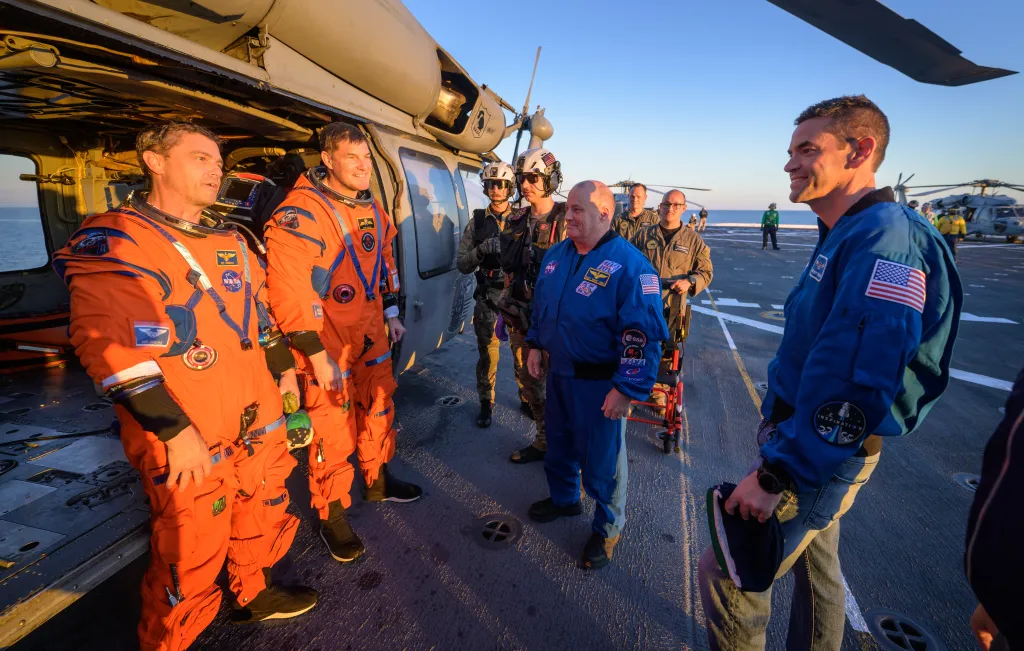

NASA’s Artemis II astronauts have safely returned to Earth. The Orion spacecraft splashed down in the Pacific Ocean on April 10, 2026, completing a 10-day journey around the Moon the first crewed lunar mission in over 50 years.
Background: What Is the Artemis II Mission?
The NASA Artemis II mission is the first crewed test flight of NASA’s Artemis program. It is humanity’s first step back toward the Moon since Apollo 17 in 1972.
Artemis II was a nine-day lunar flyby mission the first crewed flight of the NASA-led Artemis program and the first crewed flight beyond low Earth orbit since Apollo 17 in 1972.
The mission was designed to test the Orion spacecraft and all its systems in deep space. It did not land on the Moon but flew around it paving the way for a future Moon landing.
Artemis 2 faced multiple delays. NASA’s original plans targeted launch in November 2024, which was delayed until September 2025, then reforecast for early 2026 but launches were called off in both February and March 2026 due to hydrogen leaks and other problems.
The NASA Artemis II Astronauts: Who Are They?
The four NASA Artemis II astronauts made history together aboard the Orion spacecraft, which they named Integrity.
The crew included NASA astronauts Reid Wiseman (commander), Victor Glover (pilot), Christina Koch (mission specialist), and CSA Canadian Space Agency astronaut Jeremy Hansen (mission specialist).
Reid Wiseman, 50, is a NASA veteran and former International Space Station commander. Victor Glover, 49, is the first Black astronaut assigned to a lunar mission. Christina Koch, 47, holds the record for the longest single spaceflight by a woman at 328 days.
Canadian astronaut Jeremy Hansen completed the crew as the country’s first lunar mission participant a proud moment for the Canadian Space Agency.
Launch Day: April 1, 2026
NASA Artemis II astronauts Reid Wiseman, Victor Glover, Christina Koch, and Jeremy Hansen lifted off at 6:35 p.m. Eastern Time on April 1, 2026, aboard the Orion spacecraft.
The launch vehicle was NASA’s Space Launch System the most powerful rocket ever built. The crew began their 10-day journey into deep space, heading toward the Moon and into history.
Record-Breaking Lunar Flyby
One of the most thrilling moments of the Artemis II moon mission came on April 6, when the crew broke an incredible human spaceflight record.
Artemis II broke Apollo 13’s distance record and marked the farthest that humans have ever journeyed from Earth when the crew reached 252,756 miles (406,771 kilometers) from Earth.
During the mission’s most emotional scene, the teary astronauts asked permission to name a pair of craters after their moonship and Commander Wiseman’s late wife, Carroll. During the record-breaking flyby, they also documented scenes of the Moon’s far side never seen before by the human eye along with a total solar eclipse.
Even US President Donald Trump joined in the crew paused to wave after a live conversation with President Trump following their historic lunar flyby during Flight Day 6.
Artemis II Splashdown Time and Landing Details
Millions of people around the world followed the Artemis landing live on April 10, 2026.
The Orion spacecraft successfully completed a parachute-assisted splashdown in the Pacific Ocean off the coast of San Diego at 8:07 p.m. EDT on April 10, 2026.
As Orion descended through about 400,000 feet, the spacecraft entered a planned six-minute communications blackout at 7:53 p.m. as plasma formed around the capsule during peak heating. After emerging from blackout, Orion deployed its drogue parachutes near 22,000 feet, then unfurled its three main parachutes at around 6,000 feet to slow the capsule for splashdown.
The crew experienced forces of up to 3.9 Gs during re-entry a physically intense but successful return.
Artemis Landing: Where to Watch Live
Fans asking “Artemis landing where to watch” had multiple options for the Artemis 2 landing live stream.
CBS News had live coverage of the Artemis 2 landing, with live coverage beginning at 7:30 p.m. ET and splashdown scheduled for 8:07 p.m. ET on April 10, 2026.
NASA also broadcast the Artemis landing live on its official YouTube channel and website, giving millions of viewers around the world a front-row seat to history.
Mission Stats: A Journey of Staggering Numbers
The final mission numbers from NASA’s Flight Dynamics team were remarkable: Artemis II flew 700,237 miles, reached a peak velocity of 24,664 miles per hour, hit its flight path angle target within 0.4%, flew an entry range of 1,957 miles, and landed within less than a mile of its target.
NASA’s entry flight director Rick Henfling said after splashdown: “Yesterday, flight director Jeff Radigan said we had less than a degree of an angle to hit after a quarter of a million miles to the Moon and their team hit it. That is not luck; that is 1,000 people doing their job.”
What Did the Astronauts Eat in Space?
Food in space is a fascinating topic for many following the Artemis II moon mission.
NASA’s Artemis II crew ate from a fixed menu of 189 shelf-stable items, including drinks, tortillas, nuts, main dishes such as beef brisket and macaroni and cheese, as well as desserts such as cookies and chocolate designed to meet nutritional and hydration needs on a no-resupply lunar mission.
During launch and landing, the crew could consume only ready-to-eat foods, while in orbit they rehydrated freeze-dried meals using Orion’s water dispenser and heated items with a briefcase-style food warmer.
Christina Koch told NASA she was impressed by the variety, saying foods that you “wouldn’t imagine could be rehydrated” were actually good in space. Canadian astronaut Jeremy Hansen added that mealtimes were a great opportunity for the crew to bond together.
Expert Quotes and NASA Reactions
NASA officials were visibly emotional and proud after the Artemis 2 splashdown.
NASA Associate Administrator Amit Kshatriya said during a mission update briefing: “To every engineer, every technician that’s touched this machine tomorrow belongs to you. The crew has done their part.”
NASA Administrator Jared Isaacman declared after the Artemis landing: “We are back in the business of sending astronauts to the moon, bringing them back safely and this is not meant to be a once-in-a-lifetime moment. This is just the beginning.”
Global and Regional Impact
The Artemis II mission has reignited global excitement about space exploration. From the US to Canada, Europe to Asia, people stayed up through the night watching the Artemis 2 landing live.
With their flight complete, the four astronauts have set NASA up for a Moon landing by another crew in just two years, and a full-blown Moon base within the decade.
For the next generation of scientists and explorers especially young students the Artemis II splashdown is a defining moment, much like Apollo was for earlier generations.
Conclusion: What Comes Next After Artemis II?
The Artemis II mission is just the first step in NASA’s bold return to the Moon. The road ahead is ambitious and exciting.
NASA Administrator Jared Isaacman confirmed that Artemis III will perform tests with lunar landers in Earth orbit, while Artemis IV tentatively the first crewed lunar landing mission is scheduled for 2028.